 Bellingham
 Two Very Different Materials, One Decision
Homeowners in Bellingham and across Whatcom County often ask us why we walked away from LP SmartSide and other engineered wood siding products and standardized on James Hardie fiber cement instead. It's a fair question, and it deserves an honest answer rather than a sales pitch. Both products have a real place in the siding market. We just made a professional judgment, based on years of installs in this specific climate, about which one we're willing to put our name behind and back with our own workmanship warranty.
This page walks through what each material actually is, where LP SmartSide performs well, where it runs into trouble on Pacific Northwest homes, and why fiber cement became our standard rather than one option among several.
What LP SmartSide Gets Right
LP SmartSide is an engineered wood product — strand-based substrate bonded with resins, then treated with a zinc borate preservative and coated with a resin-saturated overlay to resist moisture and insects. It's lighter than fiber cement, easier to cut and nail without special blades, and generally less expensive to install. For budget-conscious projects, or on structures where the extra weight of fiber cement is a genuine concern, it's a legitimate product from a legitimate manufacturer.
It also holds paint well when new, comes pre-primed in several profiles, and gives installers flexibility with trim details. We're not going to pretend it's a bad product — it isn't. It's a wood product, and it behaves like one.
Where the Trouble Starts
Because SmartSide's core is still wood fiber, its long-term performance depends almost entirely on keeping water out of every cut edge, nail penetration, and butt joint for the life of the siding. The factory coating protects the face; it's the field-cut edges — the ones created on every single job during installation — that are the vulnerable point. Manufacturer specs require field-applied sealant on every cut edge, every time, with no exceptions. Miss one on a two-story wall, and that's a spot where moisture can start working into the substrate years before anyone notices.
In a drier inland climate, a missed edge might go unnoticed for a decade. In Bellingham, where driving rain off the Strait and Bellingham Bay hits siding sideways for months at a stretch, that margin for error shrinks considerably.
What James Hardie Fiber Cement Actually Is
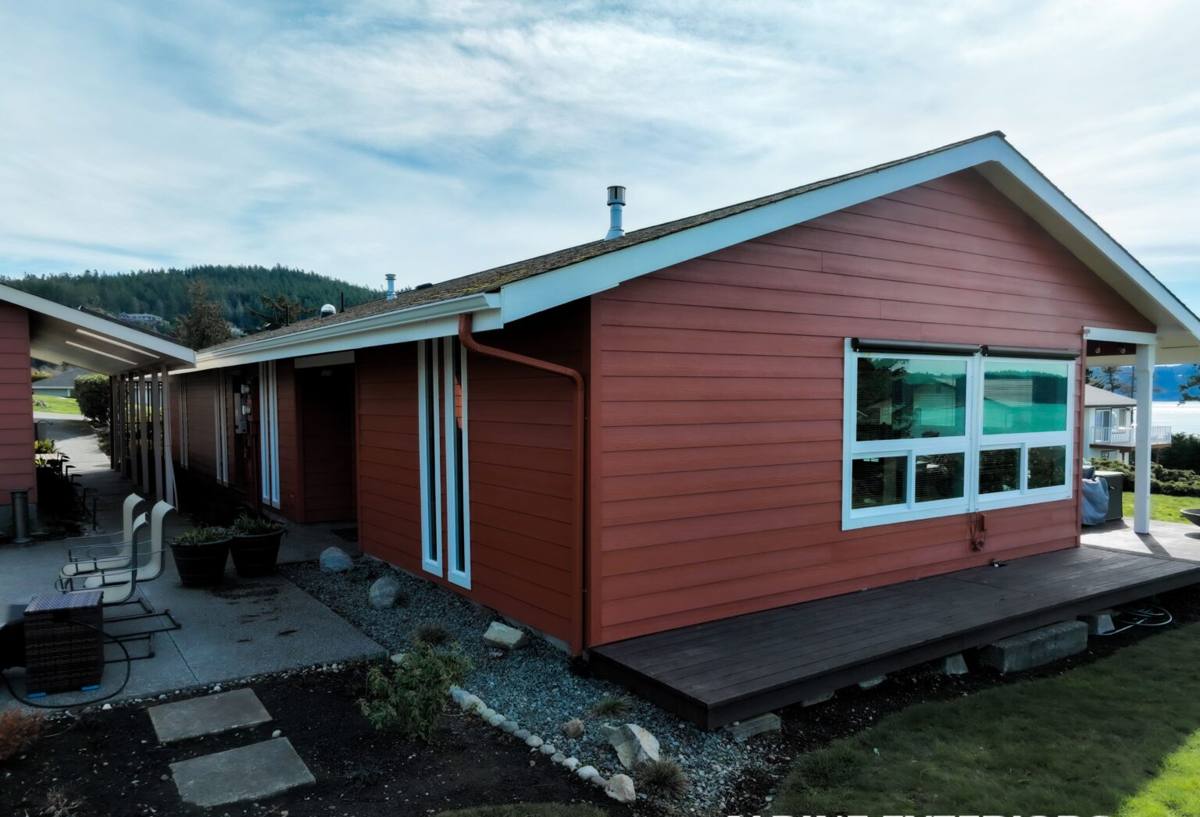
James Hardie siding is cement, sand, and cellulose fiber, autoclaved into a dense, stable board. There's no wood core to swell, rot, or feed fungus. It's non-combustible, which matters for insurance conversations as much as for safety. And it's manufactured in climate-specific formulations — the HZ5 product line is engineered for the kind of cold, wet, freeze-thaw-adjacent weather that defines western Washington winters, as opposed to the HZ10 formulation built for hot, humid Southeast climates.
Hardie's ColorPlus finish is a baked-on, factory-applied coating with a longer color warranty than field-applied paint typically achieves, which matters on a material meant to stay on a wall for decades rather than one repaint cycle.
Product Lines We Work With
- HardiePlank lap siding — the standard horizontal siding, available in several exposure widths and textures (cedarmill or smooth)
- HardiePanel — vertical panel siding, often paired with board-and-batten trim for a modern or farmhouse look
- HardieShingle — staggered or straight-edge panels for a shingle-style appearance without the maintenance of real cedar shingles
- HardieTrim — matching trim boards for a consistent, sealed system rather than mixing materials at every corner and window
How Each Material Handles Bellingham's Climate
Whatcom County sits in a specific weather pattern that's harder on siding than most people realize until they've lived here through a few winters. Salt-laden air off Bellingham Bay and the Strait of Georgia accelerates corrosion on fasteners and finishes. Driving rain, often wind-blown horizontally rather than falling straight down, finds any gap in flashing or sealant that a calmer climate would never test. And the long, low-sun moss season — roughly October through April — keeps north-facing and shaded walls damp for extended stretches, which is exactly the condition that favors fungal growth on any wood-based product.
Fiber cement doesn't feed moss or mildew the way a wood substrate can, and it doesn't matter to a cement board whether a wall stays damp for a week or a month — there's no organic material for anything to grow into. That's a material-level advantage, not a marketing claim, and it's the main reason our standard shifted the way it did after seeing both products age on real Whatcom County homes.
Installation Sensitivity: The Part Nobody Talks About
Both products are only as good as their installation, but they're sensitive to different mistakes. SmartSide installation lives or dies on edge-sealing discipline and correct nailing to avoid splitting. Fiber cement installation lives or dies on proper clearances, flashing details, and following Hardie's fastening and joint-treatment specifications exactly — cut edges need to be primed too, though the consequence of a missed spot is corrosion resistance and paint adhesion rather than substrate rot.
We bring this up because a poorly installed product of either type will disappoint a homeowner, and a well-installed product of either type will outperform expectations. Installation quality is not a footnote — it's arguably as important as the material choice itself. That's part of why we limit ourselves to one system we can install to spec every time rather than juggling installation standards for multiple product lines.
Cost and Long-Term Value
| Factor | LP SmartSide (Engineered Wood) | James Hardie (Fiber Cement) |
|---|---|---|
| Material cost | Generally lower upfront | Moderately higher upfront |
| Core material | Wood strand composite | Cement, sand, cellulose fiber |
| Moisture behavior | Resists face moisture; vulnerable at unsealed cut edges | Non-organic core; does not rot or support fungal growth |
| Fire rating | Combustible | Non-combustible |
| Finish | Factory primer, field paint typical | ColorPlus factory-baked finish available |
| Repaint interval | Typically shorter, depends on exposure | Longer with ColorPlus finish |
| Typical manufacturer warranty | 5-year limited on substrate, shorter on finish | 30-year non-prorated limited warranty on the substrate |
The upfront cost gap is real, and we tell homeowners that plainly. But siding is a 20-to-30-year decision, not a five-year one, and the maintenance and replacement math tends to favor the material that isn't racing against its own cut edges.
Warranty: Read the Fine Print
Warranty length only means something if the coverage holds up under real conditions. James Hardie backs its fiber cement products with a 30-year non-prorated limited warranty that's transferable to a new owner if the home sells, which matters to buyers doing due diligence on an older listing. Engineered wood warranties are typically shorter on the substrate and often carry more specific exclusions tied to installation and maintenance compliance — including that edge-sealing requirement. A warranty with more exclusions is a warranty that's harder to actually collect on when something goes wrong ten years in.
Our Standard: Why We Only Install Hardie
We stopped installing LP SmartSide and other engineered wood and vinyl products because we got tired of watching maintenance-dependent materials struggle against a maintenance-hostile climate. Bellingham's combination of salt air, sideways rain, and a moss season that runs half the year rewards materials that don't need perfect long-term upkeep to perform. James Hardie fiber cement, installed to manufacturer spec, is the product we're willing to stand behind without qualifications.
That's not a knock on every engineered wood product ever made — it's a statement about what we've decided our crews will install and warranty. Homeowners are always free to choose differently; we just won't be the ones installing something we don't believe holds up here.
What to Ask Any Contractor Before Choosing Your Siding Material
- What warranty does the manufacturer offer on the substrate versus the finish, and is it transferable?
- Does the installer follow the manufacturer's exact fastening, clearance, and edge-treatment specifications?
- How does this material perform on north-facing or shaded walls in a wet climate?
- What's the realistic repaint or refinish interval, and what does that cost over 20 years?
- Is the material combustible, and does that affect your homeowner's insurance premium?
- Can the contractor show you the specific product line engineered for this region's climate zone?
Making the Right Call for Your Home
Every home and budget is different, and a siding conversation should start with your specific house, exposure, and goals — not a generic pitch. If you're weighing fiber cement against engineered wood, or you're just trying to figure out why your current siding is failing faster than expected, we're glad to walk your property with you and give you a straight answer, even if part of that answer is what we won't recommend. Reach out for a free, no-pressure estimate and we'll tell you exactly what we'd do on your home and why.