 Bellingham
 Blaine's Exterior Is Fighting a Different Battle Than Bellingham's
Blaine sits at the northern edge of Whatcom County, wrapped by Semiahmoo Bay and Drayton Harbor and just south of the Peace Arch border crossing. That waterfront position is part of what makes the town beautiful, and it's also exactly what makes exterior materials work harder there than they do a few miles inland. Salt-laden air moves off the water and settles on siding, trim, and metal fasteners year-round. Add the Pacific Northwest's long wet season — steady, driving rain that doesn't let up for months at a time — and you have a climate that punishes any exterior product with a weak point in its finish, its seams, or its moisture management.
We install siding, roofing, windows, and decks across Whatcom County, and Blaine is one of the areas where we see the clearest difference between homes that were built or re-sided with the coastal exposure in mind and homes that weren't. It usually shows up first in the siding, because siding is the material with the most total surface area exposed to wind-driven moisture and salt.
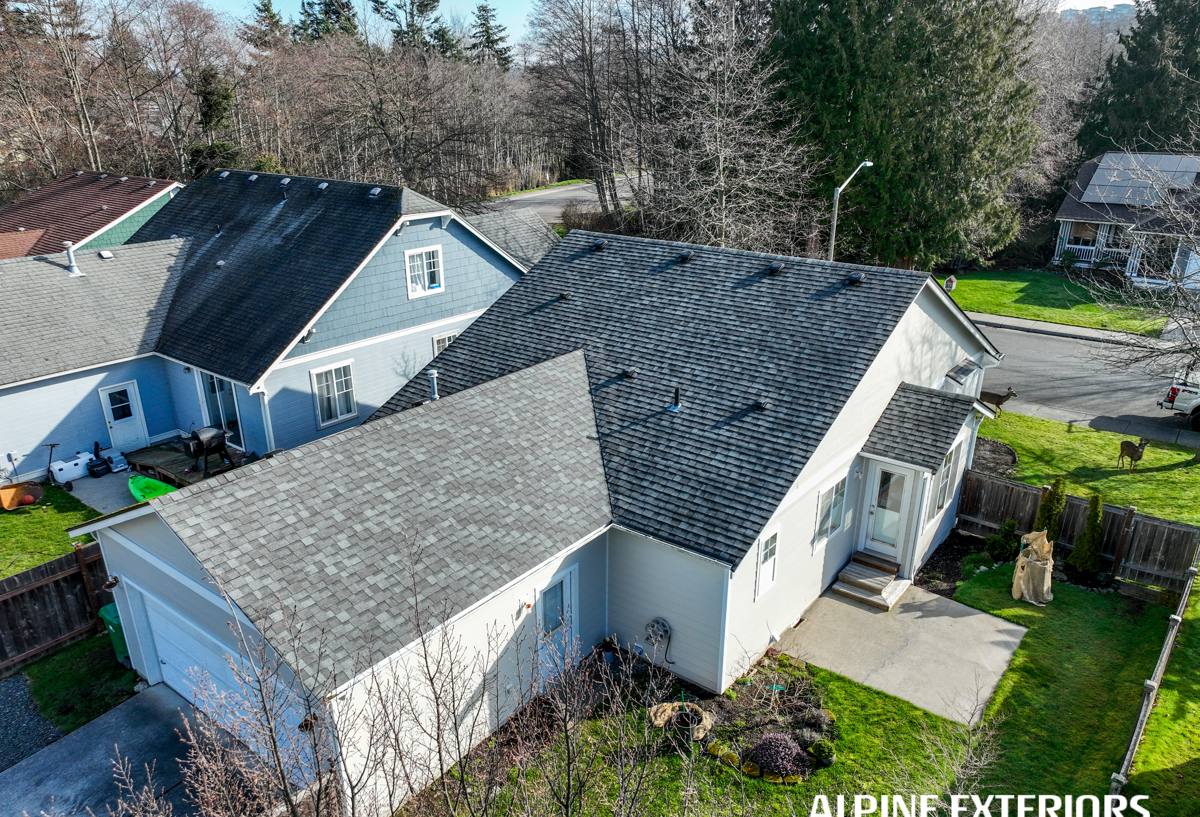
What Salt Air, Rain, and Moss Actually Do to a House
Salt Air
Airborne salt is corrosive to metal and slowly degrades many paint and coating systems, especially at fastener heads, corner trim, and anywhere two materials meet. On wood-based sidings, salt exposure accelerates the breakdown of the surface finish, which then exposes the substrate underneath to moisture it isn't built to handle.
Driving Rain
Blaine doesn't just get rain — it gets rain pushed horizontally by wind off the water. That matters because a lot of siding failures aren't about water landing on a wall, they're about water finding its way behind the wall through lap joints, butt seams, and poorly flashed penetrations. Once moisture gets behind cladding that can't dry out quickly, rot and mold follow.
Moss and Algae
Whatcom County's damp, shaded, mild-temperature stretches — especially fall through spring — are close to ideal growing conditions for moss and algae on exterior surfaces. On north-facing walls, under eaves, and near mature trees, homes can develop a persistent green or black film that isn't just cosmetic. Moss holds moisture against the surface it's growing on, extending the amount of time siding stays wet after every rain event.
Why We Standardized on James Hardie Fiber Cement
We only install James Hardie fiber cement siding. We don't install vinyl, LP SmartSide, Cemplank, Allura, primed spruce, or cedar. That's not a marketing position — it's a decision we made after years of seeing which products actually hold up on the Whatcom County coastline and which ones need more attention than a homeowner should have to give them.
Fiber cement is a mix of cement, sand, and cellulose fiber. It doesn't rot, it isn't a food source for insects, and it's non-combustible, which matters increasingly given wildfire smoke and ember exposure risk across the broader region. James Hardie's ColorPlus finish is baked on at the factory under controlled conditions, which gives it better fade and chip resistance than field-applied paint — a real advantage in a location where painters' schedules are already fighting the rain half the year.
Hardie also engineers regional product lines (HZ5 for harsher climates, HZ10 for milder ones) specifically because siding performance isn't uniform across the country. That climate-specific engineering is part of why we trust it on a bay-front or harbor-adjacent home in Blaine the same way we'd trust it on a home a mile inland — the product is built with moisture cycling and coastal exposure already accounted for.
How the Main Siding Options Compare on a Coastal Whatcom County Home
| Material | Moisture Behavior | Salt Air / Corrosion | Maintenance | Our Take |
|---|---|---|---|---|
| James Hardie Fiber Cement | Won't rot; dimensionally stable when installed to spec | Non-combustible, holds finish well | Occasional wash; factory finish reduces repainting | What we install |
| Vinyl | Sheds water but can warp/crack in temperature swings | Can fade and become brittle over time | Low, but damage often means full-panel replacement | We don't install it |
| LP SmartSide / Wood-Based | Engineered wood core is vulnerable if the finish is compromised | Salt accelerates finish breakdown at seams | Finish and caulking need regular attention | We don't install it |
| Cedar | Natural material, absorbs and releases moisture | Salt and UV both age the surface quickly | Highest — staining/sealing on a recurring cycle | We don't install it |
Every product on that list has a legitimate case somewhere. Vinyl is inexpensive and low-maintenance in mild, dry climates. Cedar has real aesthetic appeal and a long history in the Northwest. But on a marine-influenced site like Blaine, the trade-offs — finish degradation, seam vulnerability, ongoing upkeep — outweigh the benefits closely enough that we don't feel comfortable putting our name on the installation.
Installation Details That Matter More Here Than Inland
The product is only half the equation. A lot of siding failures we get called out to inspect trace back to installation shortcuts, not the material itself. On a Blaine home, a few details get extra attention from us:
- Rain-screen gap: a drainage plane behind the siding lets any moisture that does get past the cladding dry out instead of sitting against the wall sheathing.
- Flashing at every penetration: windows, doors, hose bibs, and vents all need properly lapped flashing so wind-driven rain can't work its way behind the siding at those transition points.
- Fastener spec: corrosion-resistant fasteners, installed per Hardie's specifications, so salt air isn't attacking the one thing holding a panel in place.
- Correct joint treatment: butt joints and corners sealed and finished the way the manufacturer specifies, not caulked over as an afterthought.
- Clearance from grade and hardscape: keeping the siding's bottom edge properly clear of soil, decking, and standing water sources.
These aren't exotic techniques — they're the manufacturer's own installation requirements. But skipping them is exactly how a good product ends up with a bad reputation on a house, and it's exactly why Hardie's warranty coverage depends on installation being done correctly.
Roofing, Windows, and Decks Face the Same Environment
Siding gets most of the attention because it covers the most square footage, but the same salt air, rain, and moss pressure affects the rest of a home's exterior. On roofing, we watch for moss colonization in shaded valleys and around chimneys, and for flashing and underlayment that can handle sustained wet weather rather than just occasional showers. On windows, aging seals and frames in a marine climate lose their weather-tightness faster, which shows up as fogging between panes or drafts that weren't there a few years ago. On decks, salt air and standing moisture are hard on fasteners and connectors even when the decking material itself is holding up fine — hardware corrosion is often the first sign of trouble, well before the boards show it.
Because we handle all four — siding, roofing, windows, and decks — we can look at a Blaine property as one exterior system rather than treating each component in isolation. Moisture that's getting behind siding at a roofline transition, for example, is a roofing-and-siding problem together, not two separate ones.
Moss and Algae Management
No coating stops moss and algae from landing on a surface — what matters is how the material responds once they do. Fiber cement doesn't feed mold or fungal growth the way wood-based products can, and a factory-applied finish gives moss and algae less to grip onto and less opportunity to work into a compromised surface. Regular gentle washing (never high-pressure blasting directly at siding seams) keeps growth from building up, especially on north-facing walls and areas shaded by trees or neighboring structures — common conditions around Blaine's residential streets near the harbor and inland toward the interstate.
Signs Your Current Siding Is Already Struggling
If you're not sure whether your siding still has years left in it or is quietly failing behind a decent-looking surface, these are the signs we look for first:
- Soft or spongy spots when you press on the siding, especially near the bottom courses
- Paint that's peeling, bubbling, or needing repainting far more often than it used to
- Visible gaps opening up at seams, corners, or trim joints
- Persistent moss or algae that comes right back within weeks of cleaning
- Warping, buckling, or panels that look wavy rather than flat
- A musty smell near exterior walls, which can indicate trapped moisture
Any one of these on its own might be minor. Several together usually mean the siding system — not just the surface finish — is losing the fight against the climate.
Why a Local Crew Is Worth Insisting On
A contractor based in Whatcom County knows what a bay-front home in Blaine is up against because we see it on job after job — not from a regional average, but from actually being out here in it. That local familiarity shapes decisions a crew from outside the area might not think twice about: how much rain-screen gap to build in, which walls need the most moss-conscious detailing, how flashing has to be handled around a marine-exposed window. It also means someone who's easy to reach if a question comes up after the job is done, rather than a company that installed and moved on to the next region.
If you're weighing a siding replacement, a re-roof, new windows, or a deck project on a Blaine property, we're glad to take a look and walk you through what your home specifically needs — no pressure, no obligation. A free estimate is a straightforward way to find out where you stand before deciding anything.