 Bellingham
 Why Birch Bay Homes Take a Different Kind of Beating
Birch Bay sits right on the water along the Strait of Georgia, and that waterfront location is exactly what makes it such a desirable place to live — and exactly what makes its homes harder on exterior materials than a house a few miles inland in Bellingham or Ferndale. Three things stack up against your siding here: salt-laden air blowing off the water, driving rain that comes in sideways during winter storms, and a long, damp shoulder season that gives moss and algae months to establish themselves on north-facing walls and shaded rooflines.
None of these factors is dramatic on its own. It's the combination, year after year, that separates siding systems that hold up from siding systems that start showing problems in year eight or ten instead of year thirty. We've worked on homes throughout Whatcom County, and the properties closest to the water consistently need more resilient materials and more careful installation than the same house would need set back from the shoreline.
Salt Air and What It Does to Building Materials
Salt in the air isn't just a coastal cliché — it's airborne moisture carrying dissolved minerals that settle on every exterior surface, including siding, trim, flashing, and fasteners. Over time, salt exposure accelerates corrosion on unprotected metal fasteners and trim, and it can contribute to premature breakdown of coatings and finishes that weren't engineered with coastal exposure in mind. Paint that's rated for a typical inland climate often chalks, fades, or fails faster near the water. This is one of the reasons we pay close attention to fastener selection and flashing details on Birch Bay jobs specifically — the siding panel itself is only part of the system.
Driving Rain and Wind-Driven Moisture
Birch Bay's exposure to the water means storms arrive with real wind behind them, and wind-driven rain behaves differently than a straight-down downpour. It gets pushed sideways and upward under laps, around trim, and into any gap in the water-management plane that a less careful installation might leave. Siding that depends on paint film alone to stay waterproof, or that swells and takes on moisture at cut edges and seams, is going to struggle in this kind of exposure. What matters more than the marketing on the front of any siding product is what happens at the seams, the butt joints, and the flashing details — because that's where wind-driven rain actually tests a wall system.
The Long Moss Season
Western Whatcom County's mild, wet winters and shoulder seasons give moss, algae, and lichen a long runway to establish themselves, especially on shaded north and east elevations, under roof overhangs, and anywhere air doesn't move much. Moss growth isn't just cosmetic. It holds moisture against the surface underneath it, and sustained moisture contact is where a lot of siding materials — particularly wood-based and wood-adjacent products — start to degrade from the inside out even while looking fine from the street.
Why We Install Only James Hardie Fiber Cement
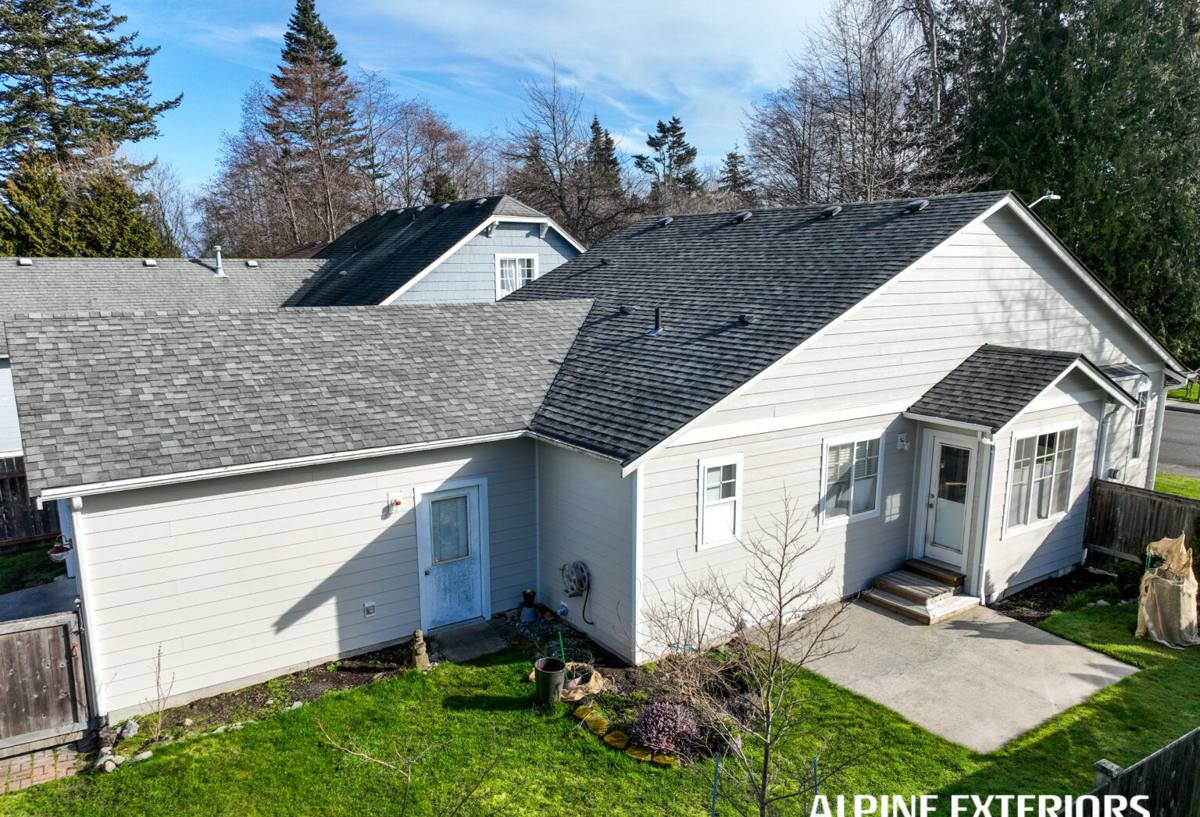
We made a decision as a company to install James Hardie fiber cement siding exclusively — not vinyl, not LP SmartSide, not cedar, not primed spruce, not other fiber cement brands. That's not a marketing position; it's a standard we hold because of what we've seen play out on real houses in real Pacific Northwest weather, and Birch Bay's conditions are a good example of why it matters.
Fiber cement is a mix of cement, sand, and cellulose fiber. It doesn't have the organic wood content that gives moss and moisture a food source, and it won't swell, rot, or delaminate the way wood-based products can when they stay damp for long stretches. It's also non-combustible, which matters increasingly in a region where wildfire smoke and ember exposure have become part of the annual conversation, even for coastal communities. James Hardie's ColorPlus factory finish is baked on and cured under controlled conditions before the product ever reaches the jobsite, which gives it materially better fade and wear resistance than a field-applied paint job — a real advantage in a salt-air environment where field-applied finishes tend to break down faster.
James Hardie also engineers specific product lines (their HZ5 and HZ10 designations) for different climate zones, accounting for moisture exposure and temperature swings by region. For a shoreline property in Whatcom County, that climate-specific engineering is not a nice-to-have — it's the difference between a product designed for this exposure and one that simply happens to be sold here.
What Correct Installation Looks Like on a Coastal Home
Good material choice only pays off if the installation respects it. On Birch Bay homes we pay particular attention to:
- Weather-resistant barrier and flashing continuity at every window, door, and penetration — this is where wind-driven rain finds its way in if it's going to
- Correct fastener type and spacing, since corrosion resistance matters more here than a few miles inland
- Proper clearance between siding and grade, decks, and roof lines so moisture doesn't sit against the bottom edge of the panel
- Rainscreen or drainage detailing where the wall assembly benefits from it, so any incidental moisture has somewhere to go
- Caulking and sealant choices rated for coastal UV and salt exposure, not generic interior-grade product
James Hardie publishes detailed installation specifications, and a warranty that isn't honored unless those specs are followed. That's part of why the crew doing the work matters as much as the product going on the wall — a beautiful siding system installed with shortcuts at the flashing details will fail at exactly the points a coastal storm is most likely to find.
Comparing Siding Options for a Birch Bay Exposure
| Material | Salt Air / Moisture Behavior | Moss & Algae Resistance | Finish Longevity |
|---|---|---|---|
| James Hardie Fiber Cement | No organic content to break down; engineered climate-specific lines | No wood substrate for moss to feed on | Factory ColorPlus finish, strong transferable warranty |
| Vinyl | Can warp/distort with heat and impact; seams are a moisture path | Surface growth still occurs; can trap moisture behind panels | Color is molded-in but fades over time; not repaintable easily |
| LP SmartSide / Engineered Wood | Wood-strand core is more moisture-sensitive at cut edges and damage points | Organic content can support growth if moisture penetrates | Factory finish varies by product; field touch-ups needed at cuts |
| Cedar / Primed Spruce | Solid wood absorbs and releases moisture; most exposure-sensitive option | Highest risk — organic material is a direct food source | Requires ongoing repainting/staining maintenance |
Roofing, Windows, and Decks in the Same Exposure
Siding doesn't work in isolation, and a Birch Bay property usually needs its whole exterior envelope thought through together. A roof with moss buildup on the shaded slopes is shedding granules and holding moisture against the deck below it, which shortens the roof's life and can send water looking for a way into the wall assembly beneath. Windows near the water benefit from proper flashing integration with the siding plane — a window that leaks at the head flashing will show up as a "siding problem" months later, even though the siding did its job. Decks exposed to salt air and driving rain need hardware and fastening that accounts for corrosion, plus drainage that keeps water from pooling against the house.
Because we handle siding, roofing, windows, and decks, we look at a Birch Bay home's exterior as one connected system rather than four separate trades that happen to touch the same house. That matters most exactly in an exposure like this one, where water finds the gap between trades if nobody's watching for it.
Why a Local Crew Matters Here
Whatcom County's coastal microclimates aren't uniform — a property directly on Birch Bay's waterfront faces more sustained salt and wind exposure than one set back on higher ground a mile away, even within the same community. A crew that works this specific stretch of coastline regularly develops a feel for which details need extra attention on a given lot: which elevations take the worst weather, where moss tends to establish first, and where wind-driven rain is most likely to test a wall assembly. That's the kind of judgment that comes from doing the work here repeatedly, not from a general specification sheet.
What to Ask Before You Hire
Whether you're getting bids from us or anyone else, a few questions separate a contractor who understands coastal exposure from one who's just installing whatever's in stock:
- What fastener and flashing materials do you use, and are they rated for coastal/salt exposure?
- How do you detail moisture management at window and door openings specifically?
- What warranty comes with the material, and what installation requirements does it depend on?
- Have you worked on other homes in this specific area, and what have you seen go wrong here?
- How do you handle drainage and clearance at grade, decks, and roof intersections?
Planning a Siding Project in Birch Bay
Whether your current siding is showing moss staining, failing paint, soft spots near ground level, or you're simply planning ahead for a home exposed to the water year-round, it helps to have someone look at the whole envelope — siding, roofline, window flashing, and decks — before deciding what to prioritize. Coastal exposure rewards getting the details right the first time, since redoing work on a shoreline property costs more in both material and disruption than doing it properly at the outset.
If you own a home in Birch Bay and want a straightforward look at where your exterior stands, we're happy to come take a look and give you a free, no-pressure estimate — no obligation, just an honest read on what your house needs.