 Bellingham
 Roof Repair in Birch Bay: A Job Built for This Coastline
Birch Bay sits directly on the water in northern Whatcom County, a short drive from our Bellingham crew but a noticeably harsher environment than most of the towns further inland. Salt-laden marine air moves off the bay every day, rain arrives sideways as often as it falls straight down, and mild temperatures keep moss and algae growing on shaded roof planes for most of the year. A roof repair here isn't the same job as a roof repair in a drier, more sheltered part of Whatcom County — the same leak, the same missing shingle, the same lifted flashing behaves differently once you account for what this specific climate does to a roof over time.
This page is about roof repair specifically — not a full tear-off, not a general overview of roofing materials, but the actual work of diagnosing and fixing a Birch Bay roof that's leaking, aging, or showing storm damage. We handle full roof replacement too when that's genuinely the right call, but a large share of the calls we get out to Birch Bay are homes that need a correct, targeted repair rather than an entire new roof, and we think that distinction is worth explaining properly rather than lumping it in with a general roofing pitch.
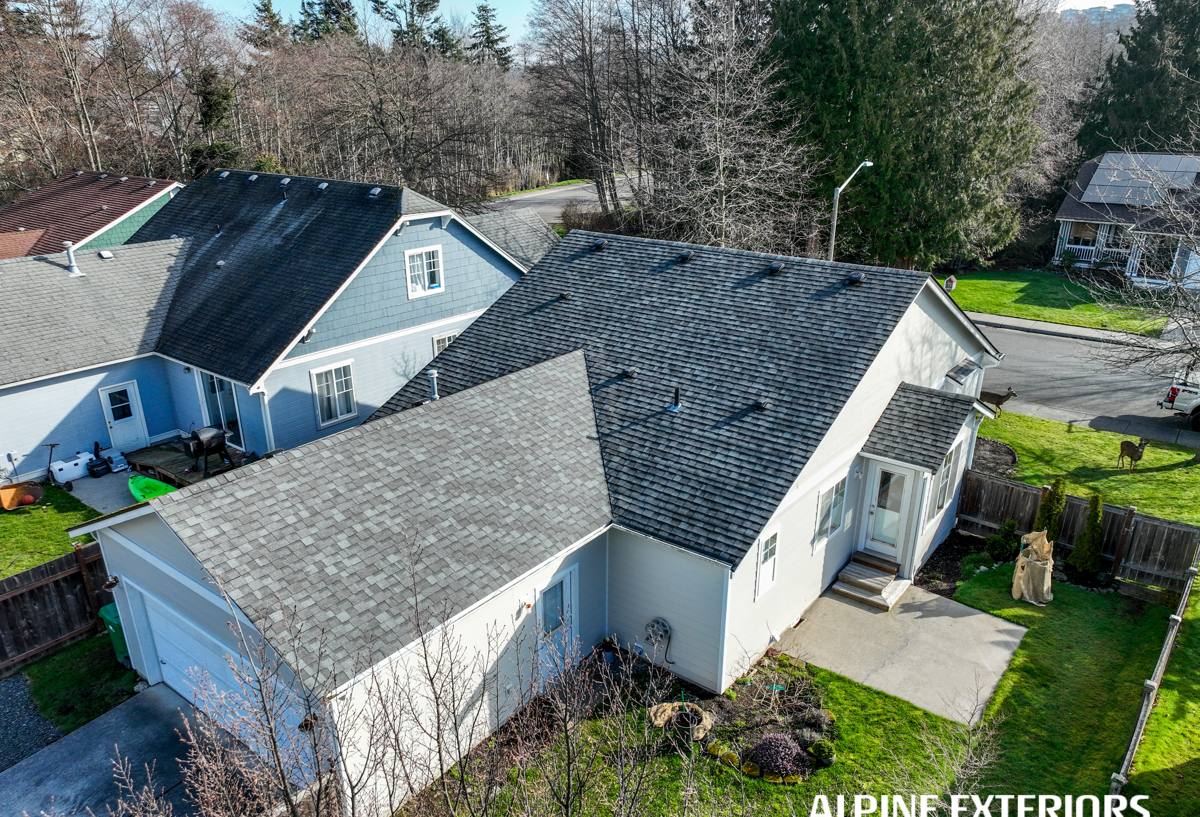
What This Climate Does to a Birch Bay Roof
Salt Air and Corrosion
Being this close to the water means Birch Bay roofs take on more airborne salt than a roof even a few miles inland. Salt accelerates corrosion in exposed fasteners, flashing, and any metal component that isn't rated for it. On a repair call, that shows up as rusted nail heads backing out of shingles, flashing that's thinned and pitted enough to let water track behind it, and gutter hardware that's failed well before it should have on paper.
Wind-Driven Rain
Rain off the water doesn't fall straight down here — wind pushes it sideways into valleys, up under shingle tabs, and around anything protruding through the roof plane: chimneys, vent stacks, plumbing boots. That's a heavier and more directional load than a simple rainfall total suggests, and it's exactly why so many Birch Bay leaks trace back to flashing and lap details rather than a hole punched straight through the roofing material.
A Long Moss and Moisture Season
Shade, mild temperatures, and near-constant dampness give moss a growing season that runs most of the year on north-facing or tree-shaded roof planes. Moss does more than look bad: it holds water against the roofing surface, works into shingle laps, and can lift or loosen material that would otherwise still have years of life left in it. A repair that only addresses the visible leak without dealing with the moss causing it tends to be a repeat call within a season or two.
The Repair Calls We See Most Often in Birch Bay
Most of the repair work we do here falls into a handful of recurring categories. None of these are unusual roofing problems in the abstract — what's specific to Birch Bay is how often they show up and how much worse they get if left alone through another wet season.
- Flashing that's lifted, corroded, or improperly lapped at chimneys, vent pipes, skylights, and roof-to-wall transitions
- Shingles lifted or loosened by moss growth in valleys and on shaded slopes
- Wind damage after a storm — missing, cracked, or creased shingles, usually on exposed or corner sections of the roof
- Valley leaks where two roof planes meet and water volume concentrates
- Corroded or backed-out fasteners no longer holding roofing material securely
- Water intrusion at the roof edge from gutters and downspouts clogged with moss and debris
Any one of these can usually be fixed as a repair rather than a full replacement, provided the underlying roof deck hasn't already taken on long-term moisture damage.
Repair or Replace? How We Help You Decide
We don't default to recommending a full replacement just because a homeowner called about a leak. The right answer depends on a handful of specific factors we check during the inspection.
| Factor | Points Toward Repair | Points Toward Replacement |
|---|---|---|
| Roof age | Well within its rated lifespan | At or near the end of its expected service life |
| Extent of damage | Localized to one section or detail | Spread across multiple slopes or the whole roof |
| Roof deck condition | Solid, dry wood beneath the affected area | Soft, spongy, or visibly rotted decking |
| Repair history | First or second repair in the roof's life | Repeated patches on the same areas over the years |
| Moss and moisture pattern | Contained to one shaded slope | Widespread across the whole roof and returning quickly |
We'll walk the roof, get into the attic where it's accessible, and explain plainly which column your roof falls into before recommending anything. A roof that lands mostly in the repair column doesn't need a sales pitch toward full replacement, and we'd rather keep your trust for the day you do need a new roof than push one on you early.
What a Correct Roof Repair Actually Involves
A roof repair done right addresses the actual path water is taking into the house, not just the spot where it happens to be showing up inside. Those aren't always the same location — water can travel along the underlayment or roof deck for several feet before it finds a gap in the ceiling below. Skipping that diagnostic step is the single biggest reason a "repaired" roof leaks again in the next storm.
On every repair, that means:
- Tracing the leak to its actual entry point rather than patching wherever the water happens to be visible
- Removing and replacing damaged shingles, underlayment, or decking rather than sealing over them
- Re-lapping and re-sealing flashing correctly at valleys, chimneys, vent pipes, and wall transitions
- Matching replacement shingles as closely as possible to the existing roof in type, profile, and color
- Clearing moss and treating the affected area so the same failure doesn't recur within a season
- Checking that attic and roof deck ventilation near the repair is actually working, since trapped moisture speeds up the next failure
Materials We Use for Coastal Roof Repairs
Material choice on a repair matters just as much as it does on a full roof — maybe more, since a repair is only as good as how well it matches and ties into what's already there.
| Component | What We Use | Why It Matters in Birch Bay |
|---|---|---|
| Fasteners | Corrosion-resistant nails rated for coastal exposure | Standard fasteners corrode faster in salt-laden air and back out, loosening shingles |
| Flashing | Metal rated for long-term weather exposure, properly lapped and sealed | Thin or poorly rated flashing pits and fails faster this close to the water |
| Underlayment | Moisture-rated underlayment, not a minimum-code product | Sustained dampness demands more than the cheapest code-compliant option |
| Shingles | Matched as closely as possible to existing material, moss-resistant where practical | A visibly mismatched patch is a cosmetic problem, and a mismatched profile can open a new water path |
Our Repair Process, Step by Step
Timing Repairs Around Whatcom County's Weather
Roof repair work needs a reasonably dry window to do it right — shingles, flashing sealant, and underlayment don't set up properly on a soaked roof deck, and a mossy, wet roof surface is genuinely dangerous to walk. When storm damage or an active leak can't wait for a clear stretch of days, we can put on a temporary tarp or emergency patch to stop water from getting further into the house, then come back and complete the permanent repair once conditions allow. Because our crew is based in Bellingham and already out working this coastline on a regular basis, we're usually able to get to a Birch Bay roof faster than a contractor coming from further away, which matters when a storm has just torn something loose.
- Inspection: We walk the roof and check the attic or interior ceiling where accessible, looking for the actual source of the problem, not just the symptom.
- Diagnosis and scope: We explain what we found, why it happened, and what a correct repair involves, in plain language before any work starts.
- Written estimate: You get a clear scope and price before we schedule the work — no verbal promises that change once the job starts.
- The repair itself: Damaged material comes out, the actual cause gets addressed, and replacement material is matched and installed to the same standard we'd use on a new roof.
- Follow-up: Where practical, we check our own work after the next significant rain, because a repair that holds through one dry week doesn't tell you much in this climate.
Signs a Birch Bay Roof Needs a Repair Now
- Water staining on an interior ceiling, especially near an exterior wall or after a windy storm
- Moss buildup on shaded slopes or in valleys that keeps returning after cleaning
- Shingle granules collecting in gutters or at the base of downspouts
- Missing, cracked, or curling shingles, particularly after a storm
- Flashing that looks lifted, rusted, or missing sealant around chimneys and vents
- Daylight visible through the roof deck from inside the attic
- Gutters and downspouts that stay clogged with moss and debris despite regular cleaning
Any one of these is worth a look before the next wet season. Caught early, most are a straightforward repair. Left alone, several of them turn into interior damage and a much bigger job.
Why a Crew That Already Works Birch Bay Matters
A contractor who works this stretch of coastline regularly knows how salt air, wind-driven rain, and moss actually behave on real Birch Bay roofs across a full year, not just how a product performs on a spec sheet. That familiarity shows up in specific decisions during a repair: which roof orientations in Birch Bay hold moss longest because of prevailing wind and shade, how much extra flashing attention a given valley needs given how directly it faces the water, and which fastener grade is worth the extra cost so a repair doesn't need revisiting after one more winter. It also means someone who isn't guessing at the difference between a waterfront exposure like Birch Bay and a more sheltered inland roof a few miles away elsewhere in Whatcom County — those are genuinely different repair jobs even when the visible damage looks similar at first glance.
If your Birch Bay roof has a leak, storm damage, or an ongoing moss problem, we're glad to take a look and give you a straightforward, honest read on what it actually needs — a repair, or something more. Reach out using the form below to schedule a free, no-pressure estimate.