 Bellingham
 We get asked fairly often why our trucks only carry one brand of siding. It's a fair question — most contractors in Whatcom County will install whatever a homeowner picks, order it through their supplier, and move on to the next job. We made a different call years ago: James Hardie fiber cement, exclusively, on every home we side. Not because we get some special deal on it, but because after enough call-backs on other products in this climate, it's the only material we're willing to put our name behind.
This page is about the "why," not a sales pitch. Bellingham sits on Bellingham Bay with salt-laden air rolling in off the water, a rain season that runs most of the year, and enough shade and moisture in older neighborhoods to keep moss and algae in business twelve months a year. That combination is hard on siding. It's also exactly the environment James Hardie's engineering is built around.
The Climate Problem We're Actually Solving For
Whatcom County doesn't get hurricanes or wildfires the way some regions do, but it has its own slow, grinding set of conditions that wear siding down over decades rather than all at once.
Salt Air Off Bellingham Bay
Homes within a few miles of the water take on airborne salt that accelerates corrosion in fasteners and finishes, and it can be brutal on cheaper coatings that aren't formulated to resist it. We see it most on west- and north-facing walls that catch the marine air directly.
Driving Rain, Not Just Rain
Bellingham's rain usually comes with wind off the Strait, which drives water sideways into laps, seams, and trim joints instead of just falling straight down. Any siding product with weak edges, poor water-shedding detail, or a finish that lets moisture in at the cut ends is going to fail here faster than it would in a drier, calmer climate.
A Long Moss and Algae Season
Shaded lots, tree cover, and near-constant damp conditions from fall through spring give moss, mildew, and algae a long runway to take hold on north-facing and tree-shaded walls. Siding that absorbs moisture into its substrate gives organic growth something to root into; siding that doesn't, mostly just needs an occasional wash.
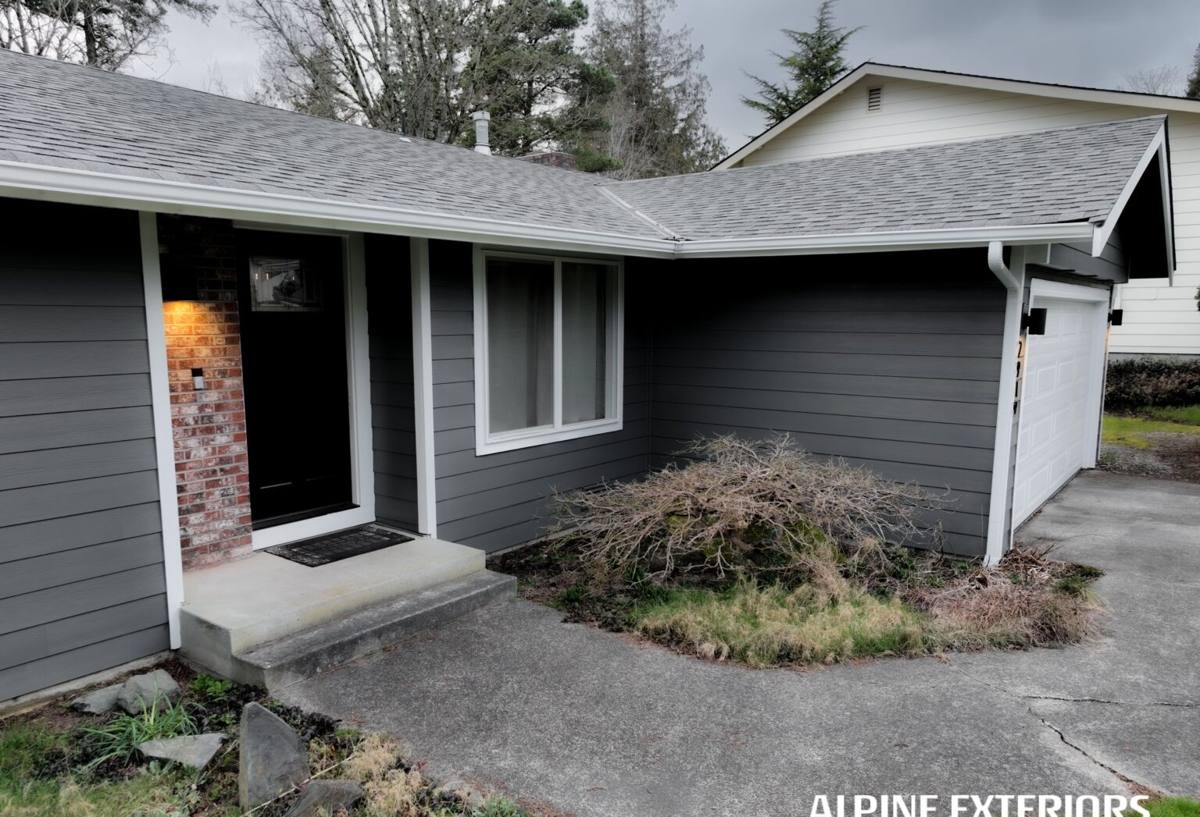
What James Hardie Fiber Cement Actually Is
James Hardie siding is made from a mix of cement, sand, and cellulose fiber, cured under pressure and heat into a dense, stable board. It's not a plastic composite and it's not wood — it's engineered to behave like neither. That matters because it sidesteps the two failure modes we see most often in this climate: it doesn't rot or swell like wood-based products, and it doesn't expand, contract, or become brittle in cold the way vinyl and some engineered wood products can.
Because it's non-combustible, it also carries a fire-resistance rating that matters to insurers and to homeowners thinking long-term about risk, even in a region that isn't considered high wildfire risk.
HZ5: Engineered for This Specific Climate
James Hardie builds region-specific formulations called HZ (HardieZone) products, and the Pacific Northwest falls under the HZ5 specification — the version engineered for the cold, wet, high-humidity conditions we actually get here, as opposed to the hotter, drier formulations sold in the Southwest. That's a meaningful distinction: a siding product optimized for Arizona heat isn't performing the same job as one optimized for Whatcom County rain, even if the box looks similar.
HZ5 boards are formulated for moisture resistance and dimensional stability in freeze-thaw and high-rainfall conditions, which is the exact stress pattern a Bellingham exterior wall goes through every winter.
ColorPlus: Why the Finish Matters As Much As the Board
A lot of the siding failures we get called out to inspect aren't failures of the substrate — they're failures of the paint. Field-applied paint on any siding material is only as good as the prep, the weather on install day, and how many years pass before it's recoated. James Hardie's ColorPlus Technology is a factory-applied, baked-on finish, cured under controlled conditions before the board ever reaches a job site.
- Consistent color and sheen across every board, without job-site paint variables
- Stronger adhesion than field-applied paint, which resists peeling and chipping
- Better fade resistance under UV exposure over time
- Touch-up product available for the rare repair, matched to the factory color
For a house exposed to salt air and driving rain, a finish that was cured in a factory rather than rolled on in a driveway on a 55-degree Bellingham afternoon is not a minor detail — it's the first line of defense.
Product Lines and Where They Fit
| Product | Look | Best Use |
|---|---|---|
| HardiePlank Lap Siding | Traditional horizontal lap, smooth or cedar-textured | Whole-house siding, the most common choice |
| HardieShingle | Staggered or straight-edge shingle profile | Accent gables, Craftsman and cottage-style homes |
| HardiePanel | Vertical panel, often with battens | Modern facades, garages, accent walls |
| HardieTrim | Smooth trim boards | Corners, window and door casing, fascia |
| HardieSoffit | Vented and non-vented panel | Eaves and overhangs, moisture and pest resistance |
Color selection runs through James Hardie's ColorPlus palette, which includes a range of neutrals and regionally popular tones that hold up well against the muted gray-green backdrop typical of Pacific Northwest landscaping. Boards are also available primed for a custom field-painted color if a homeowner wants something outside the standard palette, though we always explain the trade-off in finish durability before recommending that route.
The Warranty, In Plain Terms
James Hardie backs its fiber cement products with a non-prorated limited warranty (typically 30 years on siding, with separate terms on ColorPlus finish) that's transferable to a subsequent homeowner if the house sells. That transferability matters more than people expect in a market like Bellingham's, where a well-documented, warrantied exterior is a real selling point rather than a line item buyers have to take on faith.
The warranty is also conditioned on installation to manufacturer specification — which is the whole reason installation quality gets its own section below, rather than being an afterthought.
Why Correct Installation Is Non-Negotiable
Fiber cement is only as good as the details around it. We've inspected plenty of Hardie siding installed by other contractors that was failing early — not because the product was bad, but because it was hung wrong. In a climate that drives rain sideways for months at a time, these details are the difference between a 30-year exterior and a 10-year problem.
- Correct nailing pattern and fastener type — blind or face nailing per Hardie spec, not whatever the crew had on the truck
- Proper clearance at the bottom of the wall and away from grade, decks, and roof lines to prevent wicking
- Caulking and flashing at every penetration, window, and door — not just at the visible seams
- Correct minimum overlap on laps to shed driving rain instead of channeling it inward
- Field-cut edges sealed or primed before installation, since a raw cut edge is the one place moisture can get into the board
- Rain screen or proper weather-resistive barrier behind the siding, especially important given how much moisture Whatcom County walls are exposed to
Skipping any one of these doesn't usually show up as a problem in year one. It shows up in year eight or ten, as a stain, a soft spot, or a warranty claim that gets denied because the installation didn't meet spec. That's the actual reason we standardized on one product installed one correct way, rather than juggling multiple materials and installation methods across a crew.
How Hardie Compares on the Factors That Actually Matter Here
| Factor | James Hardie Fiber Cement | Typical Alternative Materials |
|---|---|---|
| Moisture behavior | Dimensionally stable, engineered for high-rain climates (HZ5) | Wood-based products can swell, delaminate, or rot; vinyl can warp |
| Fire resistance | Non-combustible | Wood-based and vinyl products are combustible |
| Finish durability | Factory-baked ColorPlus finish | Field-applied paint, dependent on install conditions and recoat schedule |
| Salt air resistance | Formulated to hold up under coastal exposure | Variable; some finishes chalk or fade faster near salt water |
| Warranty structure | Non-prorated, transferable | Often prorated or non-transferable |
| Maintenance | Occasional wash, minimal recoating | More frequent painting, caulking, or panel replacement |
What This Means for Your Project
Standardizing on one product means our crews are doing the same installation, the same way, on every job — not relearning fastening patterns and clearances for a different material every few weeks. It also means when we quote a job, we're quoting a system we know performs in Whatcom County conditions, not a product we're hoping performs.
If you're planning a re-side in Bellingham or anywhere else in Whatcom County and want to understand what James Hardie would look like on your specific home — color options, product line, and what the installation would actually involve — we're happy to walk the exterior with you and put together a straightforward, no-pressure estimate using the form below.