 Bellingham
 Siding Failure Rarely Starts on the Surface
When a homeowner in Bellingham calls about siding trouble, the first thing they usually mention is what they can see: a bulge near a window, a soft spot below a hose bib, paint that won't hold, or a corner board that's started to separate from the wall. But by the time siding shows a visible problem, the real damage has usually been building underneath for months or years. Siding is a system, not a single layer, and understanding how that system is supposed to work is the best tool a homeowner has for catching trouble early instead of late.
This page walks through what actually happens behind failing siding, why Whatcom County's climate makes certain failure modes more common here than in drier parts of the country, and what to look for before a small problem becomes a full re-side.
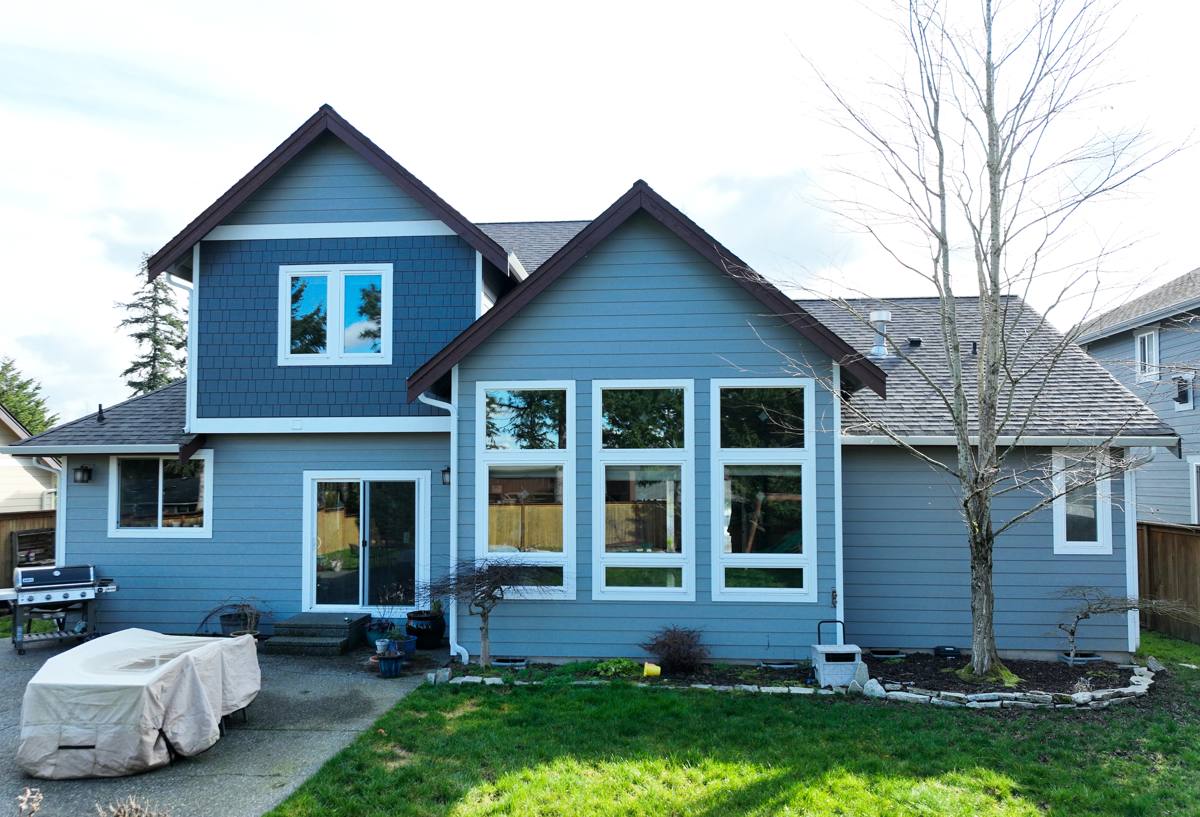
The Wall Behind the Siding Does Most of the Work
Siding is the outermost layer of a wall assembly that's supposed to manage water in two directions: shed the bulk of it before it ever reaches the wall, and let anything that does get through find its way back out. Behind the siding you typically have a water-resistive barrier (housewrap or building paper), sheathing, framing, insulation, and interior drywall. Every one of those layers has a job, and siding failure almost always traces back to a breakdown in how they work together — not just the siding material itself.
Common Points of Entry
- Nail and fastener penetrations that were sealed poorly or not at all
- Butt joints and seams where boards meet, especially on horizontal lap siding
- Window and door flashing that was installed out of sequence with the water-resistive barrier
- Deck ledger boards, hose bibs, and other penetrations added after the original siding job
- Missing or undersized kickout flashing where a roofline meets a sidewall
Once moisture gets behind the siding through one of these points, what happens next depends heavily on the material, the house wrap detailing, and how much drying capacity the wall assembly has. In a dry climate, a small amount of intrusion might evaporate before it does damage. In Bellingham, with our long wet season and short drying windows, moisture that gets in tends to stay in.
Why Whatcom County's Climate Is Especially Hard on Siding
Bellingham sits close enough to the water that salt air is a real factor on many properties, particularly those facing Bellingham Bay or exposed to wind off the Strait. Salt-laden moisture accelerates corrosion on fasteners and metal flashing, and it can degrade certain paint and coating systems faster than inland exposure would. Combine that with driving rain that comes in sideways during winter storms — pushed by wind rather than falling straight down — and siding here has to resist water intrusion from angles that gentler climates don't test as often.
Then there's moss season, which in Whatcom County isn't really a season so much as most of the year. Moss and algae thrive in the shaded, damp conditions common on north-facing walls and under eaves with limited sun exposure. Beyond being a cosmetic nuisance, moss holds moisture directly against the siding surface for extended periods, which is exactly the condition that breaks down materials sensitive to sustained wetness. A wall that dries out in a day in a sunnier climate might stay damp for a week here.
How Local Conditions Show Up in Real Wear Patterns
| Condition | What It Does to Siding | Where It Shows Up Most |
|---|---|---|
| Salt air / coastal exposure | Accelerates fastener corrosion, degrades some coatings faster | Bay-facing and west-facing walls |
| Driving, wind-blown rain | Forces water past laps and seams not designed for lateral pressure | Upper stories, gable ends, exposed corners |
| Extended moss/algae growth | Holds surface moisture against siding for long periods | North-facing walls, areas under overhangs and trees |
| Freeze-thaw cycling | Expands trapped moisture, widens cracks and gaps over time | Anywhere water has already penetrated the surface |
How Different Siding Materials Respond to Trapped Moisture
Not all siding materials handle moisture the same way once it gets behind them, and this is where material choice becomes a real factor rather than just an aesthetic one. Wood-based products — including primed spruce, cedar, and engineered wood siding — are organic materials at their core. When they take on and hold moisture repeatedly, they're vulnerable to swelling, delamination at cut edges, and eventually rot. Vinyl siding doesn't rot, but it isn't a moisture management layer either — it's designed to move and flex, which means the water-resistive barrier behind it is doing nearly all the real work, and vinyl's own seams and J-channels can become entry points if not detailed carefully.
Fiber cement is a different animal. It's made from cellulose fiber, sand, and portland cement, cured into a dense, non-organic board. It doesn't feed rot fungus and it doesn't swell and delaminate the way wood-based products can when they get repeatedly wet. That doesn't mean fiber cement is immune to problems — poor installation, unsealed cut edges, or a genuinely broken water-resistive barrier behind it can still cause damage. But the material itself isn't the weak link the way an organic substrate can be.
Early Warning Signs Worth Walking Your House For
- Soft or spongy spots when you press on siding, especially near the bottom courses
- Paint that's bubbling, peeling, or failing in a localized area rather than uniformly
- Visible gaps opening up at butt joints or around trim and window casings
- Dark staining or streaking below seams, fasteners, or flashing
- Persistent moss or algae growth that keeps returning after cleaning
- Any bulging, warping, or a section that looks slightly different in plane from the wall around it
- Musty smell or visible staining on interior walls that share an exterior wall with a suspect area
None of these signs by themselves mean a full re-side is needed. But they're all worth investigating rather than painting over, because the surface symptom is usually smaller than the underlying cause.
What Correct Installation Is Actually Protecting Against
A huge share of siding failure — across every material type — traces back to installation details rather than the product itself. Manufacturers publish specific requirements for fastener placement, clearances, flashing sequencing, and caulking, and those requirements exist because they've been tested against exactly the failure modes described above. Skipping them doesn't usually cause an immediate problem; it causes a slow one that shows up years later, often outside the original installer's warranty period.
Installation Details That Matter Most in This Climate
- Maintaining proper clearance between siding and grade, decks, and roof lines so water can't wick up or pool against the bottom edge
- Correct flashing at every horizontal transition — window heads, roof-to-wall intersections, and trim boundaries
- Sealing and painting cut edges and field cuts, not just factory edges
- Proper fastener type, spacing, and depth to avoid overdriving or splitting
- An intact, correctly lapped water-resistive barrier underneath, installed before siding goes on — not patched around it
This is also part of why we standardized on James Hardie fiber cement rather than installing several different products depending on what a customer requests. Hardie's HZ5 product line is engineered specifically for climates like ours — freeze-thaw cycling, sustained moisture exposure, and coastal air — and its ColorPlus factory finish is baked on under controlled conditions rather than field-applied, which removes one of the more common points of early coating failure. Pairing an installation discipline we control with a material engineered for this exact climate gives homeowners the best odds of a wall assembly that actually performs the way it's designed to for decades, not just the first several years.
What a Homeowner Can Reasonably Do Between Inspections
You don't need to become a building science expert to protect your siding investment, but a few habits go a long way in this climate:
- Walk the exterior once or twice a year, particularly after the wettest months, looking for the warning signs listed above
- Keep gutters clean and downspouts directing water away from the foundation and siding base
- Trim back vegetation and tree cover that keeps walls shaded and damp longer than necessary
- Address moss growth promptly with appropriate cleaning methods rather than letting it establish
- Have any new penetration — a mounted light fixture, a new hose bib, a security camera — properly flashed and sealed, not just caulked
- Don't ignore small paint failures on wood-based or engineered wood siding; they're often the first visible sign of moisture getting underneath
When It's Time to Call in a Professional Look
A visual inspection from a homeowner is a good first filter, but some symptoms genuinely need a contractor's eyes — someone who knows what normal wear looks like versus what indicates active moisture intrusion. If you're seeing soft spots, recurring interior staining on an exterior wall, or siding that's visibly out of plane, that's worth a proper look before it's addressed cosmetically. Painting over a soft board or caulking a gap without knowing why it opened doesn't fix the underlying issue — it just delays the point where the damage becomes obvious and expensive.
Whether your home currently has wood, vinyl, or an engineered product, understanding how your existing siding is likely to behave under Bellingham's conditions helps you make better decisions about maintenance timing and, eventually, replacement material.
If you're noticing any of the signs above, or you'd just like an honest assessment of how your siding is holding up, we're happy to take a look. We offer free, no-pressure estimates for Bellingham and Whatcom County homeowners — no obligation, just a straight answer about what we see.