 Bellingham
 Edgemoor's Waterfront Position Creates Its Own Exposure Profile
Edgemoor sits along the bluffs and shoreline south of downtown Bellingham, looking out over Bellingham Bay. That position is part of what makes the neighborhood desirable, and it's also exactly why exterior materials here take more abuse than the same materials would a few miles inland. Homes perched close to the water get direct exposure to salt-laden air, wind-driven rain coming off the Bay, and long stretches of shade from mature fir and cedar trees that keep siding and roofing damp well after a storm has passed. None of this is unique to any one house in Edgemoor — it's a neighborhood-wide condition tied to the terrain and the water itself.
Whatcom County's marine climate already means more rain days and lower drying potential than most of the country. Add the bluff exposure and tree cover that's common throughout Edgemoor, and you get a set of conditions that reward certain materials and installation choices, and punish others over a 10-to-20 year horizon rather than in year one.
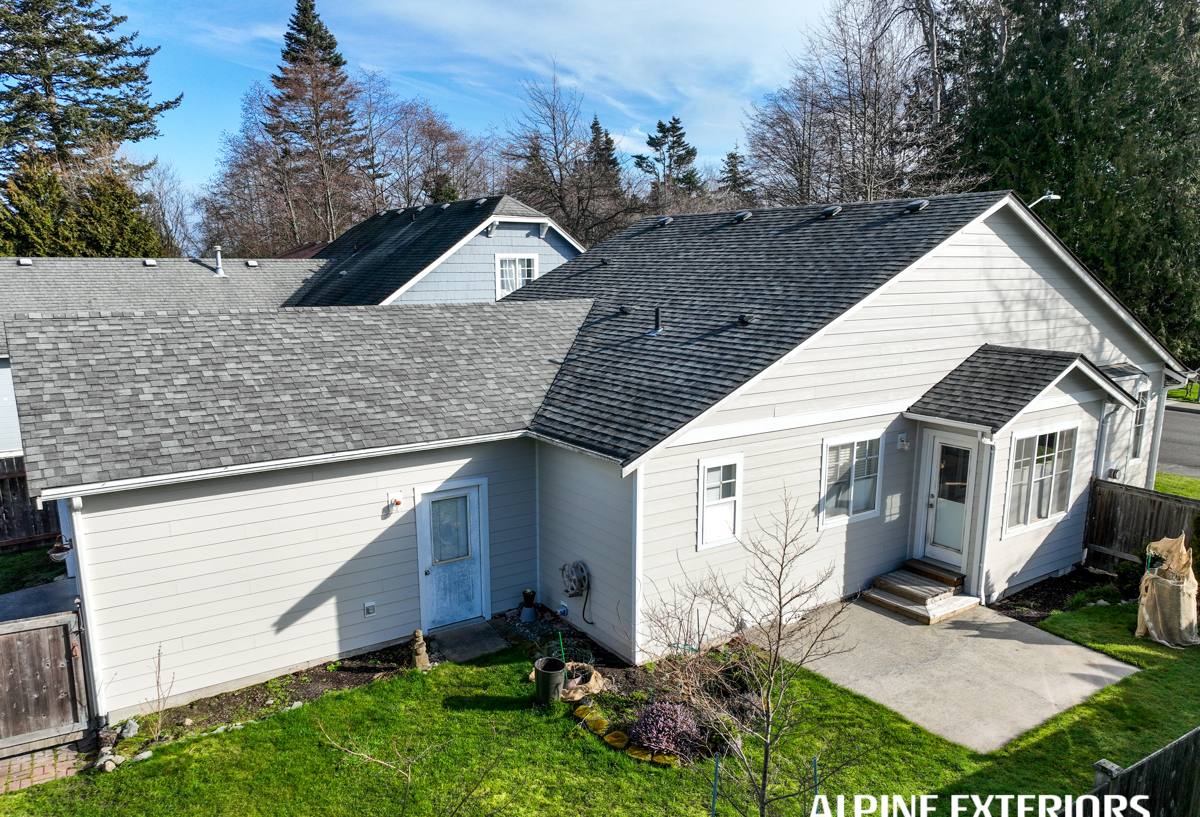
Salt Air, Driving Rain, and a Long Moss Season
What Salt Air Does Over Time
Homes close to Bellingham Bay pick up airborne salt that settles on exterior surfaces. On its own this isn't dramatic, but combined with moisture it accelerates corrosion of fasteners, flashing, and any metal trim components, and it can contribute to premature breakdown of certain paint films and coatings that weren't engineered with coastal exposure in mind.
What Driving Rain Does
Storms pushing in off the water don't fall straight down — they come in at an angle and drive against walls, window trim, and door surrounds. That means water finds its way into laps, joints, and seams that would stay dry on a more sheltered inland lot. Siding systems and flashing details that are marginal elsewhere get exposed quickly in a wind-driven rain environment like this.
What a Long Moss Season Does
Shaded, moisture-retentive sites — common under Edgemoor's tree canopy — stay damp for extended periods, which is exactly what moss and algae need to establish on roofing and siding. Beyond the cosmetic issue, moss holds moisture directly against the surface it's growing on, which is a slow but steady problem for materials that aren't dimensionally stable or that absorb water into their core.
Why This Company Installs Only James Hardie Fiber Cement
We made a decision as a company to install one siding system: James Hardie fiber cement. We don't install vinyl, LP SmartSide, Cemplank, Allura, or primed wood siding like spruce or cedar. That's not a marketing position — it's a standard we hold because of what we've seen play out on homes in exactly this kind of coastal, high-moisture environment.
Why Fiber Cement Fits Edgemoor
- Non-combustible core — fiber cement doesn't burn, which matters increasingly across Washington as wildfire risk gets factored into insurance and building decisions.
- Dimensionally stable in wet-dry cycling — unlike wood-based products, it doesn't swell, cup, or delaminate the way engineered wood or untreated wood siding can when it stays damp for long stretches.
- Factory-applied ColorPlus finish — the finish is baked on in a controlled factory environment rather than field-applied, which gives more consistent coverage and better long-term adhesion than site-applied paint, especially in a climate where paint doesn't get much chance to fully cure between rain events.
- HZ5 product engineering — Hardie's HZ5 line is formulated for climates with more moisture and freeze-thaw cycling, which fits Western Washington better than a generic national product.
- Strong transferable warranty — a real, honored warranty structure matters more on a waterfront lot where the material is working harder than average.
We're not going to claim other products are junk — plenty of them perform fine in drier, more sheltered settings. What we will say is that when we weighed maintenance burden, moisture behavior, and long-term appearance against what an Edgemoor home actually goes through, fiber cement was the only material we were comfortable standing behind with our own installation crew.
How a Local Crew Changes the Outcome
Siding, roofing, and window work in Edgemoor isn't generic exterior work — it's exterior work under a specific set of load conditions. A crew that mainly works inland, drier neighborhoods can install a product correctly on paper and still miss the details that matter here: extra attention to flashing at every penetration, wider clearances where siding meets grade or hardscape, and drying details around window and door openings that account for driving rain rather than straight-down rain.
Being based in Bellingham means we're working in this climate on a daily basis, not visiting it. We know which details fail first on a bluff-exposed wall versus a sheltered one, and we plan the installation — starting materials, flashing sequence, fastener spacing, caulk joints — around that reality rather than a generic spec sheet.
What a Correct Fiber Cement Installation Includes
- Proper starter strip and clearance at the foundation line to keep the bottom edge of siding out of standing moisture and splash-back
- Correctly lapped and sealed flashing at every window, door, and penetration — the single biggest factor in whether wind-driven rain stays out of the wall assembly
- Manufacturer-specified fastener type, spacing, and depth — over- or under-driven nails are a common source of early problems
- Field-cut edges sealed per manufacturer instructions, since raw cut edges are more absorbent than the factory-finished face
- Rain-screen or drainage gap detailing behind the siding where the wall assembly calls for it, which matters more on a wet, wind-exposed site than a dry one
Roofing, Windows, and Decks: The Same Exposure, Different Surfaces
Siding is one piece of the exterior envelope, and in Edgemoor the same salt air, rain, and moss conditions act on the roof, windows, and any exterior decking too. We handle all four because they're connected problems, not separate ones.
Roofing
Roofs in shaded, moisture-heavy parts of Edgemoor deal with moss and algae growth more aggressively than roofs on open, sun-exposed lots. Material choice, proper ventilation, and valley and flashing detail all affect how long a roof holds up before moss gets a foothold and starts trapping moisture against the roofing surface.
Windows
Wind-driven rain puts real pressure on window flashing and the seal between the window unit and the wall. Poor flashing integration at a window opening is one of the most common sources of hidden water intrusion we find when we open up a wall during a siding replacement — it's frequently the actual cause of a problem that looked, from outside, like a siding issue.
Decks
Exterior decks facing the water take direct rain, sun, and salt exposure with almost no protection. Material selection, proper fastening, and drainage away from the house all matter more here than on a fully sheltered inland deck.
Fiber Cement Versus Other Common Siding Materials
| Material | Behavior in Salt Air / Driving Rain / Moss | Long-Term Maintenance |
|---|---|---|
| James Hardie fiber cement | Dimensionally stable, non-combustible, factory-cured finish resists coastal weathering | Occasional wash-down; repaint intervals are long due to ColorPlus finish |
| Vinyl | Can warp or fade under sustained UV and temperature swings; seams are a moisture entry point | Low upkeep but limited repair options if damaged; color is not repaintable in the same way |
| LP SmartSide (engineered wood) | Wood-based core is more sensitive to sustained moisture exposure than fiber cement | Relies on intact factory coating and careful field sealing at every cut edge |
| Primed cedar or spruce | Natural wood movement and moisture absorption is highest of this group in a wet, shaded climate | Regular repainting and moisture monitoring needed to prevent rot |
What Drives Cost on an Edgemoor Exterior Project
| Factor | Why It Matters Here |
|---|---|
| Site access | Sloped, bluff-adjacent, or tree-crowded lots common in Edgemoor can add setup and staging time |
| Existing wall condition | Homes with long-term moisture exposure sometimes need sheathing repair once old siding comes off |
| Window and trim integration | Coordinating flashing details between siding and window replacement adds labor but reduces future leak risk |
| Tree cover and moss removal | Heavily shaded lots may need extra prep for moss and algae on adjacent roofing or hardscape |
| Material selection | Hardie panel, lap, and shingle profiles carry different material and labor costs |
We don't publish flat prices because every Edgemoor lot is a little different — slope, tree cover, and existing wall condition all shift the scope. A walk-through and written estimate is the only honest way to price the work.
A Homeowner's Checklist Before Hiring for Exterior Work in This Area
- Ask directly what siding material the contractor installs and why — a company that installs everything has no particular standard
- Ask how they detail flashing at windows, doors, and penetrations, not just what siding brand they use
- Confirm they're licensed and insured to work in Washington and ask about their warranty structure, including what's transferable if you sell the home
- Ask whether they're a local Whatcom County crew or a traveling crew working from out of the area
- Get a written scope that includes moisture management details, not just a material list and a price
Why Local Presence Matters Beyond the Sales Pitch
A contractor based in Bellingham has a reason to get the details right on an Edgemoor home: we're accountable in the same community, year after year, not finishing a job and moving to the next region. That shows up in small ways — showing up for a warranty check, knowing which flashing detail failed on a similar bluff-exposed home last winter, and being straightforward about what a house like yours actually needs versus a generic national recommendation.
If you're weighing a siding, roofing, window, or deck project on your Edgemoor property, we're happy to walk the exterior with you and give you a straightforward, no-pressure estimate — no invented urgency, just an honest look at what your home's exposure actually calls for.