 Bellingham
 Siding Built for Puget's Corner of Whatcom County
Puget sits close enough to Bellingham Bay that its homes feel the marine layer every day of the year. That proximity to saltwater is part of what makes the area a nice place to live, but it's also exactly why exterior materials here take more abuse than the same materials would fifty miles inland. Salt-laden air, near-constant moisture, and a moss season that can stretch from October through May put real, measurable stress on siding, trim, roofing, and anything with exposed fasteners. We work on homes throughout this part of Bellingham regularly, and the patterns repeat: south and west-facing walls that never quite dry out, north-facing roof sections holding moss well into summer, and trim boards that were never rated for this climate starting to fail years before they should.
This page walks through what we actually see on Puget-area homes, how we approach siding, roofing, windows, and decks for this specific environment, and why we standardized on one siding product instead of offering the full menu most contractors carry.
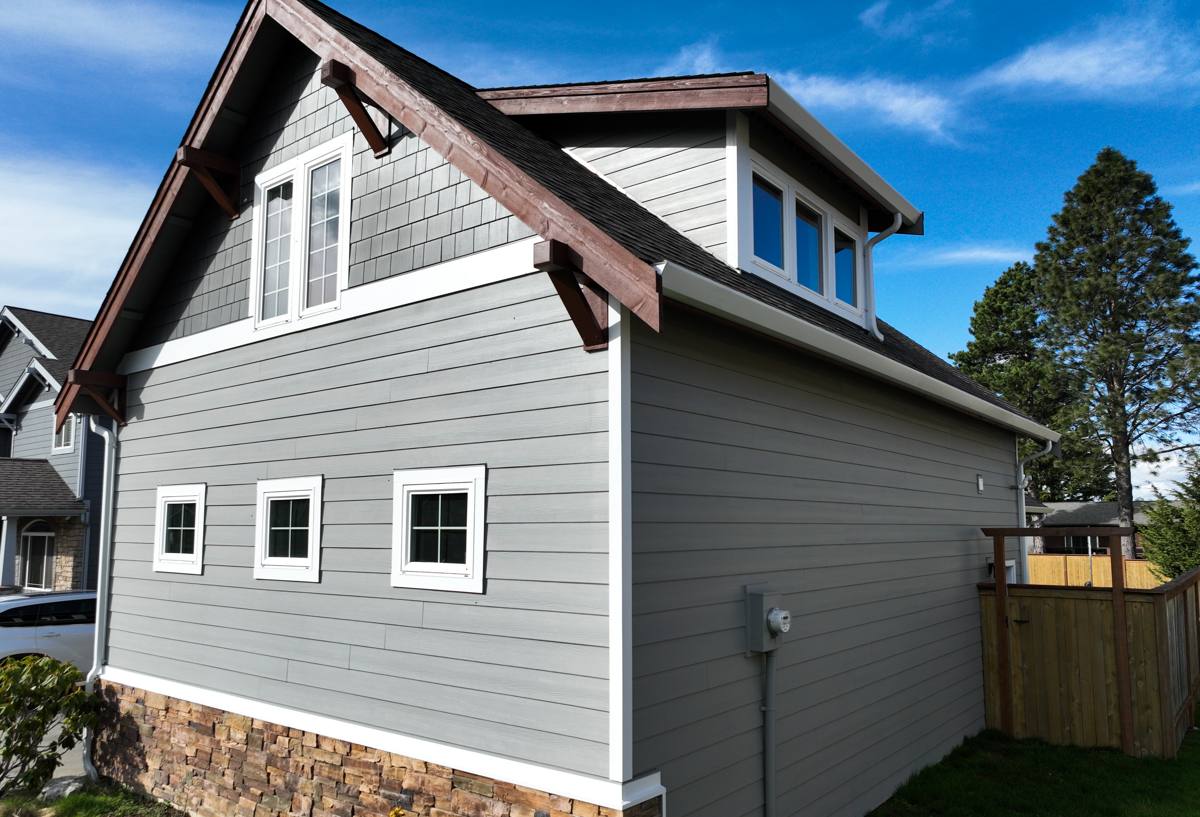
What Whatcom County Weather Does to a House
Salt Air and Moisture
Homes within a few miles of Bellingham Bay deal with airborne salt in a way that inland Whatcom County properties don't. Salt accelerates corrosion on fasteners, flashing, and any metal component on the exterior. It also interacts with paint film over time, which is part of why we pay close attention to what's holding a color coat to the substrate underneath, not just the substrate itself.
Driving Rain
Bellingham's rain isn't the gentle, straight-down kind for much of the year. Storms coming off the Strait of Georgia and Puget Sound push rain sideways into walls, especially on exposed elevations. That means water-resistive barriers, flashing details, and caulking joints matter more here than they would in a drier climate — a good product installed with sloppy flashing will still let water in.
Moss and Shade
Mature trees and a lot of cloud cover keep many Puget-area lots shaded and damp for long stretches. Moss and algae take hold on north-facing siding, roofing, and anywhere airflow is limited. Left alone, that growth holds moisture against the surface, which is a slow but steady path to rot, delamination, or coating failure depending on what the material is made of.
Why We Only Install James Hardie Fiber Cement Siding
We used to install a broader range of siding products. We don't anymore, and the reason comes directly from what we've seen fail on homes in this climate. Fiber cement from James Hardie is non-combustible, holds its factory-applied ColorPlus finish far longer than field-applied paint typically lasts, and is engineered in specific product lines for high-moisture, marine-adjacent climates like ours. That last point matters more here than almost anywhere else in Washington.
What This Means in Practice
- No wood substrate to swell, rot, or delaminate when moisture gets behind a panel or joint
- A factory finish (ColorPlus) baked on under controlled conditions, rather than a field-applied coat that has to cure in Bellingham's damp air
- Product lines engineered for specific climate zones, so the panels going on a Puget home are spec'd for wet, moderate-temperature conditions
- A manufacturer warranty that's transferable if the home sells, which matters in a market where buyers ask about exterior condition
- A material that doesn't feed moss and algae growth the way some wood-based and vinyl products can when left un-cleaned
We're honest that fiber cement isn't magic — it still needs correct installation, proper clearances, and periodic caulk and paint maintenance on cut edges. But the baseline performance, especially in a marine climate, is why it's the only siding we put our name behind.
What We Don't Install, and Why
Homeowners sometimes ask why we don't offer vinyl, LP SmartSide, or other fiber cement brands like Cemplank or Allura. Here's the honest version:
| Product | What It Gets Right | Why We Don't Install It |
|---|---|---|
| Vinyl siding | Low upfront cost, low maintenance in mild climates | Can warp or become brittle with UV and temperature swings; seams and J-channels give driving rain more entry points; not the look or longevity we want to stand behind here |
| LP SmartSide | Engineered wood strand product, easier to cut than fiber cement | Wood-based substrate is more moisture-sensitive over the long run; in a climate this wet, we've seen wood-composite products struggle at seams and cut edges over time |
| Primed spruce / cedar | Traditional look, renewable material | Requires far more maintenance — repainting, caulking, moisture monitoring — than most homeowners want to keep up with in a climate this damp |
| Cemplank / Allura fiber cement | Also fiber cement, similar core material | We standardized on one manufacturer so our crews install to one spec, one warranty structure, and one finish system every time — consistency reduces installation error |
Roofing for a Wet, Shaded Climate
Roofs in Puget deal with the same moss and moisture pressure as siding, often worse, since a roof plane holds standing moisture longer than a vertical wall. When we work on a roof here, we're looking at underlayment quality, ventilation (a poorly vented attic traps moisture that works its way back out through the roof deck), and valley and flashing details around anything that penetrates the roof — vents, chimneys, skylights. Moss removal and prevention come up constantly in this neighborhood, and it's worth treating as ongoing maintenance rather than a one-time fix, since spores travel from shaded trees onto any exposed surface within reach.
Windows: The Other Half of a Weathertight House
Siding and windows have to work as one system. A well-installed window with poor flashing integration into the surrounding wall assembly is a leak point no matter how good the siding around it is. In a driving-rain climate, we pay particular attention to head flashing above windows and proper integration with the water-resistive barrier, since that's where we most often find hidden water damage on older Bellingham-area homes when siding comes off for replacement.
Decks in a Marine, Moss-Prone Environment
Decks near Bellingham Bay face their own version of the same problems: moisture that doesn't fully dry between rain events, shaded areas where boards stay damp, and salt air accelerating corrosion on fasteners and hardware. Material choice, fastener quality, and proper spacing for drainage and airflow underneath the deck all matter more here than in a drier inland climate. A deck built without enough airflow underneath will hold moisture against the framing long after the surface looks dry.
What a Home Exterior Assessment Looks Like
When we walk a Puget-area property, we're checking a consistent set of things regardless of which service brought us out:
- Condition of existing siding at seams, corners, and any areas showing staining or soft spots
- Moss and algae growth patterns, especially on north and shaded elevations
- Flashing condition around windows, doors, and roof penetrations
- Signs of moisture intrusion at the foundation line or around deck ledger connections
- Ventilation adequacy in the attic and any enclosed deck or crawlspace areas
- Fastener and hardware condition, particularly on older decks and trim
Cost Factors for Exterior Work in This Climate
| Factor | Why It Affects Cost Here |
|---|---|
| Extent of hidden moisture damage | Wet climates often mean more sheathing or framing repair is found once old siding comes off |
| Home size and elevation exposure | South and west-facing walls exposed to driving rain may need more attention to flashing detail |
| Roof pitch and tree coverage | Heavily shaded, steep, or complex rooflines take longer to treat and detail properly for moss and drainage |
| Access and site conditions | Mature trees and tighter lots common in established neighborhoods can affect scaffolding and staging |
| Scope — single service vs. combined project | Bundling siding, roofing, windows, or a deck into one project can reduce redundant setup and site prep costs |
Why a Local Crew Matters
A contractor who works across Whatcom County regularly knows which elevations on which streets get hit hardest by wind-driven rain, which neighborhoods hold moss longest into the summer, and how close a given lot sits to salt air exposure. That local knowledge shapes real decisions — flashing details, product selection, maintenance recommendations — in ways a crew unfamiliar with the Puget Sound climate wouldn't necessarily catch. We're not guessing at how a product will hold up here; we're watching it happen on homes in this county year after year.
If you're weighing a siding, roofing, window, or deck project on a Puget-area home, we're glad to come take a look and give you a straightforward, no-pressure estimate — just fill out the form below.