 Bellingham
 Why Birch Bay Is a Different Kind of Siding Job
Birch Bay sits right where Whatcom County meets the water, and that location shapes everything about how siding ages here. Homes facing the shoreline take a steady dose of salt-laden air, which speeds up corrosion on fasteners, trim, and any material that isn't built to handle it. A few blocks back, wind-driven rain off the Strait pushes moisture sideways into wall assemblies that were only ever designed for straight-down weather. And across the whole area, shaded lots with tall fir and cedar cover create the damp, low-light conditions moss and algae love. Any one of these factors would be enough to shorten the life of an average siding job. In Birch Bay, a home usually deals with all three at once.
That combination is exactly why we treat siding replacement here as a different job than siding replacement in a dry inland neighborhood. The material matters, but so does the assembly behind it — the flashing, the water-resistive barrier, the fastening pattern, and the clearances that keep water moving out instead of in.
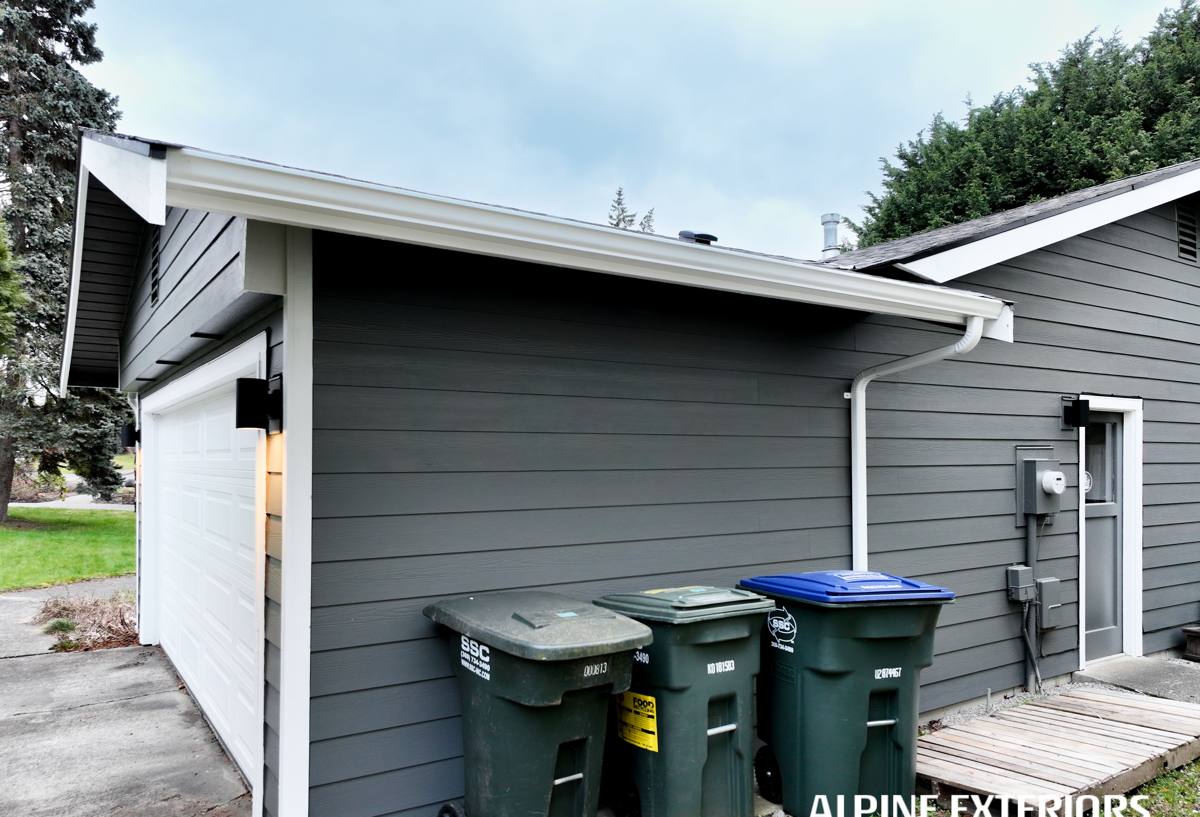
Signs a Birch Bay Home Needs Siding Replacement, Not Just Repair
Not every siding problem calls for a full tear-off. But there are signs that point past patching and toward replacement, especially on a coastal property that's been absorbing moisture and salt air for years:
- Soft or spongy spots when you press on the siding, especially near the bottom courses, around window sills, or under decks — a sign moisture has already reached the wall sheathing
- Persistent moss or algae growth that comes back within a season or two of cleaning, even after washing
- Paint that's failing in patches rather than evenly, which often means water is getting behind the material and pushing the finish off from underneath
- Visible rust streaking from fasteners or trim, a common problem on older siding systems exposed to salt air
- Gaps, warping, or buckling panels — a sign the siding has been expanding and contracting with moisture cycles
- Rot at corners, butt joints, or anywhere two pieces of siding meet, since these seams are where driving rain finds a way in first
If you're seeing more than one of these at once, it's usually a sign the whole wall system needs attention, not just the visible surface layer.
What a Correct Siding Replacement Actually Involves
It Starts Underneath the Siding, Not With It
The siding panel is the part everyone sees, but the materials behind it do most of the work of keeping a Birch Bay home dry. A proper replacement means removing the old siding down to the sheathing, checking for hidden rot or moisture damage, and installing a continuous water-resistive barrier before a single new panel goes up. Any framing or sheathing that's been compromised needs to be repaired before the new siding covers it back up — skipping this step just seals existing damage inside the wall.
Flashing Is Where Most Failures Start
Windows, doors, and any place where two rooflines or wall planes meet are the highest-risk spots for water intrusion, especially with the wind-driven rain that comes off the water in Birch Bay. Correct flashing detail at these transitions — including kick-out flashing where a roofline meets a wall — is what actually keeps rain from tracking behind the siding rather than running down the surface.
Fastening and Clearances Matter More Near the Water
Fastener choice and spacing affect how well siding holds up against wind loads and salt exposure. We also pay attention to clearance — how close the bottom edge of the siding sits to grade, decks, patios, and roof surfaces — because tight clearances trap moisture and speed up deterioration, even on high-quality materials.
Why We Install Only James Hardie Fiber Cement
We don't offer vinyl, LP SmartSide, Cemplank, Allura, primed spruce, or cedar siding. That's a deliberate standard, not a limitation in what we're capable of installing. After years of replacing siding on homes up and down this coastline, we settled on James Hardie fiber cement because it holds up to the specific combination of conditions Birch Bay throws at a house.
Fiber cement is non-combustible, which matters for wildfire-conscious insurance considerations, and it doesn't absorb and swell with moisture the way wood-based products can. Hardie's ColorPlus factory-applied finish is baked on under controlled conditions, which gives it better fade and moisture resistance than field-applied paint — an advantage on a home that's constantly being rinsed with salt air and rain. Hardie also engineers specific product lines for different climate zones, so we're not installing a one-size-fits-all product on a coastal property in Whatcom County.
We're not going to tell you every other siding product is worthless — vinyl is inexpensive and low-maintenance in mild climates, engineered wood products have real fans, and cedar has a look plenty of homeowners love. But we've made a professional call that, for the moisture load, salt exposure, and moss pressure typical of this area, fiber cement is the material we're willing to put our name behind.
How Common Siding Materials Hold Up in Birch Bay Conditions
| Material | Salt Air Exposure | Driving Rain / Moisture | Moss & Algae Growth | Finish Longevity |
|---|---|---|---|---|
| James Hardie fiber cement | Does not corrode; engineered HZ lines for coastal/wet climates | Dense, moisture-resistant board; performs well with correct flashing | Resists moisture absorption that feeds growth | ColorPlus factory finish, long repaint intervals |
| Vinyl siding | Panels themselves don't corrode, but fasteners and trim can | Can warp or gap over time; seams are a moisture entry risk | Smooth surface but growth still occurs in shaded, damp spots | Color is baked into the panel but fades over decades; can't be repainted easily if faded |
| Cedar / wood siding | No corrosion, but absorbs salt-laden moisture into the grain | Prone to swelling, cupping, and rot without diligent upkeep | Organic material is highly susceptible to moss and mildew | Requires regular refinishing/staining, especially in wet climates |
| Engineered wood (LP-type) | Composite core can be sensitive to prolonged moisture exposure | Edge and seam sealing is critical; failure points if installed loosely | Moderate resistance; depends heavily on coating and installation | Factory finish varies by product; touch-up paint needed over time |
Our Siding Replacement Process for Birch Bay Homes
Every project starts with an on-site walkthrough where we look at more than just the surface condition of the existing siding. We check the exposure of each wall — waterfront-facing walls take a different beating than a side wall tucked behind trees — and we look at drainage around the foundation, roofline transitions, and any past water staining. That assessment shapes the specific Hardie product and detailing plan for the home, rather than defaulting to one standard approach for every wall.
From there, the work follows a consistent sequence: careful removal of the old siding, inspection and repair of the sheathing and framing underneath, installation of a continuous water-resistive barrier, correct flashing at every window, door, and roof transition, and then installation of the Hardie siding itself to manufacturer fastening and clearance specifications. We finish with detailing at trim, corners, and joints — the spots most likely to let water in if rushed.
Questions Worth Asking Before Work Begins
- Will the crew inspect and repair the sheathing before new siding goes on, or just cover what's there?
- What water-resistive barrier product will be used, and is it rated for the moisture load in this area?
- How will flashing be handled at windows, doors, and roof-to-wall transitions?
- What clearance will the siding have from grade, decks, and roof surfaces?
- Which specific James Hardie product and color line is being specified, and why is it right for this wall's exposure?
- What does the manufacturer's warranty cover, and what does the installer's own workmanship warranty cover separately?
Living With Moss Season After Replacement
New siding doesn't make moss and algae disappear from the property — trees, shade, and the region's damp winters are still there. What changes is how the siding responds to that environment. A dense fiber cement panel with a factory finish sheds surface growth more easily during routine washing than a porous wood surface that gives moss something to root into. We also pay attention to landscaping clearance and gutter placement during installation, since overhanging branches and poor drainage are two of the biggest contributors to moss buildup on any exterior, regardless of material.
A simple rinse-down once or twice a year, along with keeping gutters clear and vegetation trimmed back from exterior walls, goes a long way toward keeping a Hardie exterior looking clean through Whatcom County's long wet season.
Why Local Experience in Birch Bay Specifically Matters
Siding installation isn't identical everywhere, and a crew that's only worked inland jobs may not think twice about details that matter a great deal on a waterfront-adjacent property — the extra attention to flashing on a wall that takes direct wind-driven rain, the fastener and trim choices that hold up to salt air, or the drainage considerations on a shaded, moss-prone lot. Working repeatedly in Birch Bay and around greater Bellingham means we've seen how different wall exposures on the same street can behave completely differently, and we plan the job accordingly rather than applying a generic approach.
It also means we're familiar with the permitting and inspection expectations in Whatcom County, so there are no surprises partway through the project. A siding replacement is a significant investment, and the value of that investment depends almost entirely on whether the details were done right — which is a matter of experience with this specific coastline, not just experience with siding in general.
If your Birch Bay home is showing signs of wear, or you're just weighing your options before committing, we're happy to take a look and walk you through what we'd recommend and why. Reach out for a free, no-pressure estimate using the form below.