 Bellingham
 Why Siding Takes a Beating in Sudden Valley
Sudden Valley sits in a setting that's beautiful to live in and genuinely hard on exterior building materials. The combination of moist Pacific air, driving rain off the water, and heavy tree cover creates conditions that push ordinary siding products past their limits faster than homeowners expect. Whatcom County's long wet season means siding here spends more months damp than dry, and shaded, wooded lots dry out slower after every storm than an open lot in town would.
Salt-laden air moving inland, sustained rain events, and a moss season that can stretch from fall through spring all combine to attack siding in three ways at once: moisture intrusion behind the cladding, surface growth (moss, algae, and mildew) on the face of it, and slow degradation of paint or coatings that aren't built to handle constant damp-dry cycling. Homes tucked among trees, which describes a lot of Sudden Valley, get an extra dose of this because shade slows drying time and falling debris — needles, leaves, pollen — holds moisture directly against the wall.
None of this means siding is doomed here. It means the material and the installation have to be matched to the environment, not just picked off a sample board. That's the whole reason we standardized on James Hardie fiber cement and don't install anything else.
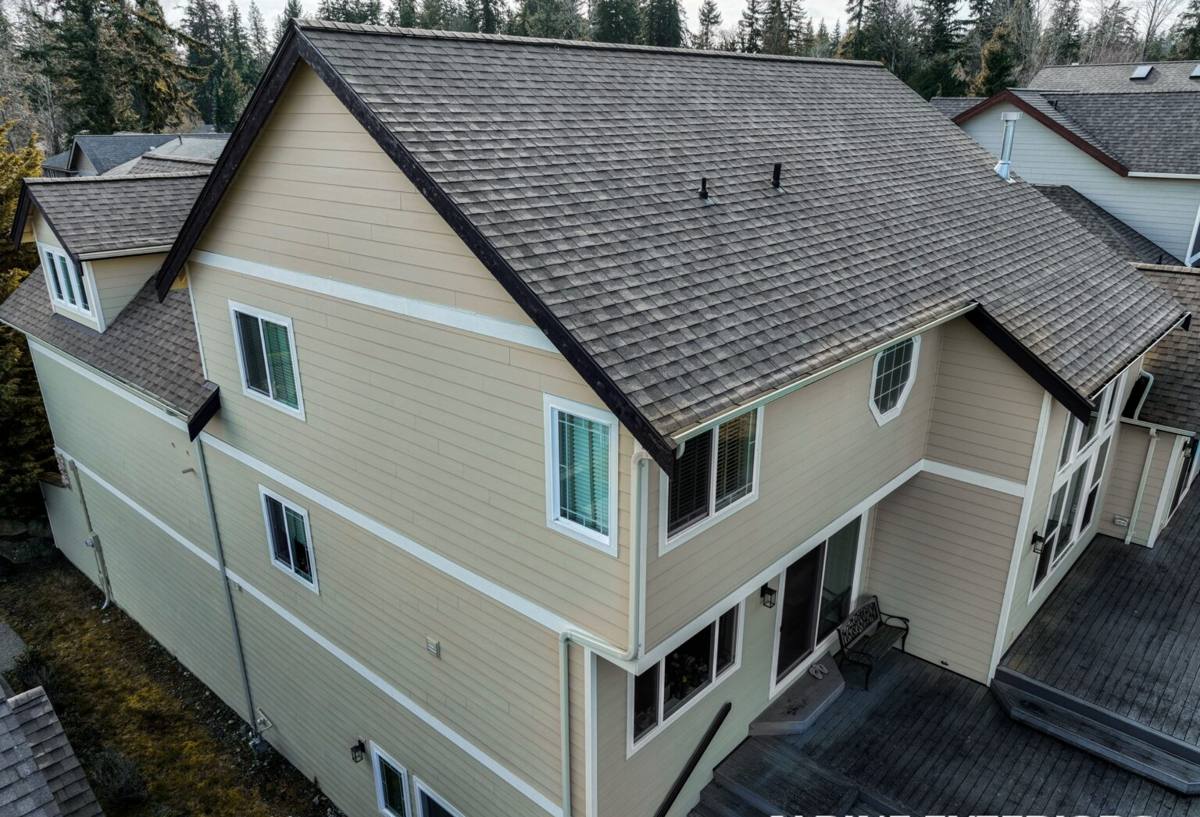
What Fiber Cement Actually Solves Here
James Hardie siding is an engineered fiber cement product — cellulose fiber, sand, and portland cement pressed and cured into a dense, stable board. That composition matters in a climate like this for a few specific reasons:
- It doesn't absorb and swell with moisture the way wood-based or wood-derived siding products can, which matters when a wall assembly stays damp for days at a time.
- It's dimensionally stable across temperature and humidity swings, so seams and fastener lines stay tighter over time instead of opening up gaps for water to find.
- It's non-combustible, which is a real consideration anywhere in Washington with nearby forest and wildland vegetation.
- The factory-applied ColorPlus finish is baked on under controlled conditions and backed by its own finish warranty, rather than relying on a field-applied coat of paint to hold up against year-round damp.
Hardie also engineers its products by climate zone — a system it calls HZ5 for the Pacific Northwest and similar regions. That's not marketing language; it changes the actual formulation of the board to better handle a wetter, milder climate than, say, the Southwest or Upper Midwest versions of the same products. A home in Sudden Valley gets a board built for exactly the weather it's going to face.
Where Moss and Algae Actually Come From
Moss and algae don't grow on siding because the siding is defective — they grow because organic spores land on a damp surface and find enough shade and moisture to establish. Shaded, wooded lots are prime territory for this. Hardie's factory finish resists staining and growth better than bare wood or field-painted surfaces, but no siding is immune if water is allowed to sit against it. That's why correct installation — not just the product choice — is what actually keeps a wall clean over the long run.
Matching the Right Hardie Product to Your Home
Not every Hardie product fits every house, and the right call usually comes down to the home's existing lines, its exposure, and what look the owner wants. The most common options we install:
| Product | Best For | Notes for This Climate |
|---|---|---|
| HardiePlank Lap Siding | Most single-family homes, traditional or modern lines | Widely used, proven track record in wet coastal climates |
| HardieShingle | Accent gables, dormers, cottage-style homes | Adds texture without the moisture problems of real wood shingle |
| HardiePanel | Modern vertical siding, board-and-batten looks | Works well on shop buildings and contemporary facades |
| HardieTrim | Corners, window/door trim, fascia | Non-combustible trim that won't rot at end grain like wood trim does |
For a wooded, shaded lot, texture and color choice also matter more than people expect — darker, matte finishes tend to show less visible staining between cleanings than very light, glossy-looking finishes, though both hold up structurally the same. We walk through the ColorPlus palette with you against your actual roofline and surroundings before you commit to anything.
What a Correct Installation Actually Involves
Fiber cement siding fails prematurely almost exclusively because of installation mistakes, not product defects. In a wet climate like Bellingham's, the details that get skipped on a rushed job are exactly the ones that cause problems two or three winters later. A correct install includes:
- A drainable weather-resistive barrier installed and lapped correctly behind the siding, not just a single flat layer of house wrap
- Proper flashing at every window, door, and horizontal trim transition — the single most common source of hidden water intrusion
- Manufacturer-specified fastener type, spacing, and penetration depth, not whatever happens to be in the nail gun
- Correct clearance between the bottom of the siding and roofing, decks, patios, and grade — Hardie specifies minimum gaps for a reason
- Butt joints and panel seams sealed or flashed per Hardie's install guide, not just caulked over and hoped for
- Field-cut edges primed or sealed before installation, since raw cut edges are more absorbent than the factory face
This is also where a crew's experience with heavily wooded, damp lots pays off directly. Homes set back among trees often need extra attention at ground-contact clearances and around any spot where a roofline sheds water directly onto a wall below — details that are easy to overlook if a crew is used to installing on open, sunny lots.
Our Process, Start to Finish
1. On-Site Assessment
We walk the exterior with you, check the condition of the existing siding and sheathing, and note anything — a shaded north wall, a spot with heavier tree drip, an area with visible past moisture damage — that needs specific attention in the plan.
2. Product and Color Selection
We go over the right Hardie product line, texture, and ColorPlus color for your home and its setting, factoring in exposure and how the finish will read against your surroundings.
3. Prep and Moisture Barrier
Old siding comes off, sheathing gets inspected and repaired if needed, and a proper weather-resistive barrier goes on before a single piece of new siding is hung.
4. Installation to Manufacturer Spec
Flashing, fastening, and clearances are done to Hardie's published installation requirements — this is what actually determines whether the siding performs for its full service life.
5. Final Walkthrough
We go around the finished exterior with you, check trim and caulk lines, and make sure everything meets the standard before we call the job done.
Living With It: Maintenance in a Wet, Shaded Setting
James Hardie siding needs far less upkeep than wood or vinyl, but "low-maintenance" isn't "no-maintenance," especially on a lot with heavy tree cover. A few habits keep it looking right for years:
- Rinse the siding occasionally with a garden hose or soft wash — never a high-pressure wash, which can force water behind panels and strip the finish
- Keep gutters and downspouts clear so water isn't overflowing and running down the wall face
- Trim back vegetation and branches that hold moisture or shade against the siding, especially on north- and east-facing walls
- Clear leaf and needle buildup from window sills, trim ledges, and anywhere debris can pile up and hold water
- Check caulking at trim and penetrations every couple of years and touch up as needed
What Affects the Cost of a Sudden Valley Hardie Project
| Factor | Why It Matters |
|---|---|
| Home size and number of stories | More square footage and taller walls mean more material and labor time |
| Condition of existing siding and sheathing | Hidden moisture damage found during tear-off adds repair scope |
| Trim and architectural detail | Gables, dormers, and multiple wall planes take more time than a simple rectangular footprint |
| Site access | Wooded lots, sloped driveways, and gated-community access can affect staging and equipment logistics |
| Product line and finish selection | HardiePlank, HardieShingle accents, and trim packages carry different material costs |
We give you a specific number after seeing the home in person — broad online estimates rarely account for the tear-off condition or access realities of a given lot.
Why Hire a Crew That Already Works This Neighborhood
A crew that's already worked on wooded, lake-adjacent lots in this part of Whatcom County knows things a first-time visitor doesn't: how to plan around gated-community access and scheduling, how much extra time a heavily treed lot adds to tear-off and cleanup, and which wall orientations on this kind of property tend to need the most attention to flashing and drainage. That local familiarity shows up in fewer surprises mid-project and a finished job that's built for the specific way weather behaves on your lot, not just a generic install.
If you're weighing a siding replacement or repair in Sudden Valley, we're happy to walk your home, look at what your siding is actually dealing with, and put together a straightforward, no-pressure estimate — just fill out the form below to get started.