 Bellingham
 Why Sudden Valley Siding Wears Differently Than a Typical Bellingham Lot
Sudden Valley sits back in the trees along Lake Whatcom, and that setting changes how siding ages compared to a more open, in-town Bellingham property. Homes here get more shade, more standing moisture on the north and west walls, and slower drying times after a storm rolls through. Add in Whatcom County's long wet season, the salt-tinged air that moves inland off Bellingham Bay on a west wind, and a moss season that can run eight or nine months out of the year, and you've got a climate that is genuinely hard on exterior materials. It's not that Sudden Valley homes fail faster because of poor construction — it's that the site conditions accelerate whatever weaknesses the original siding already had.
That's the lens we use when we look at a siding replacement here: not just "what's wrong with this wall today," but "what will this same wall be dealing with in year five, year ten, and year twenty in this specific spot."
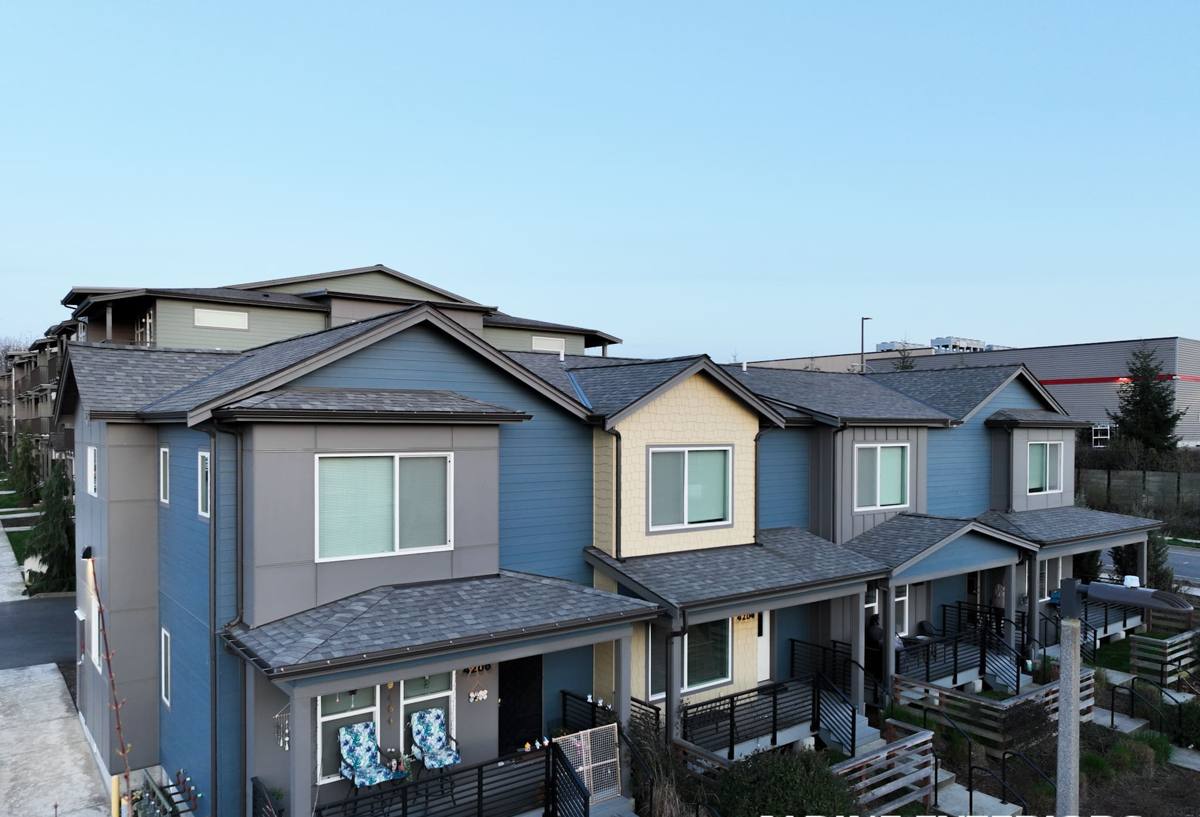
What Rain, Moss, and Humidity Actually Do to Siding Over Time
Most siding failure in this part of Whatcom County isn't dramatic. It's slow. Moisture gets behind or into the siding material and the damage builds quietly until it shows up as a soft spot, a stain, or a section that's clearly failing faster than the rest of the wall.
The mechanisms we see most often
- Prolonged moisture contact — shaded, tree-covered walls stay damp longer after rain, which matters more than total rainfall for how a material actually performs.
- Moss and algae growth — organic growth holds moisture against the surface and, on wood-based products, can accelerate rot at the point of contact.
- Freeze-thaw cycling — even mild Bellingham winters put trapped moisture through enough freeze-thaw cycles to widen cracks and joints over several seasons.
- Salt-influenced air — corrosive effects on fasteners and metal flashing add up over the years, especially where flashing details were cut short during the original install.
- UV and wind-driven rain — exposed western and southern faces take more direct weathering, so siding often ages unevenly around a single house.
None of these are exotic problems. They're the standard list for the Pacific Northwest. But Sudden Valley's tree cover and lake-adjacent humidity tend to push the timeline up — problems that might take twenty-five years to show on an open, sunny lot can show up in fifteen here.
Signs a Sudden Valley Home Needs Siding Replacement, Not Just Repair
Not every siding problem calls for a full tear-off. But there's a point where patching stops being cost-effective and starts being a way of delaying a decision you'll make anyway in a year or two. Here's how we tell the difference on a walk-through:
- Soft, spongy, or crumbling material when pressed — especially near the bottom courses, window sills, and anywhere two roof planes meet a wall
- Persistent moss or black streaking that comes back within weeks of a cleaning
- Paint that won't hold — blistering, peeling, or needing a full repaint cycle every 2-3 years instead of every 7-10
- Visible gaps, warping, or buckling panels, particularly on shaded north and west walls
- Interior signs — musty smell, soft drywall, or staining on an exterior-facing wall
- Damage concentrated around one or two problem areas rather than spread evenly, which often means a flashing or water-management failure rather than a material failure
When damage is isolated and the underlying wall assembly is dry, targeted repair can make sense. When moisture has been active for a while, replacement is almost always the better long-term value — because a repair layered over a compromised water-resistive barrier just buys you a few more years before you're back to the same conversation.
What a Correct Siding Replacement Actually Involves
The visible siding is the last thing installed and the first thing people judge. But the work that determines whether a replacement lasts happens underneath it, and it's the same regardless of neighborhood — Sudden Valley's climate just makes getting it right non-negotiable.
The sequence we follow
- Full tear-off — removing old siding down to the sheathing so we can actually see what's underneath, rather than installing over hidden rot or a failed barrier
- Sheathing inspection and repair — any water-damaged OSB or plywood gets cut out and replaced before anything else happens
- Water-resistive barrier — a new weather barrier installed correctly shingle-style, lapped so water sheds outward at every seam
- Flashing at every penetration — windows, doors, vents, hose bibs, and roof-to-wall transitions all get properly integrated flashing, not just caulk
- Furring or rainscreen detailing where appropriate — giving the wall assembly a way to dry out, which matters more on shaded, slow-drying elevations
- Siding installation to manufacturer spec — correct fastener pattern, gapping, and clearances, since most premature siding failures trace back to installation shortcuts, not the material itself
- Trim, caulking, and paint or factory finish — the last line of defense, done last for a reason
Skip or rush any one of those steps and you can still end up with a wall that looks great for a year or two before the same moisture problems resurface.
Why We Only Install James Hardie Fiber Cement
We made a decision as a company to install one siding system — James Hardie fiber cement — and not offer vinyl, LP SmartSide, or unfinished wood siding as alternatives. That's not a marketing position; it's a reflection of what holds up under exactly the conditions Sudden Valley deals with.
Fiber cement is non-combustible, doesn't provide the same food source for the moss and algae that wood-based products deal with, and doesn't warp, buckle, or melt the way vinyl can under heat and impact. James Hardie's ColorPlus factory-applied finish is baked on before the material ever reaches the jobsite, which gives it more consistent, longer-lasting color performance than field-applied paint — a real advantage in a climate where repainting cycles are already shorter than the national average. Hardie also builds regional "HZ" product lines engineered for specific climate zones, which matters in a part of the country where humidity and moisture exposure are the defining challenge rather than an afterthought.
None of that means other products are junk — it means we'd rather stand behind one system we trust completely than offer options we'd have reservations about recommending.
Our Process for a Sudden Valley Job
A few things about working in Sudden Valley specifically shape how we plan a project:
- Community guidelines — many Sudden Valley properties fall under a homeowners' association with architectural or color-approval guidelines. We'll ask about this up front so your Hardie color and trim selections clear any review process before material ever gets ordered.
- Site access and staging — wooded, sloped lots often mean tighter driveways and less flat staging area than a typical in-town lot, so we plan material delivery and dumpster placement around that reality rather than assuming a standard setup.
- Tree and landscape protection — mature trees and established landscaping are part of what makes these properties valuable, so protecting root zones and plantings during tear-off and disposal is part of the plan, not an afterthought.
- Moisture-aware sequencing — because shaded walls dry slower, we pay close attention to weather windows during tear-off so sheathing isn't left exposed longer than necessary.
What Drives the Cost of a Siding Replacement Here
Every project is different, but these are the factors that most often move the number up or down on a Sudden Valley siding replacement:
| Factor | Why it matters here |
|---|---|
| Extent of hidden moisture damage | Shaded, slow-drying walls more often need sheathing repair once old siding comes off |
| Home size and wall complexity | Dormers, multiple gables, and cut-up wall planes take more labor per square foot than a simple rectangular elevation |
| Siding profile and trim detail | Lap siding, shingle-style accents, and custom trim packages cost more than a single uniform profile |
| Site access | Steep or wooded lots with limited staging space can add time for material handling and disposal |
| Color and finish selection | Factory ColorPlus finishes vs. field-applied paint affect both material cost and long-term repainting savings |
| HOA or design review timelines | Not a cost driver directly, but can affect project scheduling if approval is required before work starts |
Materials commonly considered, and how they hold up in this setting
| Material | Moisture/moss behavior | Maintenance |
|---|---|---|
| James Hardie fiber cement | Non-combustible, resists moisture-driven warping, doesn't feed organic growth the way wood does | Occasional wash; factory finish holds color for years |
| Vinyl | Can warp or become brittle with heat/cold cycling; seams can allow moisture behind panels | Low, but color fades and cracked panels are hard to color-match later |
| Untreated or primed wood/LP | More vulnerable to moisture absorption and rot in prolonged damp conditions | Regular repainting and edge-sealing needed |
Choosing a Crew That Actually Works This Neighborhood
Sudden Valley isn't a downtown Bellingham lot, and a contractor's general experience doesn't always translate directly. A few things worth asking any crew you're considering:
- Have you worked on homes in Sudden Valley or similarly wooded, lake-adjacent properties before?
- How do you handle sheathing repair if you find hidden moisture damage once old siding is off?
- What's your plan for protecting trees, landscaping, and limited staging area during the project?
- Are you familiar with the HOA or community design-review process, if one applies to my property?
- What water-resistive barrier and flashing details do you use, and can you explain why?
- What warranty covers both the material and your labor, and how is it structured?
A crew that already knows the answers to these questions — because they've been asked before, on a house down the road from yours — tends to plan a smoother, more predictable project than one working from a generic template.
After the Install: Keeping Sudden Valley Siding Performing
Fiber cement siding done to spec needs relatively little upkeep, but a few habits matter more here than in a drier climate:
- Rinse moss and organic buildup off shaded walls once or twice a year before it has a chance to establish
- Keep gutters clear so overflow doesn't run down the wall face directly above siding
- Trim back branches and foliage that keep a wall surface shaded and damp longer than necessary
- Recaulk trim joints on the schedule your installer recommends, since caulk fails well before the siding itself does
If you're weighing a siding replacement for a home in Sudden Valley, we're happy to take a look and walk you through what we're seeing, with no pressure and no obligation. Use the form below to request a free estimate.