 Bellingham
 Why Birch Bay Siding Takes a Different Kind of Beating
Birch Bay sits right where the marine environment stops being a backdrop and starts being a daily variable in how a house ages. Homes here face a combination that inland Whatcom County properties simply don't deal with in the same intensity: salt-laden air off the water, wind-driven rain that hits siding at an angle instead of falling straight down, and a moss season that can stretch for most of the year in shaded, north-facing exposures. Any one of those factors is manageable. Together, they accelerate the failure points that eventually show up as cracked caulk lines, soft spots, discoloration, and panels that have quietly been absorbing moisture behind the surface for longer than anyone realized.
This page is about siding repair specifically for Birch Bay — not a general troubleshooting guide, but a look at what actually goes wrong on homes in this specific stretch of coastline, what a repair needs to accomplish to actually hold up, and why the process matters as much as the materials.
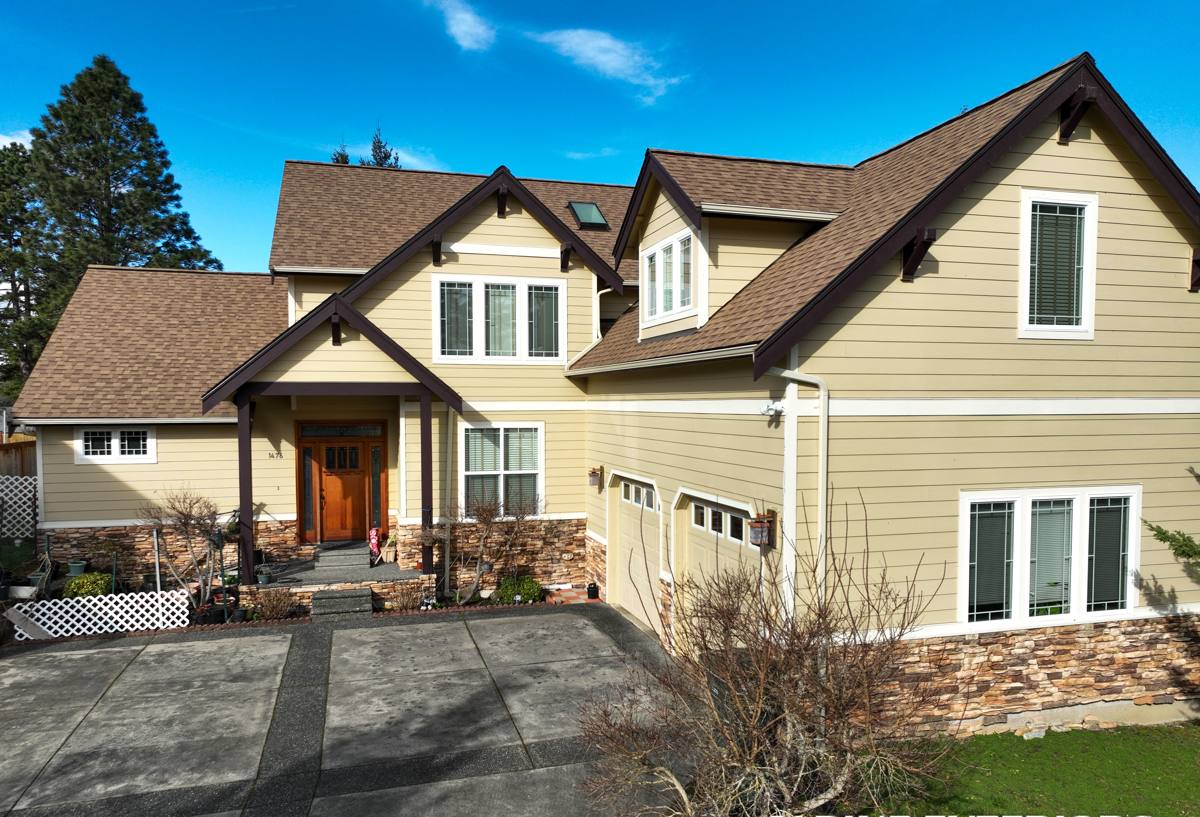
What Salt Air, Driving Rain, and Moss Actually Do to Siding
Salt Air
Airborne salt is corrosive to metal fasteners, flashing, and trim hardware, and it degrades certain paint and coating systems faster than a standard inland exposure would. On older or lower-grade siding products, this shows up as chalking, fading, or a chronic dull, weathered look no amount of pressure washing fixes. Salt exposure doesn't rot wood by itself, but it accelerates the breakdown of finishes that are supposed to be a home's first line of defense against everything else on this list.
Driving Rain
Birch Bay's exposure to wind coming off the water means rain doesn't just fall on siding — it's pushed into laps, seams, and butt joints under pressure. Siding systems that rely on gravity alone to shed water (as opposed to a properly lapped, flashed, and sealed assembly) start to leak at exactly those joints. Once water gets behind the cladding, it doesn't evaporate quickly in our climate — it sits against sheathing and framing, and that's where real structural damage begins.
Moss
Shaded north and east elevations, tree-lined lots, and the persistent damp common to this part of Whatcom County create ideal conditions for moss and algae growth on siding surfaces. Beyond the cosmetic issue, moss holds moisture directly against the siding surface for extended periods, which is exactly the kind of sustained dampness that breaks down caulk, softens under-performing substrates, and keeps painted surfaces from ever fully drying between rain events.
Signs a Birch Bay Home Needs Siding Repair
- Soft, spongy, or visibly deteriorating sections when pressed — especially near the bottom courses, around window and door trim, and at inside corners
- Cracked, gapped, or missing caulk at joints, seams, and penetrations (hose bibs, vents, light fixtures)
- Persistent moss or algae staining that returns quickly after cleaning
- Bubbling, peeling, or chalking paint that goes beyond normal weathering
- Visible warping, bowing, or separation between panels or boards
- Discoloration or staining on interior walls near exterior corners — often a sign water has already gotten behind the siding
- Fastener heads showing rust streaks or backing out of the surface
- A musty smell near exterior walls, particularly after heavy rain
What a Correct Repair Actually Involves
A siding repair that only addresses the visible surface tends to fail again within a season or two, especially in an exposure like Birch Bay's. A repair worth doing addresses three layers, not one:
1. Diagnosis Behind the Surface
Before anything gets cut out or replaced, we determine how far the damage actually extends. Visible rot or soft siding is often just the edge of a larger moisture problem — the sheathing, house wrap, or framing behind it may also need attention. Patching over hidden damage doesn't fix it; it just hides it again.
2. Correcting the Water Path, Not Just the Symptom
If siding failed because water was getting behind it, replacing the damaged boards without correcting the flashing, lap sequence, or sealant detail that let water in guarantees the same failure will happen again — often in the same spot. Repair work in a high-exposure area like Birch Bay has to fix the underlying water management, not just the cosmetic damage.
3. Matching Material and Finish
Repaired sections need to match the surrounding siding in profile, exposure, and finish as closely as possible — both for appearance and so the repaired area weathers at the same rate as the rest of the wall. Mismatched patch jobs are a common sign of repair work done in a hurry.
Repair vs. Replacement: How We Make the Call
Not every damaged section needs a full re-side, and not every repair is worth doing instead of replacement. The honest answer depends on how much of the wall is affected and what's driving the damage.
| Factor | Favors Repair | Favors Replacement |
|---|---|---|
| Extent of damage | Isolated to one or two areas | Spread across multiple elevations |
| Underlying cause | Single failed joint or fastener issue | Systemic water intrusion or product-wide failure |
| Age and material of existing siding | Newer, still-sound material elsewhere on the home | Original material near or past its service life |
| Sheathing/framing condition | Dry, undamaged behind the affected area | Soft sheathing or framing found during diagnosis |
| Moss/algae history | Surface-level, manageable with maintenance | Chronic, recurring despite cleaning |
We'll always tell you plainly which category your home falls into. If a repair will genuinely hold up, we'll recommend it — there's no upside for us in replacing siding that doesn't need it.
Why We Only Repair and Replace With James Hardie Fiber Cement
When we're called out for a siding repair in Birch Bay, we're often looking at whatever product was on the home originally — sometimes vinyl, sometimes an older fiber cement product, sometimes primed wood trim that was never meant to handle this kind of coastal exposure. Where a repair calls for new material — a damaged section, a full elevation, or trim replacement — we use James Hardie fiber cement, and we don't install anything else.
That's a deliberate standard, not a brand preference. Hardie's fiber cement is non-combustible, engineered specifically for wet marine climates through its HZ5 product line, and finished with a factory-applied ColorPlus coating that's built to hold color and resist the fading salt air causes in field-applied paint. It carries a strong transferable warranty when installed to Hardie's specifications. In an exposure like Birch Bay's — where salt air, driving rain, and near-constant moss pressure are working against the siding every day of the year — we want repairs and replacement sections built from a material engineered for exactly that environment, not general-purpose siding that happens to be available.
Our Process for Birch Bay Repair Work
- On-site assessment — We inspect the affected area and surrounding sections, checking for hidden moisture damage, not just the visible problem.
- Honest diagnosis — We tell you what's actually wrong, what caused it, and whether repair or replacement is the right call — with our reasoning, not just a recommendation.
- Scope and estimate — A clear, written estimate covering material, labor, and any sheathing or flashing work the diagnosis uncovered.
- Correct the water path — Any underlying flashing, lap, or sealant issue gets fixed as part of the repair, not left for next time.
- Install and match — Repaired sections are installed to spec and matched to the surrounding siding as closely as possible.
- Walkthrough — We show you what was done and what to watch for going forward, especially around moss-prone areas.
Why Hiring a Crew That Already Works Birch Bay Matters
Siding repair in a marine-exposed community isn't the same trade as siding repair in a sheltered inland neighborhood. A crew that regularly works Birch Bay and the surrounding Whatcom County coastline already knows which elevations tend to take the worst of the wind-driven rain, how aggressively moss builds back in shaded exposures here, and what correct flashing and lap detail looks like for a home that's fighting salt air year-round. That local pattern recognition shortens the diagnosis, and it means the repair is built for the exposure your home actually has — not a generic assumption about how siding fails.
It also means accountability. A local crew is going to be back in the area, working on neighboring homes, standing behind work that's visible to the same community it's part of.
Maintaining Repaired Siding in a Coastal Exposure
- Rinse salt residue and grime off siding periodically, especially on elevations facing the water
- Keep gutters and downspouts clear so water isn't overflowing onto siding below
- Trim back vegetation and tree cover where possible to reduce shaded, damp conditions that feed moss
- Inspect caulking at joints and trim annually — this is usually the first thing to fail in a driving-rain exposure
- Address soft spots or discoloration early; the cost and scope of repair grow quickly once water gets behind the siding
If you're seeing soft spots, recurring moss, failing caulk, or discoloration on your Birch Bay home's siding, it's worth having it looked at before the damage spreads further behind the wall. We offer free, no-pressure estimates — an honest look at what's going on and what it would take to fix it right, with no obligation to move forward.