 Bellingham
 Storm Damage Roofing in Birch Bay Has Its Own Rules
Birch Bay sits right up against the water, and that changes what a roof goes through over the course of a year. Homes a few miles inland in Bellingham deal with plenty of rain, but a roof on or near the bay also takes on salt-laden air, unobstructed wind off the water during winter storms, and a longer stretch of damp, shaded months that keep moss and moisture active almost year-round. Storm damage repair here isn't just about patching what broke in the last windstorm — it's about understanding why that spot failed first, and making sure the repair holds up against the same conditions next winter.
We work on roofs throughout Whatcom County, and Birch Bay comes with its own pattern of problems: wind-driven rain finding its way under lifted shingle tabs, fasteners and flashing corroding faster near the shoreline, and moss quietly working its way under shingle edges during the wet season until a storm finally exposes the weak spot. A good repair addresses the storm damage and the underlying cause, not just the visible hole or missing shingle.
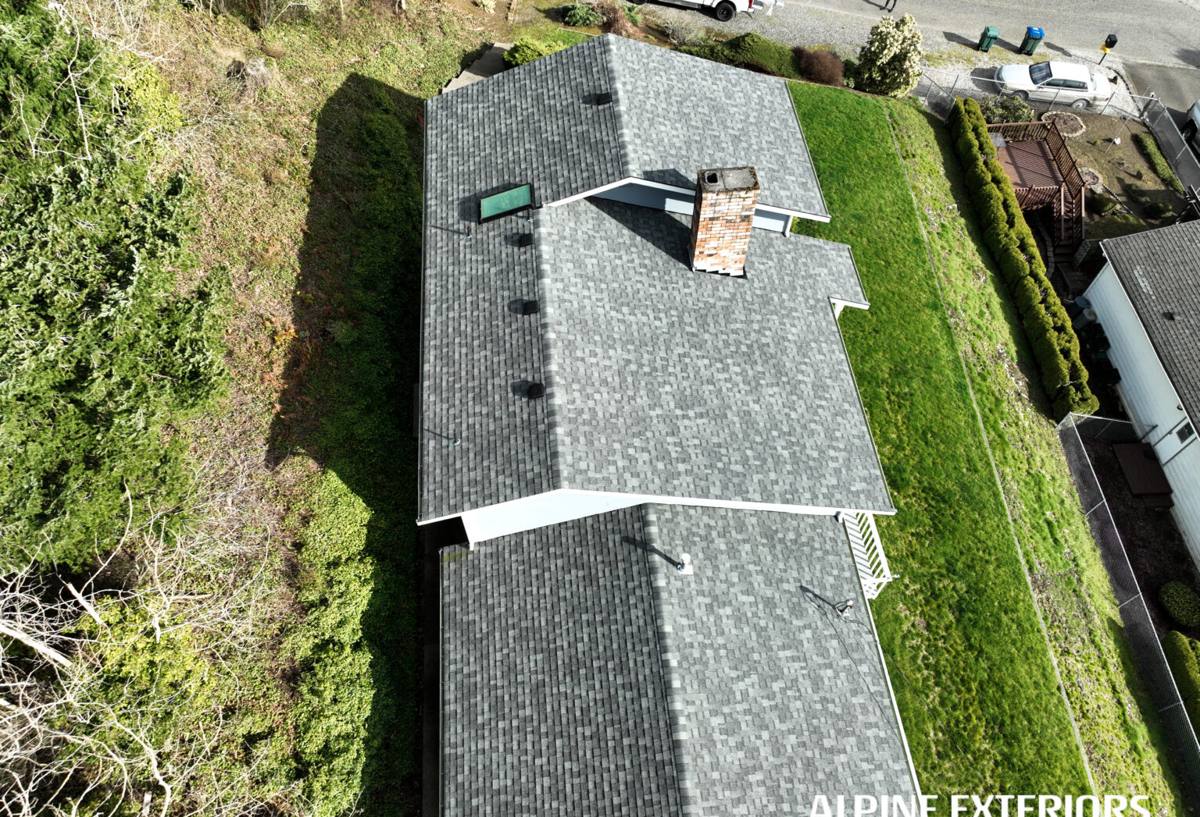
What Storm Damage Actually Looks Like on a Roof Out Here
Not all storm damage is obvious from the ground. Some of it is a missing shingle or a tarp-worthy hole. A lot of it is quieter and shows up later as a leak, a stain on a ceiling, or soft decking discovered during an unrelated repair.
Common damage patterns after a windstorm or heavy blow
- Shingles lifted, creased, or torn loose along ridges and edges where wind uplift is strongest
- Granule loss from wind-driven rain and debris, leaving bald patches that age the shingle early
- Flashing pulled away or bent around chimneys, skylights, and roof-to-wall transitions
- Gutters pulled loose or overwhelmed, sending water back up under the roof edge
- Branch or debris strikes that punch through the roofing layer, sometimes into the decking
- Fastener heads backed out or corroded, especially on older roofs closer to the water
The tricky part is that storm damage and ordinary wear-and-tear often show up in the same places at the same time. A storm may be what finally causes a leak, but the shingle underneath it might have already been thinned by years of moss and moisture. Repairing storm damage without accounting for that pre-existing condition is how homeowners end up calling about the same leak twice.
Why Moss Season Complicates Storm Repair
Whatcom County's long, wet, mild winters are exactly what moss needs to establish itself, and Birch Bay's shaded lots and marine humidity only extend that window. Moss doesn't just sit on top of a roof looking bad — it holds moisture against the shingle surface, works its way under tabs and edges, and gradually lifts and loosens the shingle's seal. A roof that would otherwise shrug off a windstorm becomes far more vulnerable once moss has been quietly prying up shingle edges for a season or two.
This is why we always look past the immediate storm damage when we're called out. If moss growth is present, we check how far it's spread, whether it's already loosened the shingle seal in nearby areas, and whether the repair needs to include moss removal and treatment so the same spot doesn't fail again during the next system that rolls through.
What a Correct Storm Repair Actually Involves
A rushed storm repair is easy to spot a year later: mismatched shingles, sealant smeared over a problem instead of a proper flashing detail, or a patch that doesn't tie into the surrounding roofing system. Doing it right takes a bit more time up front but holds up.
Steps we don't skip
- Full roof inspection, not just the damaged area — storms rarely hit only one spot
- Check the decking underneath for soft spots or water staining before re-covering anything
- Match shingle type, weight, and color as closely as possible so the repair blends and performs the same as the surrounding field
- Replace or re-seat flashing correctly at valleys, walls, and penetrations rather than relying on sealant alone
- Confirm proper underlayment coverage in the repaired section, especially at eaves and valleys where wind-driven rain concentrates
- Clear debris and treat any moss found nearby so it doesn't undermine the new work
Skipping any one of these steps doesn't always cause an immediate failure — it usually shows up as a leak during the next big storm, once the repair has had a season to be tested.
Our Process, Start to Finish
When a Birch Bay homeowner calls us after a storm, the process is straightforward and we try to move fast, since a compromised roof only gets worse the longer it sits.
- Initial call and scheduling — we ask what you're seeing (missing shingles, a leak, visible debris damage) and get a visit scheduled, prioritizing active leaks
- On-site inspection — we walk the full roof, not just the obvious damage, and check the attic or ceiling below if there's any sign of water intrusion
- Straight explanation — we tell you what we found, what's storm-related versus pre-existing wear, and what your real options are
- Written estimate — a clear scope of work and cost range before anything starts, no surprise add-ons once the roof is opened up
- Repair work — matched materials, proper flashing and underlayment detail, and cleanup when we're done
- Follow-up — if we spot early signs of a larger issue (widespread moss, aging shingles, deck damage beyond the repair area), we'll tell you honestly rather than let it become next winter's emergency call
Repair or Replace? What Actually Drives That Decision
Storm damage is often the moment homeowners first ask whether a repair even makes sense, or whether the roof is old enough that replacement is the smarter move. There's no universal answer, but a few factors consistently tip the decision one way or the other.
| Factor | Leans Toward Repair | Leans Toward Replacement |
|---|---|---|
| Roof age | Under 12-15 years, in otherwise good condition | Nearing or past the shingle's expected service life |
| Extent of damage | Isolated to one section or slope | Scattered across multiple slopes or widespread granule loss |
| Moss history | Minor, treatable growth | Long-term moss damage affecting shingle seal broadly |
| Decking condition | Solid, dry decking under the damaged area | Soft, stained, or rotted decking found during inspection |
| Shingle availability | Matching shingles still available or close enough | Discontinued product, visible mismatch unavoidable |
We'll always give you our honest read based on what we actually find on your roof — not a standard sales pitch toward the bigger job. Plenty of storm damage in Birch Bay is a legitimate, contained repair. Some roofs are simply at the point where a patch is a short-term fix on a roof that needs full attention within the next couple of years, and we'll say so plainly.
Insurance Claims and Documentation
Storm damage repairs frequently involve a homeowner's insurance claim, especially after a named windstorm or a documented weather event. We photograph damage before starting work, keep notes on what we found and why it's consistent with storm impact versus ordinary aging, and can provide a written scope of repair that homeowners can submit with a claim. We're not adjusters and don't represent the insurance company, but clear, honest documentation makes the claims process smoother on your end, and it's part of doing the job right regardless of whether insurance is involved.
Why Hiring a Crew That Already Works Birch Bay Matters
A roofing crew based out of Bellingham that regularly works Birch Bay brings a few real advantages over an out-of-area crew chasing storm work after a big blow comes through the region.
- We already know how exposed a given stretch of the bay is to wind and driving rain, which affects how we detail flashing and shingle overlap
- We're familiar with the salt-air corrosion pattern on fasteners and metal flashing near the water and use materials suited to it
- We can respond faster because we're not traveling in from out of the area after a regional storm event, when demand spikes
- We're accountable locally — this is our home region, not a one-time job we drive away from
After a significant storm, roofing contractors from outside the area sometimes come through offering fast, cheap repairs. Some of that work is fine. But a contractor who isn't local has no track record here, no reason to prioritize a callback if something's wrong with the repair, and often no real familiarity with how a Birch Bay roof behaves differently than one further inland. Checking for a Washington contractor license, current liability insurance, and a real local address and phone number is worth the extra five minutes before signing anything.
After the Repair: Keeping It From Happening Again
A solid storm repair is only half the equation in a place like Birch Bay. The other half is basic upkeep that keeps moss and moisture from setting up the next failure.
A simple post-repair maintenance checklist
- Clear gutters at least twice a year, more often if you're under trees, so wind-driven rain has somewhere to go
- Have moss growth treated before it spreads under shingle edges, not after
- Check flashing around chimneys and skylights annually for lifting or corrosion, especially on roofs closer to the shoreline
- Trim back branches that could strike the roof in high wind
- After any major windstorm, do a visual check from the ground for obviously missing or lifted shingles
- Address small leaks immediately — a small stain today is cheaper than decking replacement next year
None of this eliminates storm risk entirely, but it keeps a roof in the condition where it can actually handle what Whatcom County's weather sends its way, instead of failing at the first hard blow.
Get a Straight Answer on Your Roof
If a recent storm left you with missing shingles, a leak, or just some peace of mind you'd like to have before winter weather picks back up, we're happy to take a look. We'll give you a clear, honest assessment of what's storm damage, what's pre-existing wear, and what it actually takes to fix it right — no pressure, no upsell. Reach out using the form below to schedule a free estimate.