 Bellingham
 Window Installation for Birch Bay's Waterfront Climate
Birch Bay sits directly on the water in northern Whatcom County, and that location changes what a window installation actually needs to hold up to. Homes here take on salt-laden marine air pretty much year-round, rain that gets driven sideways into wall assemblies and window openings rather than falling straight down, and a moss and mildew season that can run most of the year on shaded or north-facing elevations. A window that's simply set into an opening and caulked around the edges might look fine on install day, but in this environment that shortcut usually shows up as a leak, a soft sill, or a fogged pane within a few wet seasons.
We install windows across Whatcom County, and Birch Bay's waterfront exposure is one of the more demanding conditions we build for — not because any particular window product can't handle it, but because the flashing, sealing, and fastening details around the window have to be right the first time. This page covers what a correct window installation actually looks like for Birch Bay homes: what the climate asks of it, how new construction and replacement work differ, and why local experience with this specific stretch of coastline matters.
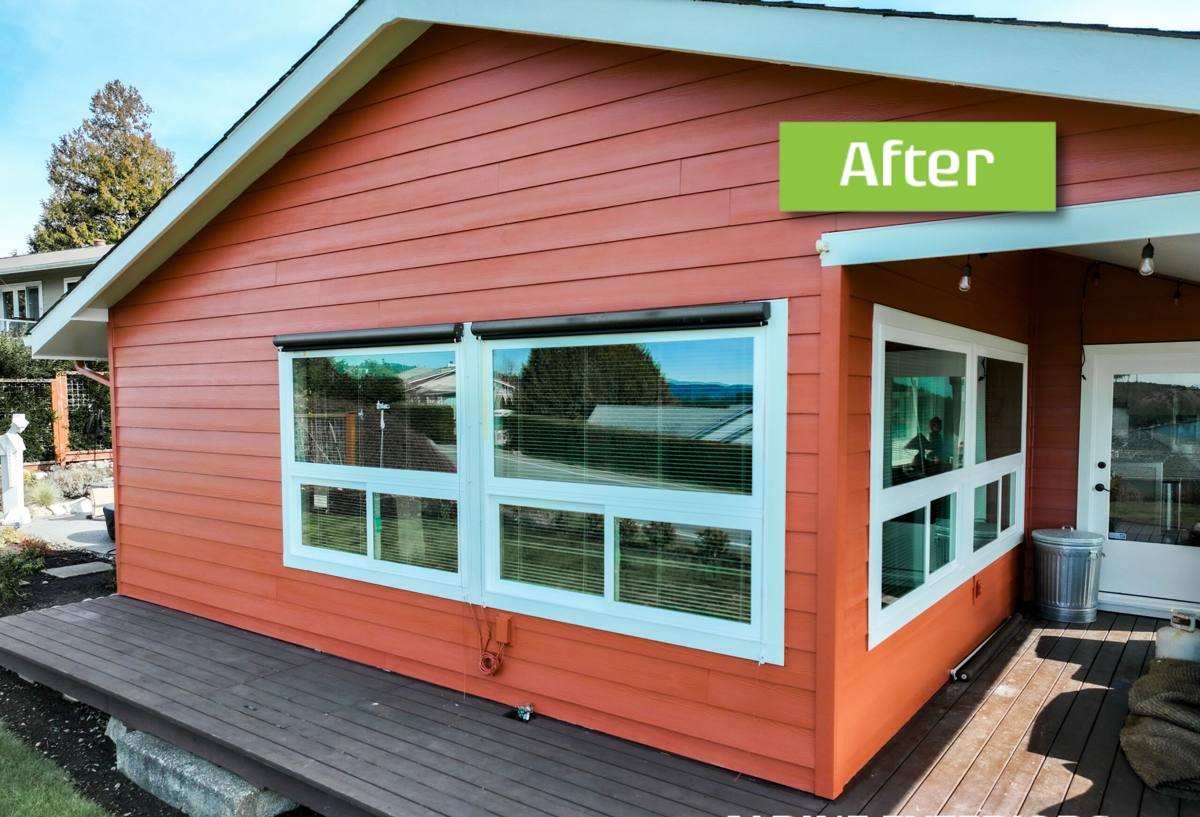
What Birch Bay's Exposure Actually Does to a Window
Salt Air and Hardware Corrosion
Direct waterfront exposure means Birch Bay homes take on more sustained salt contact than properties even a short distance inland. That salt works on window hardware, screen frames, and fasteners over time, and it's especially hard on lower-grade metal components that weren't finished with coastal exposure in mind. Locks, cranks, and hinges that stiffen up or start pitting after a few years are usually the earliest sign that a window's hardware wasn't built for this level of salt exposure.
Wind-Driven Rain at the Flashing Line
Being on open water also means Birch Bay gets more wind than sheltered inland areas, and wind pushes rain sideways into window openings instead of letting it run straight down and off. That sideways load tests the flashing and sealing around a window far more than a simple rainfall total would suggest. Most leaks we find around windows in this area trace back to a flashing detail — a missing sill pan, a head flashing that wasn't lapped correctly over the housewrap — rather than a defect in the window unit itself.
A Long Moss Season and Sill Moisture
Shaded walls, tree cover, and near-constant dampness give moss and mildew a season that runs longer here than in a drier climate. On windows, that shows up as staining and slow deterioration at the sill and lower corners, especially on wood-framed units or on any sill that doesn't pitch outward enough to shed water on its own. It's a gradual problem, which is exactly why it tends to go unnoticed until paint starts failing or the sill feels soft underfoot.
New Construction, Replacement, or Retrofit: Getting the Approach Right
Birch Bay's housing stock is a genuine mix — older waterfront cottages, homes that have been added onto over the years, and newer construction built to take advantage of the view. That mix means the right window installation approach isn't the same from house to house, and getting it right starts with an honest read of what a given opening actually needs.
| Approach | Best Fit | What It Involves |
|---|---|---|
| New construction (nail-fin) | New builds and additions with open wall framing | Window flashing integrated directly with the housewrap and sheathing before siding goes on |
| Full-frame replacement | Older openings with existing water damage or an outdated frame | Removal down to the rough opening, full flashing rebuild, new frame set from scratch |
| Insert replacement | Sound, properly flashed existing frames on newer or well-maintained homes | New window fits into the existing frame with less disruption to surrounding siding and trim |
Insert replacement is faster and less invasive, and it's a perfectly good option when the existing frame is structurally sound and was flashed correctly to begin with. The trouble is that on a lot of older Birch Bay homes, the original flashing wasn't built for this level of wind-driven rain, and an insert replacement over a bad flashing detail just seals the same problem up behind a new window. We check the condition of the existing frame and flashing before recommending either option — we don't default to the faster, cheaper answer if it means leaving a moisture problem in the wall.
Frame and Glass Choices That Make Sense on the Water
Frame material matters more on a wind-exposed waterfront wall than it does a few miles inland, since the sustained salt and moisture load work harder on cheaper components over time. Vinyl and fiberglass frames generally hold up to that exposure with less ongoing upkeep than an all-wood exterior finish, which is why we lead with them on weather-facing walls in Birch Bay — though a wood-clad interior paired with a low-maintenance exterior cladding can still make sense when the interior look matters and the frame is properly protected. On the glass side, a good low-e coating and a gas-filled sealed unit cut down on both energy loss and the interior condensation that shows up on colder nights, and any window we install meets Washington's energy code requirements for the assembly. None of that replaces correct flashing and installation, but on a wall that faces open water and takes the brunt of the weather, it's worth choosing deliberately instead of defaulting to whatever's cheapest.
Installation Details We Treat as Non-Negotiable Here
In a climate this consistently wet and salt-exposed, the difference between a window that lasts decades and one that's leaking behind the wall in a few years almost never comes down to the brand on the label. It comes down to whether these details were followed on install day:
- A sill pan pitched to carry water outward and away from the framing, not just a flat surface under the window
- Head flashing lapped correctly over the housewrap or building paper so water sheds down and out, never up and in
- Jamb flashing tied into the surrounding wall assembly, not left to caulk alone to keep water out
- Weep holes and drainage paths left clear and functional rather than sealed shut during installation
- Corrosion-resistant fasteners and hardware rated for sustained salt exposure, not standard interior-grade hardware
- Air sealing and insulation around the frame that closes drafts without trapping moisture against the framing
None of this adds meaningfully to the cost of a window job relative to the unit itself. What it does add is time and attention on install day — which is exactly the part that gets skipped on a rushed job, and exactly the part a homeowner can't easily inspect once the trim goes back on.
Signs a Birch Bay Home's Windows Need Attention
- Fogging or condensation trapped between panes, which usually means a failed seal on a double- or triple-pane unit
- Noticeable drafts or a cold spot near a closed window
- Soft, discolored, or spongy trim and sill material, particularly on shaded or north-facing walls
- Windows that have gotten hard to open, close, or latch
- Moss or dark staining building up on sills and trim faster than it should
- Visible daylight, cracked caulk, or gaps around the frame viewed from inside
- Water staining on interior walls or ceilings near a window after a windy storm
Any one of these is worth having looked at. Caught early, most of them are a repair or a reseal. Left through another wet season on a waterfront property, several of them turn into framing damage that costs a lot more to fix than the window itself.
What Actually Moves the Cost on a Birch Bay Window Project
Window pricing depends on more than the unit itself, and it's worth understanding what's actually driving the number before you compare quotes.
| Factor | Why It Matters |
|---|---|
| Installation approach | Full-frame replacement takes more labor and material than an insert replacement or new-construction install |
| Existing frame and flashing condition | Rot or past water damage found during removal needs repair before a new window goes in |
| Frame material | Vinyl, fiberglass, wood, and aluminum carry different upfront costs and different long-term upkeep in salt air |
| Number and size of openings | Larger units and picture windows take more time and material to flash correctly |
| Access and site conditions | Waterfront lots with limited access or elevation changes can add labor time |
| Energy performance | Higher-performance glass and frame packages cost more upfront but earn their keep on a wind-exposed waterfront wall |
We'll walk your specific windows and give you real numbers based on what we actually find, rather than a rough estimate based on window count alone — two homes with the same number of windows can land very differently once frame condition and access are factored in.
Our Process for a Birch Bay Window Installation
- On-site assessment — we look at each window's current condition, the state of the surrounding frame and flashing, and which installation approach actually fits
- Honest recommendation — insert replacement, full-frame replacement, or new construction, explained with the reasoning, not just the upsell
- Material and product selection — frame material and glass package matched to the specific wall's sun, shade, and wind exposure
- Removal and opening prep — the old unit comes out carefully, and any hidden rot or flashing failure gets addressed before the new window goes in
- Installation and flashing — sill pan, jamb flashing, and head flashing sequenced correctly and integrated with the existing wall assembly
- Trim, finish, and final walkthrough — exterior trim matched to the surrounding siding, and a walkthrough so you know exactly what was done
Why a Crew That Already Works Birch Bay Matters
Manufacturer installation guidance is written for average conditions in a moderate climate, and Birch Bay's waterfront exposure isn't average. A crew that has installed windows across this stretch of coastline through multiple wet seasons already knows which walls need extra flashing attention because of wind exposure, how much pitch a sill pan actually needs in a climate this wet versus what a generic install sheet calls for, and which older homes in the area are likely to have flashing that needs correcting rather than covering up. That judgment doesn't show up in a sales conversation, and it's the difference between windows that are still performing cleanly in fifteen years and ones showing drafts and soft trim in five.
It also means working with a crew that treats a window as part of the whole exterior system rather than an isolated product — because on a waterfront property, a window's flashing has to work with the siding and wall assembly around it, not just with the window itself.
If you're weighing a window installation or replacement for a Birch Bay home, we're happy to take a look at your specific windows and give you a straightforward, no-pressure estimate. There's a form below — reach out and we'll get a time on the schedule.