 Bellingham
 Birch Bay's Waterfront Location Puts Extra Load on Windows
Birch Bay sits right on the water along Whatcom County's coastline, and that location is exactly what makes window replacement here different from a typical inland job. Homes facing the Strait of Georgia take a steady diet of salt-laden air, wind-driven rain, and long stretches of damp, overcast weather that never really lets materials dry out. Add in a moss season that can run most of the year in this part of Washington, and you've got a set of conditions that will find every weak point in a window's frame, seal, or flashing detail.
None of this means windows in Birch Bay need to be exotic or overbuilt. It means the material choice, the installation details, and the sealing work have to be done with the coast in mind, not treated the same as a job twenty miles inland in Bellingham. A window that would perform fine in a sheltered neighborhood can fail early on a bluff or waterfront lot if it wasn't installed with salt air and driving rain as the starting assumption.
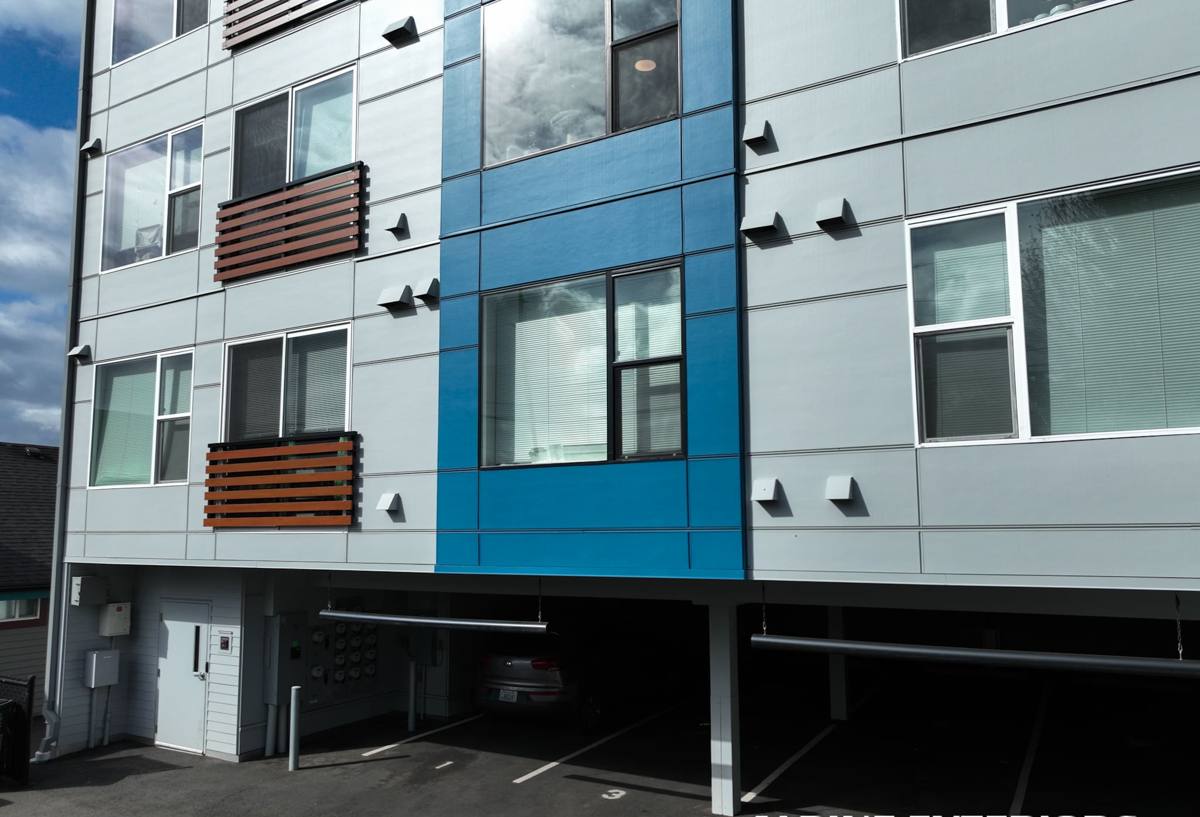
Signs a Birch Bay Home Needs Window Replacement
Coastal exposure tends to show up as a handful of specific symptoms rather than one obvious failure. Homeowners near the water most often notice:
- Fogging or a permanent haze between the panes of double-pane glass, meaning the seal has failed and the gas fill or insulating air gap is gone
- Corroded or stiff hardware — locks, cranks, and hinges that used to move smoothly and now stick or have visible pitting
- Soft, discolored, or spongy wood at the sill or lower frame corners, usually where wind-driven rain has been finding a way in for years
- Drafts or a noticeable pressure difference when storms come off the water, even with the window latched
- Moss or dark streaking building up in the tracks, weep holes, or exterior trim, which holds moisture against the frame long after the rain has stopped
- Visible daylight or a widening gap between the sash and frame as the unit ages and settles
Any one of these on its own might just call for minor repair. Several at once, especially on a window that's original to an older home, usually means the frame and seals have reached the point where replacement is more cost-effective than another round of patching.
What a Correct Window Replacement Job Actually Involves
Window replacement gets treated as a simple swap more often than it should be. On a coastal property, the details below are what separate a window that lasts fifteen-plus years from one that starts failing again in three or four.
Removing the old window without hidden damage
Before a new window goes in, the old one has to come out cleanly, and the opening has to be checked for rot, water staining, or compromised framing. On homes with any history of water intrusion — common near the water — this step often reveals soft sheathing or damaged framing that needs to be repaired before anything new is installed. Skipping this check just seals existing damage behind a new window.
Flashing and sealing for wind-driven rain
Standard flashing details that work fine in a sheltered yard aren't always enough when rain is being pushed sideways by wind coming off the water. A correct install includes a sloped sill pan to direct any water that gets past the window back outside, properly lapped flashing tape integrated with the house wrap, and backer rod and sealant at the right joints — not just a bead of caulk around the outside trim.
Fastening, shimming, and squaring the unit
A window that isn't shimmed level and square will bind, won't lock tightly, and will develop gaps at the corners over time. It also puts uneven stress on the seals, which shortens their life. This is a step that takes real time to do properly and is the first thing that gets rushed on a low-quality install.
Interior and exterior trim-out
The trim-out isn't just cosmetic — it's the final layer that keeps water from tracking behind the window on the exterior side, and it's what gives an accurate, draft-free fit on the interior. Gaps here are a common source of the drafts homeowners notice on windy days.
Choosing Window Materials for Salt Air and Coastal Moisture
There isn't one "correct" window material for every home, but some perform noticeably better than others in a salt-air, high-moisture environment. The comparison below reflects how these materials tend to hold up under the conditions Birch Bay homes actually see, not a generic national ranking.
| Material | Salt air / corrosion resistance | Maintenance | Typical lifespan |
|---|---|---|---|
| Vinyl | Very good — won't corrode or rust, minimal metal hardware exposed to weather | Low — occasional cleaning, no painting or sealing | 20-30 years |
| Fiberglass | Excellent — dimensionally stable, resists moisture and salt exposure well | Low — factory finish holds up without repainting | 30-40 years |
| Wood (with proper cladding or finish) | Fair — needs consistent maintenance to prevent rot near the coast | High — refinishing and inspection needed regularly | 15-25 years, shorter if maintenance lapses |
| Aluminum-clad wood | Good on the exterior face, but hardware and uncladded joints are still exposed | Moderate | 20-30 years |
We generally steer homeowners on exposed, waterfront, or bluff-facing lots away from bare aluminum-frame windows. Aluminum conducts heat and cold efficiently, which means more condensation on the interior in our damp climate, and its hardware and fasteners are more prone to corrosion under sustained salt exposure. That's a practical trade-off call based on how the material behaves here, not a knock on aluminum as a product — it performs fine in drier climates where thermal transfer and salt exposure aren't factors.
Our Window Replacement Process
- On-site assessment. We look at each window's condition, the surrounding framing, sun and wind exposure, and how the home has weathered so far.
- Measurement and product selection. Every opening gets measured individually — older homes especially rarely have perfectly uniform openings — and we walk through material, glass, and style options suited to that specific exposure.
- Removal and opening prep. Old windows come out, and any rot, staining, or framing damage gets addressed before the new unit goes in.
- Installation, shimming, and squaring. Each window is set plumb, level, and square, then fastened per manufacturer specification.
- Flashing and sealing. Sill pans, flashing tape, and sealant are installed to shed wind-driven rain, integrated properly with the existing wall assembly.
- Trim-out, interior and exterior. Finish work is completed on both sides, and hardware is tested for smooth operation.
- Final walkthrough. We check every window with you before considering the job done, including operation, locking, and appearance.
What Drives the Cost of Window Replacement in Birch Bay
Costs vary enough from house to house that a flat per-window number isn't honest. The factors below are what actually move the price up or down on most jobs.
| Cost factor | Why it matters |
|---|---|
| Material (vinyl vs. fiberglass vs. wood) | Fiberglass and wood cost more upfront than vinyl; the right choice depends on exposure and budget |
| Window size and style | Large picture windows, bays, or custom shapes cost more than standard double-hung or slider units |
| Glass package | Double-pane vs. triple-pane, Low-E coatings, and gas fills add cost but also add performance in our climate |
| Condition of the existing opening | Rot repair or framing work found during removal adds labor beyond a straightforward swap |
| Accessibility | Second-story, hard-to-reach, or waterfront-facing windows with wind exposure can add time and staging cost |
| Number of windows | Whole-home replacement typically brings a better per-unit cost than one or two at a time |
As a general range, homeowners in our service area typically see individual window replacement costs from the low hundreds to over a thousand dollars per opening depending on the factors above, with whole-home projects varying widely based on size and material. We'll always give you an itemized, honest number for your specific home rather than a rough guess.
Why Local Experience in Birch Bay Matters
A crew that regularly works this stretch of Whatcom County coastline already knows which details matter here: how much wind exposure a given orientation gets, how moss and moisture behave on this side of the county, and what level of flashing and sealing actually holds up rather than just meeting minimum code. That familiarity shows up in fewer callbacks and fewer surprises once the weather turns.
It also matters for permitting and scheduling. Whatcom County and local jurisdictions have their own permitting requirements for window replacement depending on the scope of work, and a crew that's pulled permits in the area before knows what's expected without guesswork. For seasonal or part-time residents, working with a contractor who's reliably available and familiar with the area also means less coordination hassle from a distance.
Keeping Coastal Windows Performing After Installation
Good windows still need a bit of attention in a salt-air environment. A short seasonal routine goes a long way toward getting the full lifespan out of a new installation:
- Rinse exterior glass and frames periodically to remove salt film buildup, especially after storms
- Clear moss and debris from tracks, sills, and weep holes so water can drain instead of pooling against the frame
- Inspect exterior caulking and sealant once a year and touch up anywhere it's cracked or pulled away
- Lubricate hardware — locks, cranks, hinges — to prevent salt-air corrosion from seizing moving parts
- Check screens for corrosion or damage, especially on wind-exposed elevations
- Do a quick walk-around before the winter storm season to catch small issues before driving rain finds them
None of this is complicated, but skipping it is one of the most common reasons a good window underperforms its expected lifespan on the coast.
Ready for an Honest Look at Your Windows?
If you're dealing with fogged glass, stuck hardware, drafts, or just windows that are original to an older Birch Bay home, we're glad to take a look and give you a straightforward assessment — no pressure, no inflated scope. Use the form below to request a free estimate, and we'll walk you through what we see and what it would take to fix it right.