 Bellingham
 Building Decks for Birch Bay's Waterfront Conditions
Birch Bay sits close enough to the water that every deck built here has to deal with things a deck in a drier, inland part of Whatcom County never sees. Salt-laden air off the bay accelerates corrosion on fasteners and hardware. Driving rain off Georgia Strait finds its way into joints and end grain that would stay dry elsewhere. And the long gray stretch of fall through spring means moss and algae get a real head start on any horizontal surface that doesn't shed water fast. A deck built without those three factors in mind will look fine for a season or two, then start showing problems — soft spots, rust streaks, slick green film underfoot — well before it should.
We build and repair decks throughout the Bellingham area, and Birch Bay projects get the same attention to detail as everything else, adjusted for the fact that this is a saltwater-exposed neighborhood. That means different fastener choices, different attention to drainage and airflow under the structure, and a finish schedule that accounts for more moss pressure than a typical inland yard.
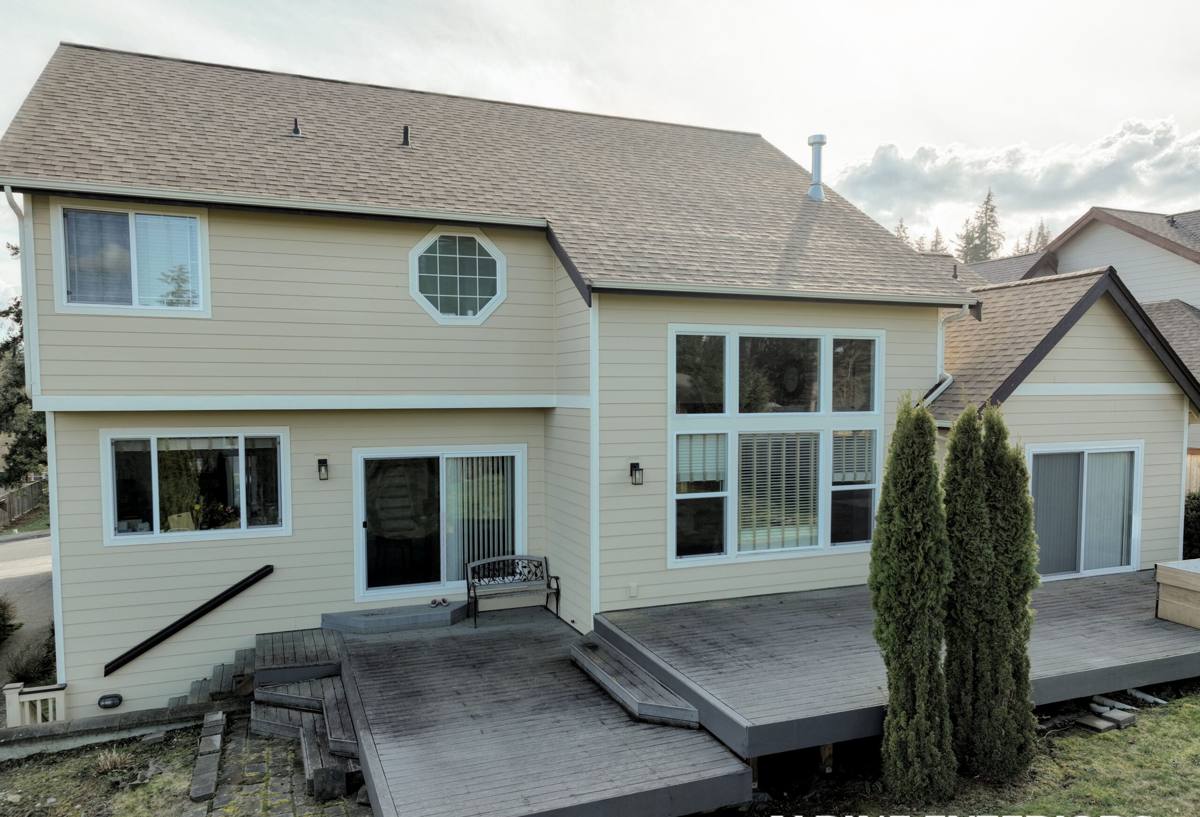
What Birch Bay's Climate Actually Does to a Deck
Salt Air and Corrosion
Homes within a mile or so of Birch Bay's shoreline get measurable salt exposure in the air, especially on windy days. Salt accelerates galvanic corrosion on any metal that isn't rated for it — cheap deck screws, unprotected joist hangers, and mismatched fastener types are the first things to fail. Once a fastener starts corroding, it weakens the connection long before it's visibly rusted through, which is part of why deck hardware failures often get discovered only when something moves underfoot.
Driving Rain and Moisture Intrusion
Whatcom County's rain doesn't just fall straight down — wind off the water regularly drives it sideways, which pushes moisture into places a calm rain never would: ledger board connections, the end grain of boards, stair stringers, and any gap where two pieces of wood meet without flashing or sealant. Wood that stays wet longer than it stays dry is wood that rots, and end grain absorbs water far faster than a flat board face.
Moss, Algae, and Surface Buildup
Long damp seasons with limited direct sun — common on shaded lots and north-facing decks around Birch Bay — give moss and algae time to establish. Beyond looking bad, a mossy deck surface holds moisture against the boards continuously and becomes genuinely slick, which is a real slip hazard on stairs and ramps.
What a Correctly Built Deck Looks Like Here
None of the issues above are exotic — they're well understood in coastal construction. The fix isn't a special product, it's building to the conditions instead of building to a generic spec sheet. On a Birch Bay project, that shows up in several specific decisions:
- Stainless steel or coated, marine-rated fasteners and hardware — not standard exterior-grade, which corrodes faster this close to salt air
- Flashing at every ledger board connection to the house, so the single highest-risk joint on the whole deck stays dry
- Proper board spacing and substructure airflow so wood can actually dry out between rain events instead of staying damp
- End grain sealed or capped, since end grain is where the fastest moisture absorption happens
- Grading and drainage under the deck so water doesn't pool against posts and footings
- A surface material and finish chosen with realistic expectations about moss and algae growth, not just appearance on install day
Decking Material Options for a Bay-Exposed Lot
There's no single "right" decking material for every Birch Bay home — it depends on budget, how much maintenance the owner wants to take on, and how exposed the site is. Here's how the common options actually compare under these conditions:
| Material | Moisture & Salt Behavior | Moss/Algae Resistance | Maintenance |
|---|---|---|---|
| Pressure-treated wood | Good if properly sealed and re-sealed; end grain is the weak point | Needs regular cleaning to stay ahead of moss | Annual cleaning, re-sealing every 1-3 years |
| Cedar | Naturally rot-resistant but still needs sealing near salt air | Moderate — still needs periodic cleaning | Sealing every 1-2 years, regular cleaning |
| Composite decking | Doesn't absorb moisture or rot; hardware still needs to be corrosion-rated | Better resistance, but still grows moss without airflow and cleaning | Occasional washing, no sealing needed |
| PVC decking | Fully moisture-proof board itself; same hardware rules apply | Good, with proper drainage and airflow | Lowest — mainly periodic washing |
Whatever material a homeowner chooses, the substructure and fastener decisions matter just as much as the decking itself. A composite deck built on corroding hardware or blocked drainage will still fail early — the surface material doesn't fix a substructure problem.
Framing and Substructure: Where Most Deck Failures Start
Homeowners naturally focus on the decking surface because that's what they see, but the framing underneath is where a deck actually lives or dies in a climate like this. Joists, beams, posts, and the connections between them take on constant moisture cycling — wet, dry, wet again — for eight or nine months of the year around Birch Bay. A few framing details matter more here than they would in a drier region:
- Joist hangers and structural connectors rated for the exposure, installed with matching fastener material — mixing metals accelerates corrosion on both
- Posts set on proper footings above grade, not buried directly in soil where they'll wick moisture constantly
- Beam-to-post connections detailed to shed water rather than trap it in a pocket
- Adequate clearance between the ground and the lowest framing members for airflow and future inspection access
This is also where cutting corners is hardest to spot after the fact — a deck can look perfectly finished on top while the framing underneath is already compromised. That's why an honest deck builder treats the substructure as the part of the job that actually determines how long the deck lasts, not just the part that has to pass a quick inspection.
Ledger Boards and Attachment Points: The Highest-Risk Connection
If a deck is going to fail structurally, it's most often at the ledger board — the piece that attaches the deck to the house itself. This connection carries a large share of the deck's total load, and it's also the joint most exposed to water intrusion, because it sits directly against the house's exterior wall. Done wrong, water gets behind the ledger, works its way into the house's rim joist or wall framing, and causes rot that's expensive to find and expensive to fix. Done right, flashing directs water away from that joint entirely, and the fasteners are sized and spaced to the actual load the deck will carry.
On a freestanding deck, this isn't a concern — but freestanding designs bring their own footing and post requirements that need to be sized correctly for wind and structural load, which matters on more exposed Birch Bay lots.
Our Process for a Birch Bay Deck Project
1. On-Site Assessment
We look at the lot's actual exposure — how close to the water, how much direct sun the deck area gets, existing drainage patterns, and (for a rebuild) what condition the current structure is in and why it failed.
2. Design and Material Selection
We talk through decking material, layout, railing style, and any stairs or multi-level elements, with honest tradeoffs on cost versus long-term maintenance for this specific site.
3. Framing Built to the Exposure
Corrosion-rated hardware, properly flashed ledger connections, and footings and posts sized for the load and the site — not a one-size-fits-all spec.
4. Decking, Railing, and Finish Work
Surface installation with attention to board spacing, end-grain protection, and drainage, finished according to whatever material was chosen.
5. Walkthrough
We go over the finished deck with the homeowner, including what maintenance schedule actually makes sense for a bay-exposed property — not a generic care sheet.
Repair, Rebuild, or Replace?
Not every deck problem around Birch Bay means starting over. The right call depends on what's actually failing:
| Situation | Usually Means |
|---|---|
| Surface boards worn, cupped, or mossy but framing is sound | Resurface — replace decking, keep the structure |
| Rust staining, loose railings, or soft spots at specific connections | Targeted repair of hardware and affected framing |
| Soft or spongy framing, rot at the ledger board, or posts settling unevenly | Rebuild — the structure itself is compromised |
| Deck was undersized, poorly attached, or never permitted correctly | Full replacement to current code and load standards |
An honest assessment up front saves money either direction — sometimes a deck that looks rough just needs new boards and hardware, and sometimes a deck that looks fine on the surface has a structural problem worth fixing before it gets worse.
Maintenance That Actually Fits This Climate
A deck built correctly for Birch Bay still needs upkeep — the climate doesn't go away after installation. A realistic maintenance rhythm looks like this:
- Rinse or lightly scrub the surface periodically to keep moss and algae from establishing, especially on shaded sections
- Check fasteners and hardware annually for early rust or corrosion, particularly after winter storm seasons
- Reseal wood decking on the schedule appropriate to the product — waiting too long lets moisture back into the boards
- Keep gutters and downspouts clear so runoff isn't dumping extra water directly onto or under the deck
- Trim back vegetation that's shading the deck and keeping it damp longer than it needs to be
Why Local Experience with Birch Bay Conditions Matters
A deck builder who mostly works inland, drier sites can still build a structurally sound deck — but they may not default to marine-rated hardware, or think through drainage the way a crew that regularly works this stretch of Whatcom County does. That experience shows up in small decisions made without being asked: which fastener to grab, how to detail a ledger flashing, where to add an extra gap for airflow. Those are the decisions that separate a deck that looks good on install day from one that still looks good in five years.
If you're planning a new deck, a rebuild, or you're not sure whether your current deck needs repair or replacement, we're happy to take a look and give you a straightforward assessment — no pressure, no inflated scope. Reach out using the form below for a free estimate.