 Bellingham
 Decking Built for Blaine's Coastline, Not a Generic Backyard
Blaine sits right on the water at the top of Whatcom County, and that location changes what a deck has to survive. Salt-laden air off the Strait of Georgia and Semiahmoo Bay works on fasteners, flashing, and railing hardware year-round, not just during storms. Add in driving rain off the water and a moss season that can run from October through May, and you have a set of conditions that punishes decking built to a generic national spec. A deck that would be fine in a drier inland town can start showing corrosion streaks, soft spots, or slick green film within a couple of seasons out here if it wasn't built with this specific exposure in mind.
We build and replace composite decks for homeowners around Blaine and the rest of Whatcom County, and we treat coastal exposure as the starting assumption, not an afterthought. That shows up in the hardware we specify, how we frame the substructure, and where we route water off the surface before it ever gets a chance to sit.
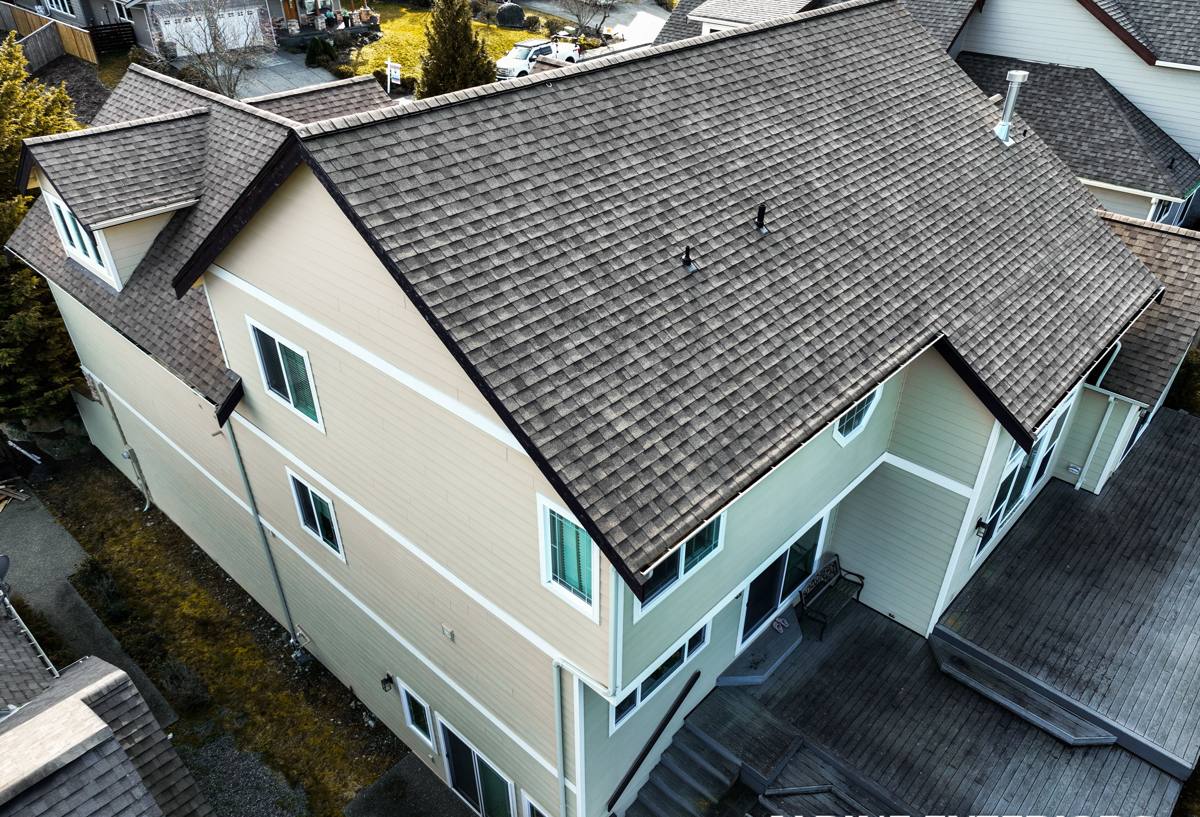
What Blaine's Climate Actually Does to a Deck
Salt Air and Metal Hardware
Composite boards themselves don't rust, but every deck has metal in it somewhere — joist hangers, structural screws, railing brackets, post bases. Standard galvanized hardware can start pitting and staining faster near the water than it would a few miles inland. Once corrosion starts on a hanger or bracket, it's a structural issue, not just a cosmetic one, because that hardware is what's holding the deck together.
Driving Rain and Water Intrusion
Rain in this part of Washington doesn't always fall straight down. Wind off the water pushes it sideways, which means it finds its way behind rim joists, under poorly flashed ledger boards, and into any gap where end grain or fastener heads are exposed. A deck that's technically "waterproof" on the walking surface can still be rotting from the inside if the framing and flashing details were rushed.
Moss, Algae, and Surface Grip
Long stretches of damp, shaded weather are exactly what moss and algae need to get established. On a deck, that's not just an appearance problem — a mossy or algae-slicked surface gets genuinely slippery, especially on stairs. The boards you pick and how much airflow the deck gets underneath both affect how fast that growth takes hold.
Why We Recommend Composite for Coastal Whatcom County Homes
Composite decking isn't automatically the right call for every project, but for homes exposed to salt air and constant moisture, it solves problems that wood decking struggles with. It won't splinter, it doesn't need annual staining, and quality composite boards resist the swelling and cupping that wood picks up from repeated wet-dry cycles. That said, composite isn't maintenance-free — it still needs to be cleaned periodically to stay ahead of moss and mildew, and not every composite product handles moisture the same way.
We steer away from lower-grade capped polymer boards in this specific climate for a practical reason: their core materials can be more sensitive to sustained moisture exposure at cut ends and fastener penetrations than mid- and top-tier composite lines. That's not a claim that any particular product fails — it's a maintenance and warranty-structure trade-off we've learned to weigh carefully before we put our name behind an install this close to saltwater.
Composite vs. Wood vs. PVC — Honest Trade-offs for This Climate
| Material | Salt Air Resistance | Maintenance | Typical Lifespan Here |
|---|---|---|---|
| Pressure-treated wood | Moderate — needs sealing to hold up | Annual cleaning and re-staining | 10-15 years with upkeep |
| Composite (mid/top-tier) | Strong when detailed correctly | Periodic wash-down, no staining | 25-30+ years, manufacturer-warrantied |
| PVC/vinyl decking | Very strong, fully synthetic | Low, but can look less natural | 25-30+ years |
Wood can still be the right choice for some homeowners, especially on a budget or for a specific look, and we'll build a solid wood deck when that's what fits the project. But for most Blaine homeowners dealing with year-round salt exposure, composite offers the best balance of appearance, low upkeep, and long-term performance.
What a Correct Composite Deck Build Involves Here
Substructure First
The framing underneath is where most coastal deck failures actually start, even though it's invisible once the boards go down. We use corrosion-resistant fasteners and hardware rated for exterior and coastal exposure, not standard interior-grade hardware, on every ledger connection, joist hanger, and post base. On any deck attached to the house, we pay close attention to ledger flashing — that's the single most common point where water gets behind the siding and starts rot that isn't visible until it's advanced.
Joist Spacing and Board Direction
Composite boards have manufacturer-specified joist spacing requirements, and going wider than spec to save material leads to bounce and premature sagging. We also think through board direction and drainage slope so water sheets off the surface instead of pooling, especially on covered or partially covered decks where sun exposure to dry things out is limited.
Airflow Underneath
A deck built low to the ground with poor ventilation underneath stays damp longer after every rain, which accelerates moss growth on the surface and slows drying of the framing below. Where grade and code allow, we build in enough clearance and venting to let air move underneath.
Fastening and Fascia Details
Hidden fastener systems keep the surface clean and reduce the number of exposed metal points where corrosion or water tracking can start. We finish fascia boards and picture-frame edges with the same coastal-rated hardware as the structural connections, since trim details are often where a deck starts to look worn first.
Our Process, Start to Finish
- On-site assessment — we look at existing framing (if it's a replacement), grade, drainage path, sun/shade exposure, and how close the deck sits to salt spray or prevailing wind.
- Material selection — we walk through board tiers, color options, and railing systems based on your budget and how much sun/shade the deck actually gets, since that affects heat retention and moss risk.
- Permitting — most deck rebuilds and new builds in Whatcom County and the City of Blaine require a permit, especially for attached decks or anything above a certain height. We handle that paperwork as part of the project.
- Demo (if replacing) — we remove old decking and inspect the framing underneath before deciding what gets reused versus rebuilt.
- Framing and flashing — corrosion-resistant hardware, correct ledger flashing, proper joist spacing per manufacturer spec.
- Decking and railing install — hidden fastener systems where applicable, picture-framed edges, and railing hardware rated for coastal exposure.
- Final walkthrough — we go over care instructions specific to the board you chose and answer questions before we consider the job done.
Cost Factors for a Blaine Composite Deck
Every deck is priced around size, complexity, and material tier, but a few factors matter more here than in a typical inland project:
| Factor | Why It Matters in Blaine |
|---|---|
| Hardware grade | Coastal-rated fasteners and hangers cost more than standard galvanized but resist salt corrosion far longer |
| Board tier | Mid/top-tier composite handles moisture at cut ends and fastener points better than budget capped polymer |
| Height and railing code | Elevated decks require code-compliant railing systems, which adds material and labor |
| Access and site conditions | Waterfront or sloped lots can complicate equipment access and footing work |
| Ledger vs. freestanding | Ledger-attached decks need careful flashing work against the house; freestanding decks avoid that risk but need their own footings |
We give straightforward, written estimates after seeing the site — we don't quote sight-unseen for a project this dependent on site-specific conditions.
Maintaining a Composite Deck Near the Water
Composite doesn't need staining or sealing, but "low-maintenance" isn't "no-maintenance," especially with Blaine's moss season and salt exposure. A simple seasonal routine goes a long way:
- Sweep off leaves, needles, and debris regularly so moisture doesn't get trapped in pockets on the surface
- Wash the deck with a mild soap and water solution a couple of times a year to head off moss and algae before it gets established
- Rinse salt residue off railings and hardware periodically, especially after storms with onshore wind
- Check railing connections and stair fasteners once a year for movement or corrosion staining
- Keep gutters and downspouts near the deck clear so runoff isn't dumping extra water onto or under the structure
- Trim back vegetation that's shading the deck excessively and keeping it damp longer than it needs to be
Why a Locally Experienced Crew Matters for This Job
Deck work looks straightforward from a distance, but the difference between a deck that holds up near saltwater for decades and one that needs hardware replaced in five years usually comes down to details nobody sees after the job is done — flashing behind the ledger, the fastener grade in the joist hangers, the slope built into the frame. A crew that works Blaine and the rest of Whatcom County regularly has already seen how local exposure plays out over time on decks built with shortcuts, and builds accordingly from the first framing member. That's not something you can fully verify from a bid on paper — it comes from having done the work in this specific environment.
If you're planning a new composite deck or need to replace one that's showing its age, we're happy to take a look and put together a straightforward, no-pressure estimate. Fill out the form below and we'll get in touch to schedule a time to come out.