 Bellingham
 Siding Repair for Blaine's Coastal Exposure
Blaine sits right on the water at the northern edge of Whatcom County, and that waterfront location is exactly why siding here fails differently than it does further inland. Homes facing Semiahmoo Bay and the Salish Sea take a steady diet of salt-tinged marine air, wind-driven rain that gets pushed sideways into walls instead of falling straight down, and a moss and mildew season that can run most of the year on shaded or north-facing elevations. We're based in Bellingham and work this stretch of the county regularly, and Blaine's exposure is consistently among the toughest we see on the siding we're asked to repair.
Siding repair is a different job than new installation. It means diagnosing why a specific section failed, figuring out whether the problem is cosmetic or has already reached the wall assembly behind the cladding, and fixing it in a way that matches the surrounding material and holds up to the same conditions that caused the original damage. Done right, a repair should disappear into the wall. Done wrong, it becomes the next spot that fails.
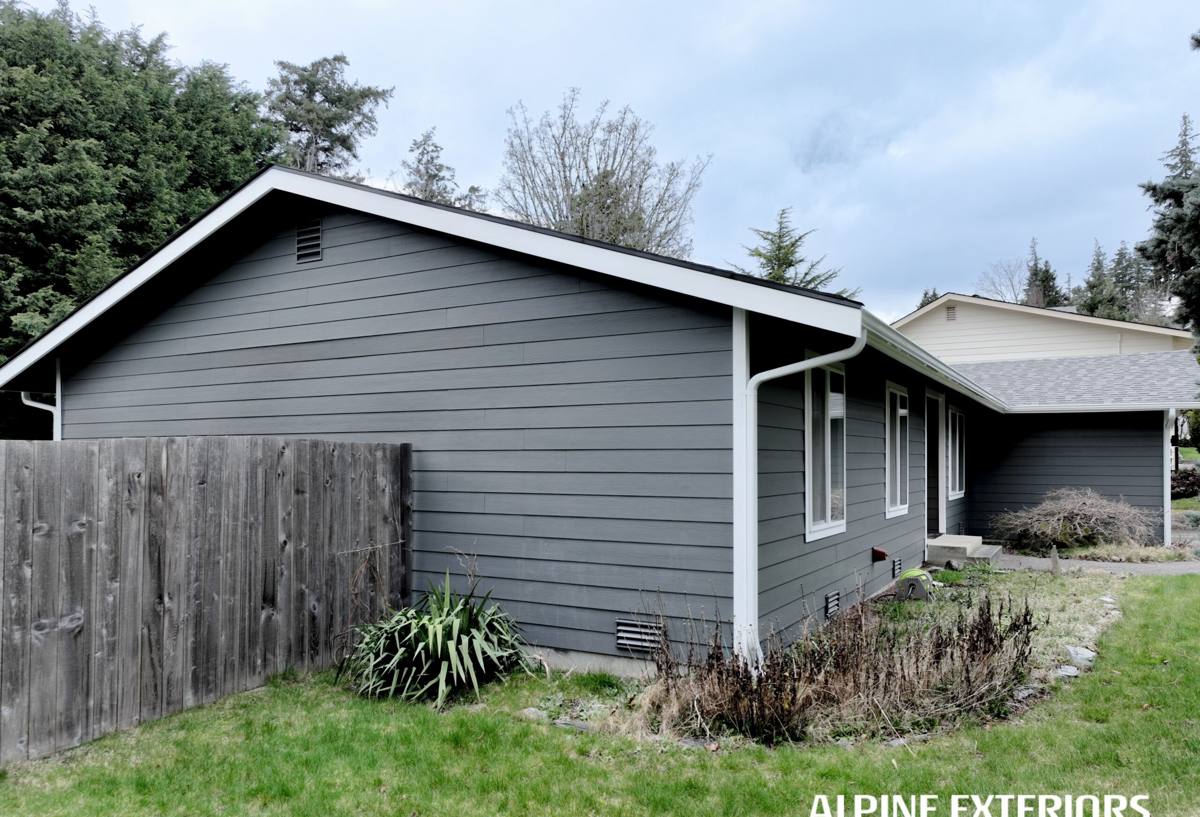
Why Blaine's Climate Is Hard on Siding Specifically
Salt Air and Fasteners
Homes close to the water deal with a slow, steady corrosive effect on exposed metal — fasteners, flashing, and trim hardware take the brunt of it. A lot of the repair calls we see in coastal areas like this trace back to a fastener or flashing detail that corroded or failed years before the siding itself showed visible damage.
Wind-Driven Rain
Rain that comes in at an angle finds every gap a straight-down rain would miss — un-sealed seams, poorly lapped flashing, trim joints that were caulked instead of properly flashed. Blaine's exposed waterfront position means these wind events aren't occasional; they're a regular part of the local weather pattern.
Moss, Mildew, and Shaded Walls
Whatcom County's long damp season keeps shaded and north-facing walls wet for extended stretches, which is exactly the environment moss and mildew need to take hold. Beyond the cosmetic staining, trapped moisture against a wall for months at a time is what turns a small original defect into a repair job.
Signs a Blaine Home Needs Siding Repair, Not Just a Wash
Not every stain or discoloration means something structural is wrong, but some signs point to damage that's already past the surface. Homeowners in this area should watch for:
- Soft or spongy spots when pressed, especially near the base of walls or below windows
- Visible gaps, cracks, or separation at seams and corner joints
- Paint or finish failure concentrated in one section rather than spread evenly across a wall
- Staining that runs downward from a specific point, suggesting water is tracking from one failed spot
- Bubbling, peeling, or a chalky texture on the surface finish
- Persistent moss or dark staining on shaded walls that doesn't clear with normal cleaning
- Visible daylight or drafts at trim and window transitions from inside the home
Any one of these on its own might be minor. Several appearing in the same area, or damage that keeps returning after cleaning, usually means water has already gotten behind the cladding and the fix needs to address the wall assembly, not just the visible surface.
What a Correct Siding Repair Actually Involves
Diagnosing the Real Cause
The visible damage is rarely the whole story. Before we replace or patch anything, we look at what let water in — a failed flashing detail, a caulked joint that should have been flashed, a fastener that backed out or corroded, or a wall assembly issue behind the siding itself. Repairing the surface without addressing the entry point means the same failure comes back.
Checking What's Behind the Siding
Where there's evidence of moisture intrusion, we check the condition of the sheathing and wall assembly underneath before closing anything back up. A repair that looks clean on the outside but goes back over compromised sheathing hasn't actually solved the problem.
Matching Existing Material
This is where Hardie repair work gets more involved than people expect. ColorPlus finishes are baked on at the factory in specific color runs, and older siding may be in a color or profile that's been updated or discontinued since the original install. We match as closely as the current product line allows and are upfront with you about it when an exact match isn't possible, rather than promising something we can't deliver.
Correcting the Detail, Not Just the Board
A repair should fix the flashing, fastening, or sealing detail that caused the failure in the first place — installed to the manufacturer's specification for this climate, not patched with caulk as a shortcut. That's the difference between a repair that lasts and one that's back on our schedule in a year or two.
Repair vs. Replace: How We Help You Decide
| Situation | Repair Usually Makes Sense | Replacement Usually Makes Sense |
|---|---|---|
| Damage extent | Isolated to one or two sections | Spread across multiple walls or elevations |
| Wall assembly condition | Sheathing and framing underneath are sound | Widespread rot or moisture damage found behind cladding |
| Age of existing siding | Newer install with years of expected life left | Siding is near or past its expected service life |
| Color/profile match | Reasonably close match available | Product discontinued and mismatch would be visually obvious |
| Root cause | One-off flashing or fastener failure | Systemic issue (original install error, wrong product for exposure) |
We'll tell you honestly which side of this table your home falls on. There's no benefit to us in talking a homeowner into a full replacement when a proper repair will hold, and there's no benefit in patching something that's going to fail again in a season or two.
Why James Hardie Repairs Differently Than Other Siding
We only install and repair James Hardie fiber cement, and that standardization matters as much on repair work as it does on new installs. Hardie's HZ5 product line is engineered for exactly the kind of moisture and climate exposure Blaine deals with, it's non-combustible, and its ColorPlus factory finish holds up better against salt air and UV than field-applied paint. When we're repairing a Hardie wall, we're working within a system we know well — the fastening spec, the flashing requirements, the way the material behaves at cut edges and joints. That familiarity is part of what makes a repair reliable rather than a temporary patch.
Our Repair Process
On-Site Assessment
We start by looking at the damaged area and the wall around it, checking moisture levels where there's evidence of intrusion, and identifying the actual cause rather than just the symptom.
Clear Explanation Before Work Starts
We tell you what we found, what we recommend, and why — including whether a color or profile match will be exact or approximate, and whether repair or partial replacement is the better call for that section.
Repair to Manufacturer Spec
Fastening, flashing, and sealing follow James Hardie's published requirements for this climate zone, the same standard we hold new installs to, not a reduced standard because it's a repair.
Final Check
We walk the finished repair with you and point out what to watch for going forward, especially if the surrounding siding is aging and other sections may need attention down the road.
Why Hire a Crew That Already Works Blaine
Blaine's waterfront exposure isn't identical to Bellingham's, even though they're in the same county — homes right on the water get a more concentrated version of the salt air and wind-driven rain that affects the whole region. A crew that's done repair work in this specific area has already seen which flashing details tend to fail first in this exposure, which fastener choices hold up and which corrode early, and how much worse a small original defect gets after a few wet seasons this close to the water. That's the kind of judgment that comes from doing the work here repeatedly, not from a general siding background alone.
Cost Factors for Siding Repair in Blaine
Repair costs vary more than new installation costs because every job starts from a different amount of hidden damage. A few things that move the price on a given repair:
- Extent of damage found once the affected boards are removed
- Condition of the sheathing and framing underneath
- Whether an exact color and profile match is available or a broader section needs replacing to keep the wall looking consistent
- Number of separate areas needing attention versus one isolated spot
- Access and site conditions, including proximity to the water and wind exposure during the work itself
We give real numbers after seeing the actual damage rather than quoting a flat repair rate — two homes with similar-looking surface damage can need very different amounts of work once we see what's behind the siding.
If you're seeing damage, staining, or soft spots on your Blaine home's siding, we're happy to take a look, explain honestly what we find, and give you a straightforward, no-pressure estimate for the right fix. There's a form below — reach out and we'll set up a time to come by.