 Bellingham
 Blaine sits right on the water at the top of Whatcom County, which means its roofs take a beating that inland Bellingham neighborhoods simply don't see in the same combination. Salt-laden air off the bay, wind-driven rain that comes in sideways more often than straight down, and a moss season that can run eight or nine months out of the year all stack up against asphalt shingles, flashing, and fasteners. We've repaired enough roofs in this corner of the county to know that a "generic" roof repair approach doesn't hold up here — the fix has to account for the specific way this climate attacks a roof.
This page covers what roof repair actually looks like when it's done right for a Blaine home: what the climate does to roofing materials, what a correct repair involves versus a patch job that fails again in a year, and how our process works from first look to final walk-through.
Why Blaine's Coastal Climate Is Hard on Roofs
Three conditions do most of the damage to roofs in this area, and they compound each other.
Salt Air
Blaine's proximity to Semiahmoo Bay and the Strait of Georgia means airborne salt settles on every exposed surface, including the roof. Salt accelerates corrosion on exposed metal — flashing, nail heads, gutter hardware, and vent caps — well before the shingles around them show their age. A roof with rusted flashing but otherwise intact shingles is a repair situation we see regularly out here, and it's easy to miss if you're only looking at the shingles themselves.
Driving Rain
Wind off the water pushes rain sideways, not straight down. That matters because a lot of roofing details are engineered assuming water sheets downward — laps, step flashing, and underlayment overlaps are all oriented for that. Wind-driven rain finds the gaps that gravity alone would never reach, working its way under shingle tabs, around chimney flashing, and into any nail that's backed out even slightly. This is why leaks in Blaine often show up nowhere near where you'd expect based on the roof's slope.
Long Moss Season
Cool, damp, shaded conditions for most of the year give moss a long runway to establish itself, especially on north-facing slopes and roofs with tree cover. Moss isn't just cosmetic. It holds moisture against the shingle surface far longer than the shingle is designed to tolerate, and as it grows it lifts shingle edges and works its rhizoids under the granule layer. A roof that looks "just a little mossy" from the ground is often further along in granule loss than it appears.
Common Roof Problems We See in Blaine Homes
Given the conditions above, certain failure patterns show up over and over on repair calls in this area:
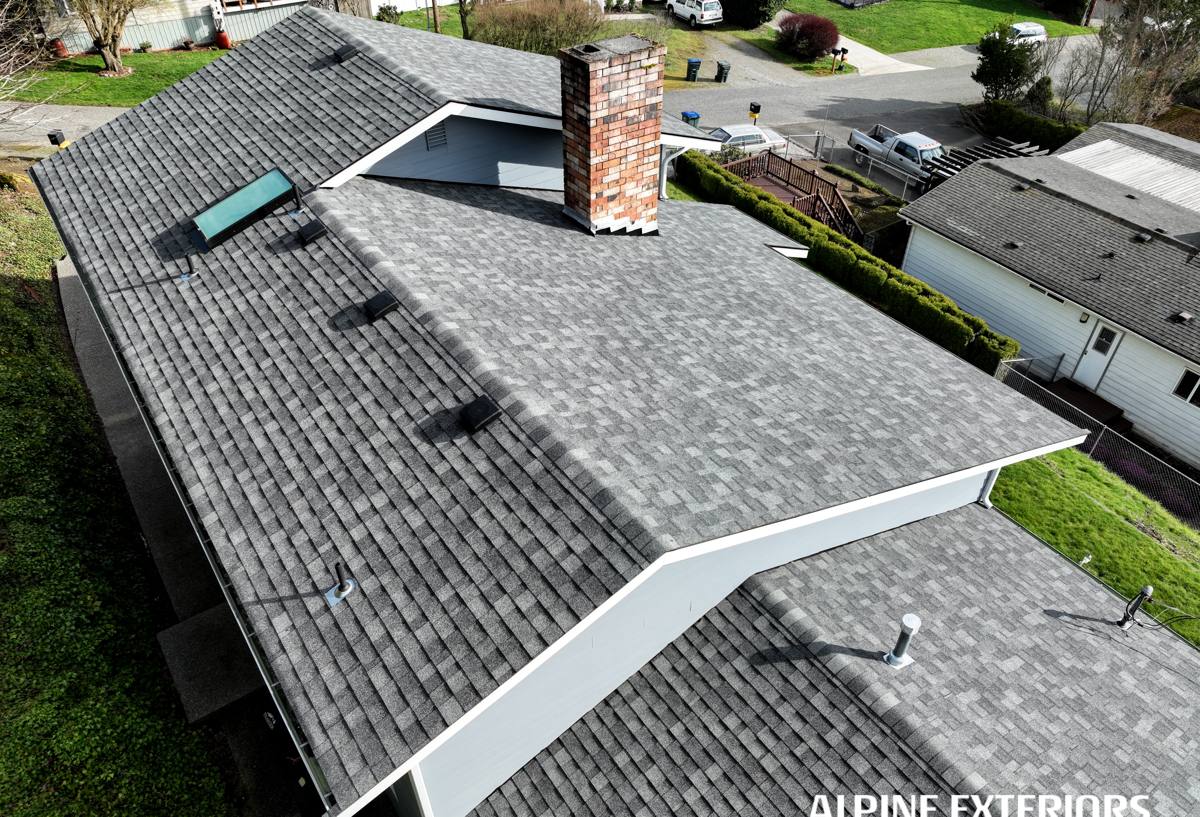
- Rusted or lifted flashing around chimneys, skylights, and roof-to-wall transitions
- Moss buildup along ridges and in shaded valleys, with granule loss underneath
- Shingle tabs lifted or cracked from repeated wind-driven rain exposure
- Corroded fasteners that have backed out just enough to let water track down the shaft
- Gutter and downspout failures that push water back up under the roof edge instead of away from it
- Soft or discolored roof decking discovered only once shingles are pulled back
Individually, most of these are straightforward to fix. The trouble comes when a couple of them are happening at once and only one gets addressed — the leak often returns within a season because the underlying cause was never actually removed.
What a Correct Repair Actually Involves
A roof repair that's going to hold up in Blaine's conditions has to go past the visible symptom. If a homeowner points to a stain on a ceiling, that's the effect — the cause is usually somewhere else on the roof entirely, often uphill from where water is entering the attic space. Correct repair work generally includes:
- Tracing the leak to its actual entry point, not just patching where water is showing up inside
- Checking the decking underneath the damaged area for soft spots or rot before any new material goes down
- Replacing corroded flashing rather than caulking over it — caulk is a temporary seal, not a repair
- Matching shingle type, weight, and where possible color so the repair doesn't stand out or create a mismatched wear pattern later
- Re-nailing or replacing fasteners in the affected area, since a single backed-out nail is often the actual culprit
- Clearing moss and treating the surface if moss contributed to the failure, so the repair isn't undone by the same growth within a year
Our Roof Repair Process
We keep this process consistent whether the job is a single flashing repair or a multi-area patch after a storm.
- On-site inspection. We get on the roof (weather permitting) and in the attic if accessible, looking for the actual water path rather than assuming based on the interior stain location.
- Honest assessment. We tell you what we find, including if the damage is more extensive than expected or if a repair isn't the right call anymore — see the comparison below.
- Written scope and estimate. You know what's being fixed, with what materials, before any work starts.
- The repair itself. Decking addressed first if needed, then flashing, then shingle or roofing material, then fasteners and sealant details.
- Cleanup and walk-through. Debris and old material hauled off, and we show you what was done and why.
Repair vs. Replacement: How We Help You Decide
Not every leak needs a new roof, and not every roof with a leak is a good candidate for another patch. We look at a handful of factors and lay them out plainly rather than defaulting to whichever job is bigger.
| Factor | Favors Repair | Favors Replacement |
|---|---|---|
| Roof age | Under roughly 15 years, within expected lifespan | Near or past typical service life for the material |
| Extent of damage | Isolated to one area — a flashing point, one slope, one valley | Multiple areas failing independently across the roof |
| Decking condition | Solid, no rot found on inspection | Soft or rotted decking found in more than one spot |
| Granule loss | Localized, shingles elsewhere still have life left | Widespread granule loss across most slopes |
| Moss history | First or occasional moss issue, treatable | Chronic moss damage across multiple past seasons |
When a roof falls clearly on the repair side of this table, we say so and price it as a repair — there's no reason to sell a full replacement when a targeted fix will genuinely hold up.
Materials and Why They Matter Here
For repair work, matching the existing roofing material matters more than it might seem. A mismatched shingle weight or profile can create a slightly raised seam that catches wind-driven rain the same way the original failure point did. For flashing, we use corrosion-resistant metal appropriate for a salt-air environment rather than whatever is cheapest, since standard-grade flashing in this location tends to show rust again within just a few years. Where a full slope or larger section needs work rather than just a spot repair, we'll talk through material options and their trade-offs honestly — including maintenance burden and how each performs specifically against moss and driving rain, not just upfront cost.
Signs You Need a Roof Repair Now
Some signs are obvious; others are easy to write off as cosmetic until they've caused real damage underneath. Worth checking for:
- Any ceiling stain, even a small one that seems to have "stopped" — it usually hasn't
- Visible moss on ridges, valleys, or north-facing slopes
- Granules collecting in gutters or at the base of downspouts
- Shingle tabs that look lifted or curled when viewed from the ground
- Rust streaks below flashing points, chimneys, or vent stacks
- Daylight visible through the roof deck from inside the attic
- A noticeably higher energy bill, which can indicate moisture in insulation
If more than one of these applies, it's worth having someone look sooner rather than later — small leaks in this climate rarely stay small over a wet Whatcom County winter.
Why a Local Crew Matters for This Job
Roof repair is one of those jobs where local experience actually changes the outcome, not just the sales pitch. A crew that regularly works in Blaine and along the rest of the Whatcom County coastline already knows which flashing details tend to fail first in salt air, which slopes hold moss longest given the local tree cover and shade patterns, and how far wind-driven rain typically travels under a shingle edge before it hits something absorbent. That's the difference between a repair that addresses the actual cause and one that treats the visible symptom and gets called back out in a year. We also know this area well enough to give a straight answer about whether a repair makes sense or whether you're better off planning for replacement — because we'll likely be the ones you call the next time something needs attention.
If you're seeing signs of a roof problem in Blaine or dealing with an active leak, we're happy to come take an honest look. Use the form below to request a free, no-pressure estimate — we'll tell you what we find and what we'd recommend, no obligation either way.