 Bellingham
 Why Decks in Cordata Wear Out Faster Than Homeowners Expect
Cordata sits far enough inland to avoid the harshest marine exposure, but it still gets the full package of Whatcom County weather: salt-tinged air carried in off Bellingham Bay and the Strait, long stretches of driving rain from fall through spring, and a moss season that can run eight months or longer in shaded yards. None of that is dramatic on its own. The problem is duration. A deck here doesn't fail from one big storm — it fails from thousands of hours of dampness sitting against wood and fasteners that were never designed to stay wet that long.
We've worked on enough decks in this part of Bellingham to know the pattern. Homes with mature trees or north-facing backyards hold moisture longest, and those are almost always the decks that need attention first. If your deck gets afternoon shade most of the year, or backs up to landscaping that stays damp, it's carrying more moisture load than a deck out in the open — even if it looks fine from a distance.
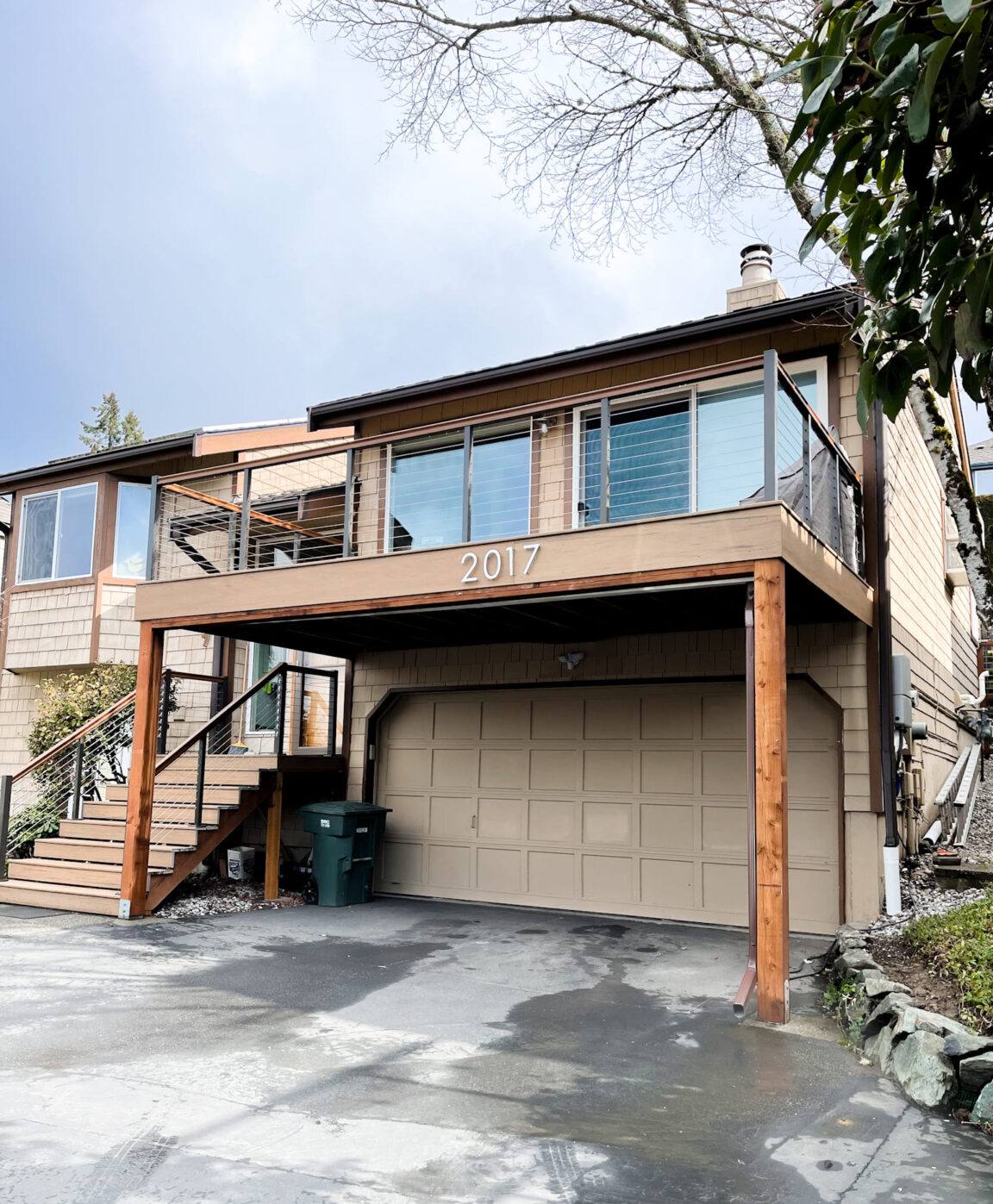
Signs Your Deck Needs Repair — Not Just a Cleaning
Homeowners often assume a tired-looking deck just needs pressure washing and a new coat of stain. Sometimes that's true. But surface grime can hide structural problems underneath, and pressure washing an already-soft board can make things worse. Before you book a cleaning, walk the deck and check for these:
- Boards that feel spongy or flex noticeably when you step on them, especially near the house or at board ends
- Dark staining or a sour, musty smell around the ledger board where the deck attaches to the house
- Nails backing out or popping up above the board surface
- Visible gaps opening between decking boards, or boards cupping (edges higher than the center)
- Green or black film that comes back within weeks of cleaning — a sign moss and algae have a steady moisture source to feed on
- Railings that wiggle at the post base, or stair stringers that feel less solid than they used to
- Rust streaks running down from screws or joist hangers
- A noticeable bounce or give when several people stand in the same area
Any one of these on its own might be minor. Two or three together usually mean it's time for an actual inspection rather than a cosmetic fix.
What a Correct Deck Repair Actually Involves
Deck repair gets treated as a simple job — swap a board, tighten a rail, done. Done right, it's closer to targeted carpentry with a few non-negotiables:
Finding the real source of the damage
Replacing a rotted board without figuring out why it rotted just buys you a few more years before the same spot fails again. Most of the time the cause is trapped moisture: poor drainage between boards, a missing or failed flashing detail at the house connection, or a finish that stopped shedding water years before anyone noticed.
Checking what's underneath, not just what's on top
Decking boards are the part everyone sees, but joists, beams, and the ledger board do the structural work. A repair that only addresses the top surface while ignoring soft framing underneath isn't a repair — it's a temporary patch.
Matching fasteners and hardware to the material
Mixing incompatible metals — the wrong screws with certain treated lumber, or old galvanized hardware that's already corroding — accelerates future failure. Fastener choice matters as much as board choice.
Getting water moving away from the structure, not into it
Every repair should leave the deck better at shedding water than it was before: proper gaps between boards, correct flashing where the deck meets the house, and slope where it's supposed to exist.
The Problem Areas We See Most Often on Cordata Decks
| Area | What Typically Goes Wrong | Why It Happens Here |
|---|---|---|
| Ledger board (house connection) | Hidden rot behind the flashing, sometimes not visible until the board is pulled back | Constant rain runoff and limited sun exposure on many north- or east-facing decks |
| Decking boards | Cupping, splitting, soft spots, persistent moss growth | Long wet season keeps boards damp for months at a stretch |
| Support posts and footings | Base rot at grade level, movement in older concrete piers | Splash-back from bare soil, ground saturation in wet months |
| Joists and beams | Rot at joist ends, corroded hangers, sagging between supports | Poor original flashing details, hardware not rated for the exposure |
| Stairs and railings | Loose posts, soft stringers, failed connections at the base | Ground contact and heavier moisture exposure than the main deck surface |
The ledger board deserves special mention. It's the single most common source of expensive surprises, because the flashing that's supposed to protect it is hidden behind the house siding and decking — a homeowner has no way to check it without pulling boards back. We check it early in any repair, not as an afterthought.
Repair, Partial Rebuild, or Full Replacement?
Not every deck problem calls for the same level of work. The right call depends on how much of the structure is still sound versus how much moisture damage has spread.
| Approach | Best For | What's Involved |
|---|---|---|
| Spot repair | A few isolated bad boards or a loose railing, with sound framing underneath | Remove and replace individual boards or hardware, re-seal exposed cuts |
| Structural repair | Sound decking but compromised joists, ledger, or posts | Sister or replace framing members, correct flashing, then reinstall or reuse decking |
| Partial rebuild | One section (stairs, a landing, a railing run) failing while the rest holds up | Rebuild the affected section to current framing and fastening standards |
| Full replacement | Widespread rot, undersized original framing, or a deck at the end of its service life | Tear-off and rebuild from the footings up |
We'll tell you honestly which category your deck falls into. If a repair will genuinely hold up, we're not going to sell you a rebuild — and if a deck has more hidden damage than a repair can responsibly fix, we'll say that too, with the reasoning behind it.
Our Deck Repair Process
- Walk-through inspection. We check the decking, framing, ledger connection, posts, and railings — probing suspect areas rather than just looking at the surface.
- Straight explanation of findings. You get a clear picture of what's causing the problem, not just a list of symptoms.
- A written scope and price. Broken down by what's being repaired, so you know exactly what you're paying for and why.
- Removal of damaged material. Only what actually needs to come out — we don't tear into sound structure to pad the job.
- Structural correction first. Framing, flashing, and hardware get addressed before any new decking goes down.
- Decking, railing, or stair work. Installed with proper spacing and fastening for drainage and long-term movement.
- Finish and seal. Any exposed cuts or new wood get treated before the job is called done — an untreated cut end is where the next round of rot starts.
- Final walkthrough with you. So you know what was done and what to watch for going forward.
Choosing Materials: Matching What's There vs. Upgrading
When we replace boards on an existing deck, the first question is whether to match the current material or use the repair as a chance to upgrade a section. Both are reasonable, depending on the deck's age and your plans.
Matching existing wood decking
If the rest of the deck is in good shape, matching species and dimension keeps the repair blending in and keeps cost down. This works well for isolated damage on a deck that otherwise has years of life left.
Upgrading to composite in repaired sections
Composite decking resists moisture absorption and won't rot the way wood can, which is a real advantage in a climate with this much sustained dampness. The trade-offs are worth knowing: composite costs more upfront, installation is less forgiving of mistakes (fastener spacing and gapping matter more, not less), and it still needs a sound, dry structure underneath — composite boards don't fix rotted framing. We'll walk you through whether it makes sense for your specific repair rather than defaulting to one answer.
Pressure-treated framing lumber
For anything structural — joists, beams, posts — we use lumber rated for the exposure it will see. This isn't optional in a climate where framing stays damp for months at a time; using anything less is how decks end up needing this same repair again in a few years.
Keeping a Repaired Deck Solid Through the Next Wet Season
A good repair should buy you years, not months — but a little upkeep on your end makes a real difference given how much rain and shade this area gets. A short list worth keeping somewhere handy:
- Sweep debris and wet leaves off the deck regularly through fall — trapped organic matter holds moisture against the boards and feeds moss growth
- Keep gutters and downspouts near the deck clear so runoff isn't dumping directly onto or under it
- Re-seal or re-stain wood decking on the manufacturer's recommended schedule, not just when it looks faded — the finish is what's actually shedding water
- Trim back vegetation that's shading the deck or blocking airflow underneath it
- Check the ledger board area and post bases once a year for early signs of staining or softness
- Address small issues — a loose board, a popped nail — before the next wet season rather than after
None of this is complicated, but it's the difference between a repair that lasts and one that quietly starts failing again in the same spot.
Why It Matters That We Already Work in Cordata
Deck repair done right depends on understanding how a specific climate treats wood and hardware over time, not just knowing general carpentry. Working regularly in Cordata and the surrounding Bellingham neighborhoods means we've already seen how ledger boards, framing, and decking in this specific mix of rain, shade, and salt-tinged air actually behave over the years — not in a manual, but on real decks a few miles from the next one. That's what tells us where to check first, what corners get skipped in original construction, and what actually holds up here versus what looks fine for a season and then doesn't.
It also means straightforward logistics: we're not driving in from across the county, scheduling is easier to work around, and if something needs a follow-up look after the first wet season, we're not hard to reach.
Get an Honest Look at Your Deck
If your deck in Cordata is showing soft spots, moss that won't quit, or just doesn't feel as solid as it used to, we're happy to take a look and give you a straight answer — repair, partial rebuild, or otherwise — with no pressure either way. Use the form below to request a free estimate.