 Bellingham
 Why Happy Valley's Climate Is Hard on Windows
Happy Valley sits close enough to Bellingham Bay that salt-laden air reaches window frames and hardware year-round, and Whatcom County's weather pattern doesn't give windows much of a break. Wind-driven rain off the water pushes water sideways into gaps that would stay dry in calmer climates. Add in the tree cover and shade that much of the neighborhood enjoys, and you get long stretches of the year where moisture just sits against the building — the moss and algae season locals know well. None of this is dramatic on its own, but stacked together over years, it's exactly the combination that finds every weak point in a window installation.
A window that's a poor match for this environment, or one that was installed without proper flashing and sealing, won't fail on day one. It fails slowly — a soft spot in a sill, a foggy pane, a draft that gets a little worse each winter. By the time it's obvious, moisture has usually already gotten into the wall assembly around it.
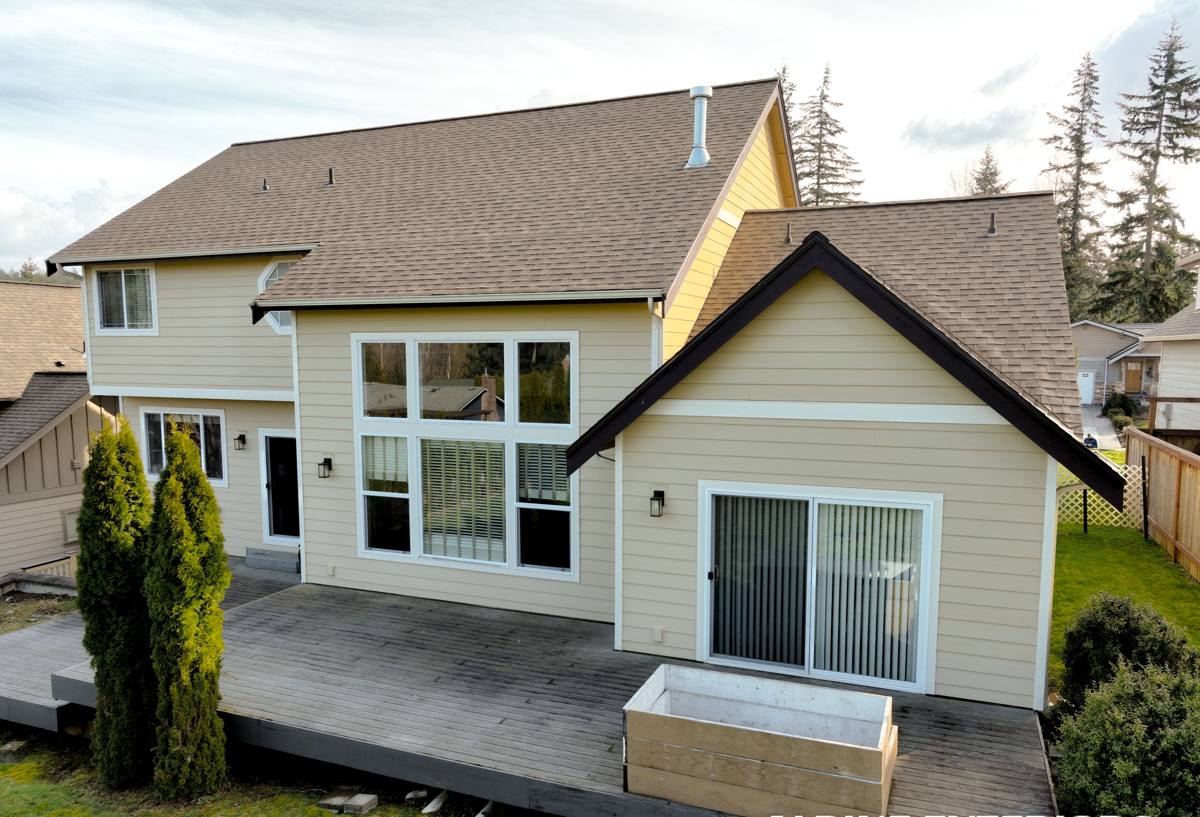
How These Conditions Show Up as Window Problems
Most of the window calls we get in this part of Bellingham fall into a few predictable categories:
- Fogging or haze between panes — the seal on an insulated glass unit has failed and moisture is getting trapped inside the glass, not just on the surface.
- Soft, spongy, or discolored sills — especially on wood-frame windows on the shaded or north-facing sides of a house, where things dry out slowest.
- Moss or dark green staining around the frame or on the trim below a window, which holds moisture against the wood and paint longer than it should sit there.
- Noticeable drafts around older aluminum-frame windows, which conduct cold and don't seal as tightly as modern frames once gaskets age.
- Corroded hardware — locks, cranks, and hinges that stick or show white corrosion, more common here than in drier inland climates because of the salt content in the air.
Any one of these is worth a look before it turns into a repair on the wall framing behind the window, which is a much bigger job than replacing the window itself.
What a Correct Custom Window Installation Actually Involves
"Custom" windows just means the units are built to the exact rough opening of your house rather than pulled off a shelf — which matters a lot on older Happy Valley homes where openings are rarely a standard modern size. But the product is only half the job. How it goes in determines whether it lasts.
Flashing and Water Management
The window needs to be integrated into the wall's water-resistive barrier correctly — flashing tape or flashing paper lapped in the right order (bottom, sides, then top) so water draining down the wall sheds over the window, not behind it. This is the single most common corner cut on bad installs, and it's invisible once the siding goes back on.
Insulation and Air Sealing
The gap between the window frame and the rough opening should be filled with a proper insulating material and sealed with backer rod and sealant on the interior and exterior — not just caulked over on the outside and left hollow inside. A hollow gap is both a heat-loss path and a place for condensation to form.
Frame and Sash Fit
The unit has to be shimmed level, plumb, and square before it's fastened. A window that's slightly racked will bind, won't seal against its weatherstripping evenly, and will wear out its hardware faster.
Choosing Materials That Hold Up Here
There's no single "best" window material — it depends on your home's style, budget, and how exposed the window is to weather. Here's how the common options compare for a coastal Whatcom County environment specifically:
| Frame Material | Moisture Resistance | Maintenance | Notes for This Climate |
|---|---|---|---|
| Vinyl | Very good — won't rot or corrode | Low — occasional cleaning | Solid value option; quality varies a lot between manufacturers |
| Fiberglass | Excellent — dimensionally stable in wet/dry swings | Low | Handles temperature and moisture cycling well; higher upfront cost |
| Wood-clad (wood interior, clad exterior) | Good if detailed correctly | Moderate — interior wood still needs care | Classic look for older homes; exterior cladding protects the wood from driving rain |
| Bare wood | Fair — needs diligent upkeep | High — repainting/sealing on a schedule | We're honest with clients that bare wood is the highest-maintenance choice in a salt-air, high-moisture area |
| Aluminum (uncoated/older style) | Poor — conducts cold, prone to condensation | Moderate | Generally what we're replacing, not installing new |
For most Happy Valley homes, we steer clients toward vinyl or fiberglass for full replacements, and wood-clad when matching an existing architectural style matters more than minimizing upkeep. We'll walk through the honest trade-offs for your specific house rather than push one product line.
Our Process for Happy Valley Projects
- On-site assessment — we look at each opening, check for existing water damage or rot around the frame, and note anything specific to your home's exposure (shade, prevailing wind, roofline drainage).
- Measuring and ordering — custom units are built to the exact opening, which takes lead time; we'll give you a realistic timeline up front rather than guess.
- Removal — old windows come out carefully so we can inspect the framing underneath before anything new goes in. If we find rot, we address it before installing the new window, not after.
- Installation — proper flashing sequence, shimming, insulation, and sealing as described above.
- Exterior and interior finish — trim, caulking, and touch-up work so the new window looks like it belongs on the house.
- Walkthrough — we test operation and locks and go over care basics before we consider the job done.
Repair, Restore, or Replace?
Not every window on an older Happy Valley home needs full replacement. Some questions worth answering before deciding:
- Is the frame itself sound, with only the glass unit or weatherstripping failed? That's often a repair, not a replacement.
- Is there soft or rotted wood at the sill or jamb? That usually pushes toward replacement, since repairing rot properly means opening up the wall anyway.
- Does the window still operate smoothly, or is it painted shut, hard to lock, or racked in its frame?
- Is there persistent moss, algae, or dark staining directly below the window that keeps coming back no matter how often it's cleaned?
- Do you feel a draft at the frame edge even when the window is fully latched?
- Is the glass fogged or hazy between the panes, not just dirty on the surface?
If you're mostly seeing "yes" to the first two questions, that's usually a real replacement conversation. If it's just the last few, a repair or reseal may buy you several more years.
What Affects the Cost of Custom Windows
We don't publish flat pricing because every house and opening is different, but these are the main factors that move the number up or down:
| Factor | How It Affects Cost |
|---|---|
| Frame material | Vinyl generally costs less than fiberglass or wood-clad; bare wood custom units run higher still |
| Glass package | Upgraded low-E coatings and gas fills add cost but improve comfort and condensation resistance |
| Number of openings | Whole-house projects typically bring a better per-window cost than one-off replacements |
| Access and second-story work | Upper-floor or hard-to-reach openings take more time and equipment |
| Condition behind the window | Rot repair at the sill or framing, if found during removal, is additional work |
| Trim and finish work | Matching existing exterior trim profiles or repainting adds labor beyond the window unit itself |
We'll always identify these factors specifically for your home during the estimate, rather than quoting a number before we've seen the openings.
Why Hire a Crew That Already Works in Happy Valley
Window installation quality depends a lot on judgment calls made on-site — how much flashing overlap a particular wall assembly needs, whether an opening is out of square enough to need extra shimming, how a new window should tie into existing siding and trim without looking bolted on. A crew that regularly works in this part of Bellingham has already seen the range of home ages and construction styles common to the neighborhood, and knows what City of Bellingham permitting and inspection expects for window replacement work.
There's also a practical local-knowledge piece to it: knowing how much moss and buildup to expect on a shaded elevation, how exposed a given wall is to wind off the bay, and what kind of flashing detail actually holds up through a wet Whatcom County winter versus one that looks fine on install day and fails in year three. That's the kind of judgment that only comes from doing this work in this specific climate, repeatedly, not from a general install checklist.
If you're weighing a window repair, a few replacements, or a full-house project in Happy Valley, we're glad to take a look and give you an honest read on what your home actually needs — no pressure, no obligation. Use the form below to request a free estimate.