 Bellingham
 Siding Repair Around Sudden Valley: A Community Built Into the Trees at Lake Whatcom
Sudden Valley sits along the shore of Lake Whatcom, tucked into a heavily wooded stretch of Whatcom County east of Bellingham. Homes here are surrounded by mature trees, built on sloped lots, and close enough to the lake and the broader marine air pattern that reaches this part of Washington that they take on a specific mix of weather stress most inland neighborhoods don't see to the same degree. When a homeowner here calls about a siding repair, it's rarely a simple like-for-like swap of a cracked board. The real question is almost always what's been happening behind that board for the past several seasons, and whether the visible damage is the whole story or just where a longer-running problem finally became visible.
We handle siding repair calls throughout Whatcom County, and Sudden Valley's combination of tree cover, lake proximity, and driving rain makes it one of the areas where getting the diagnosis right matters just as much as the repair itself.
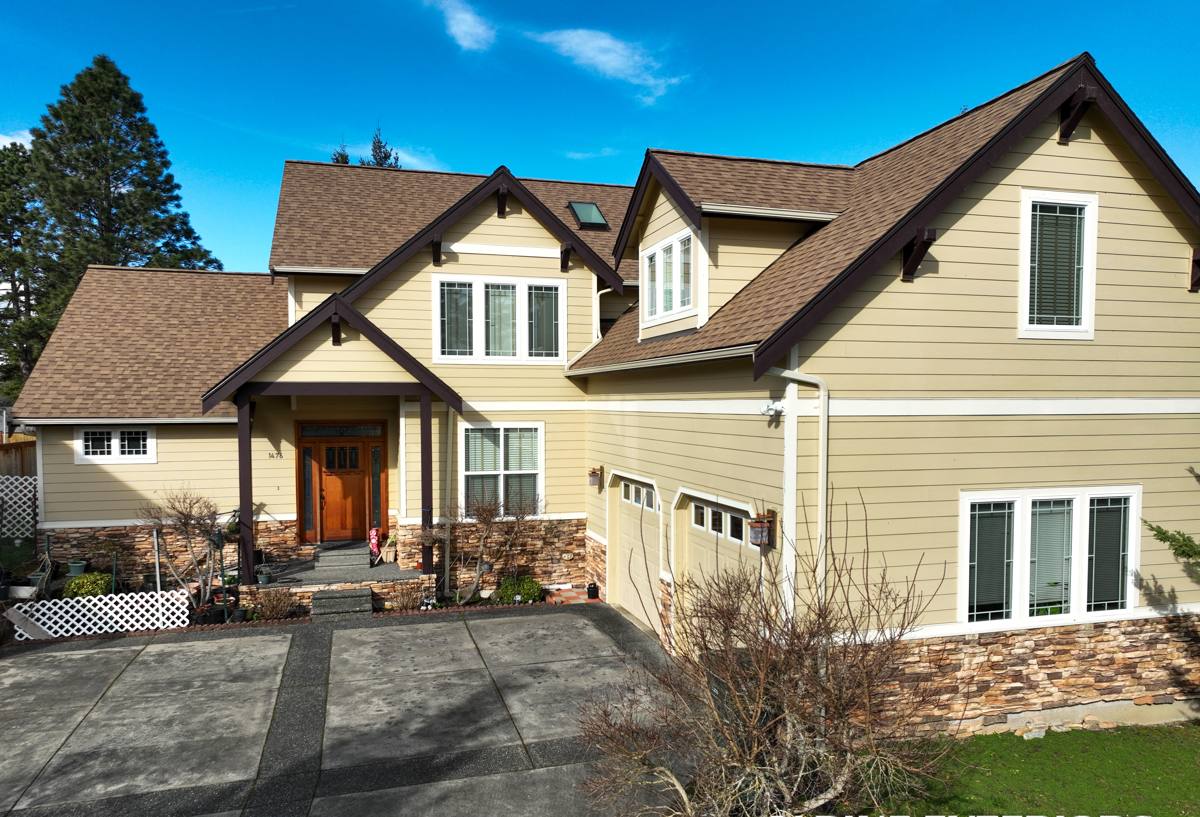
What Actually Damages Siding in This Part of Whatcom County
A Moss Season That Doesn't Really End
Most of the country gets a moss season and then a dry stretch where surfaces get a chance to recover. Shaded, tree-surrounded lots around Sudden Valley often don't get that break. Moss, algae, and mildew can stay active on north-facing or heavily shaded walls for most of the year, which means any siding that depends on drying out between rain events is fighting a losing battle on those elevations. Left alone, that growth holds moisture directly against the wall surface, which is exactly the condition that speeds up rot, fastener corrosion, and finish failure.
Driving Rain and Marine-Influenced Air
Lake Whatcom and the marine-influenced air that reaches inland from the Sound don't just bring more rain, they bring rain that moves sideways under wind. Wind-driven rain finds its way into lap joints, trim seams, and butt joints that a siding system built for calmer weather was never really tested against. That same air carries a mild salt influence that works slowly on exposed fasteners and hardware over years, eventually showing up as rust streaking or a finish that's chalked out well ahead of its rated life.
Impact and Mechanical Damage
Beyond moisture, Sudden Valley's wooded lots mean falling branches, wind-thrown debris, and general impact damage from storms are a more regular occurrence than in open, treeless subdivisions. A cracked panel or a section knocked loose in a windstorm needs attention promptly, since an open seam is an invitation for the moisture problems above to start working on the wall assembly behind it.
Diagnosing the Real Problem Before Any Repair Starts
The visible damage on a siding call is often the smallest part of the actual problem. A stained or soft-feeling board at the base of a wall might be a simple splash-back issue, or it might be the first visible sign of years of moisture tracking down from a failed seal higher up. Before we touch a single board, we look at the whole picture: how the damaged area drains, what's above it that could be feeding water down to it, and whether the sheathing behind the siding has been compromised.
Surface Damage vs. Something Deeper
Cracked, faded, or impact-damaged siding that hasn't let moisture behind the wall is usually a straightforward repair. Soft, spongy, or discolored siding, especially near grade, around window and door trim, or under a roofline that drains onto the wall, often means moisture has been getting behind the panel for a while. That distinction changes the entire scope of the job, and it's not something that can be judged accurately from the ground or from a photo.
Tracing the Source, Not Just the Symptom
A lot of what looks like a siding problem on a Sudden Valley home actually started somewhere else. A roof valley shedding water onto a wall below it, a window that wasn't flashed correctly during a past renovation, or a deck ledger trapping moisture against the house can all surface later as damaged siding, even though the siding is just where the water finally showed itself. Repairing the visible damage without tracing it back to the actual source usually just buys a year or two before the same spot fails again.
What a Correct Siding Repair Actually Involves
A repair that holds up is not just cutting out a bad section and nailing in a new one. Done right, it addresses the material, the water management behind it, and how the new work ties into what's already on the wall.
Matching Material and Finish
On a home already sided in James Hardie fiber cement, a proper repair means matching the same profile, exposure, and ColorPlus finish so the repaired section doesn't stand out as an obvious patch. On homes with an older or different siding material, we'll tell you honestly whether a true match is realistic or whether the repair will always read as a visibly different section, so you can make that call with full information rather than a surprise after the work is done.
Flashing and Water Management, Not Just a Patch
Any repair that opens up a section of wall is a chance to check and correct the flashing, house wrap, and seam detailing underneath, not just staple the new piece over whatever was there before. Skipping that step is the single most common reason a repair fails again within a couple of years: the visible siding looks fine, but the water management behind it was never actually fixed.
Sealing Seams and Penetrations Correctly
Every new joint the repair creates needs to be sealed and lapped the way the original installation should have been, accounting for the wind-driven rain this area sees regularly. A repair that leaves a new seam more exposed than the surrounding original work has just relocated the vulnerability instead of removing it.
Repair or Replacement: How We Help You Make the Call
Not every damaged section means a full re-side, and not every home with a few problem spots is actually a repair candidate. The honest answer depends on how much of the wall assembly has been affected and how old the existing siding already is.
| Situation | Usually Points To | Why |
|---|---|---|
| Isolated impact damage, siding otherwise sound | Targeted repair | Sheathing and surrounding boards are unaffected; a matched patch solves it |
| Soft or stained siding near grade or trim, small area | Repair with substrate check | Localized moisture intrusion can often be corrected without a full tear-off |
| Recurring moss and moisture damage across multiple walls | Broader repair or partial re-side | Pattern suggests systemic water management issues, not one bad spot |
| Original siding near or past its service life | Full replacement | Patching an aging system usually just delays a larger project at higher eventual cost |
| Widespread rot in sheathing found during repair | Replacement of affected sections at minimum | Repairing over compromised sheathing doesn't solve the underlying problem |
We'll always tell you plainly which category your home falls into rather than defaulting to whichever answer is more profitable for us. A lot of the time, a well-executed repair is genuinely the right call, and we'll say so.
Why We Repair Sudden Valley Homes With James Hardie Fiber Cement
We repair and install one siding product, James Hardie fiber cement, on every job we take on. It's not that other products don't have a place in the market; it's that in a climate with this much sustained moisture, moss pressure, and driving rain, we've made a professional decision to stand behind one system we know completely rather than juggle several with different failure points and repair rules.
Hardie's ColorPlus factory finish is baked on under controlled conditions rather than field-applied, which matters directly for repair work: a factory-matched replacement plank holds its color and sheen far more consistently over time than a field-painted patch on wood or engineered wood siding would. Hardie's climate-engineered HZ product lines are built for regions with sustained moisture exposure, which is a closer match to conditions around Lake Whatcom than a generic national formulation. It's non-combustible, dimensionally stable across wet and dry cycles, and backed by a strong, transferable warranty, all of which matter as much on a repair as they do on a full installation.
Our Process for a Sudden Valley Repair Call
We keep the repair process straightforward and honest from the first visit through the finished work.
- Walk the property in person and inspect the damaged area along with anything above, below, or adjacent to it that could be feeding the problem
- Check for hidden moisture or sheathing damage before quoting, not after the work has already started
- Give you a clear, written explanation of whether this is a repair, a partial re-side, or a full replacement situation, and why
- Match material, profile, and finish as closely as realistically possible on Hardie-sided homes
- Correct the flashing and water management behind the repaired section, not just the visible siding
- Walk the finished repair with you before we consider the job done
Why a Crew That Already Works Sudden Valley Matters
A contractor who regularly works this specific stretch of Whatcom County has already seen how moss, driving rain, and lake-adjacent moisture behave on real homes here through a full year of seasons, not just on a spec sheet. That experience shows up in practical ways on a repair call: knowing which wall orientations on a wooded, sloped lot stay damp longest, recognizing the early signs of moisture tracking before it becomes a structural problem, and understanding which detailing shortcuts tend to fail first in this specific climate. A crew unfamiliar with the area might do a technically competent repair that still misses the local conditions driving the damage in the first place.
If you've got a section of siding that's cracked, stained, soft, or just not looking right on your Sudden Valley home, we're glad to take a look and give you a straight answer on what's actually going on and what it will take to fix it properly. Reach out using the form below to schedule a free, no-pressure estimate.