 Bellingham
 Why Silver Beach Asks More of a Siding System
Homes in Silver Beach sit close enough to Bellingham's marine air and open water exposure that siding here works harder than it does further inland. Damp, salt-tinged air moves through the neighborhood most of the year, driving rain comes in sideways off winter storms, and the tree cover that makes Silver Beach a nice place to live also means shade, standing moisture, and a moss season that can run eight months or longer in a wet year. Add Whatcom County's short, cool summers, and a wall assembly rarely gets a long, dry stretch to fully release moisture before the next system rolls through.
That combination is unforgiving on siding that isn't dimensionally stable or that depends on a painted surface to keep water out. It's also why we only install James Hardie fiber cement on Silver Beach homes — not because every other product is bad, but because this specific climate rewards a siding system that doesn't swell, doesn't rot, and doesn't need repainting every few years to keep doing its job.
What This Climate Actually Does to a Wall
Moisture that never fully dries
Shaded lots and persistent damp air mean the siding, especially on north- and west-facing walls, can stay wet longer between rain events. Wood-based products absorb that moisture at cut ends, seams, and fastener holes. Over years, that shows up as swelling, cupping, or soft spots — usually first at the bottom courses and around windows.
Moss, algae, and organic growth
Moss doesn't just grow on roofs here. It takes hold on any siding surface that stays damp and shaded, and it's especially aggressive on textured wood-grain finishes and porous painted surfaces. Beyond the look of it, moss and algae hold moisture against the wall longer than bare siding would, which accelerates whatever underlying moisture problem already exists.
Driving rain and wind-driven wetting
Storms off the water don't just fall straight down — they push rain sideways into laps, seams, and trim joints. A siding system with poor water management at those joints will take on moisture at exactly the spots where wood rot and paint failure start.
Why James Hardie Fits Silver Beach Specifically
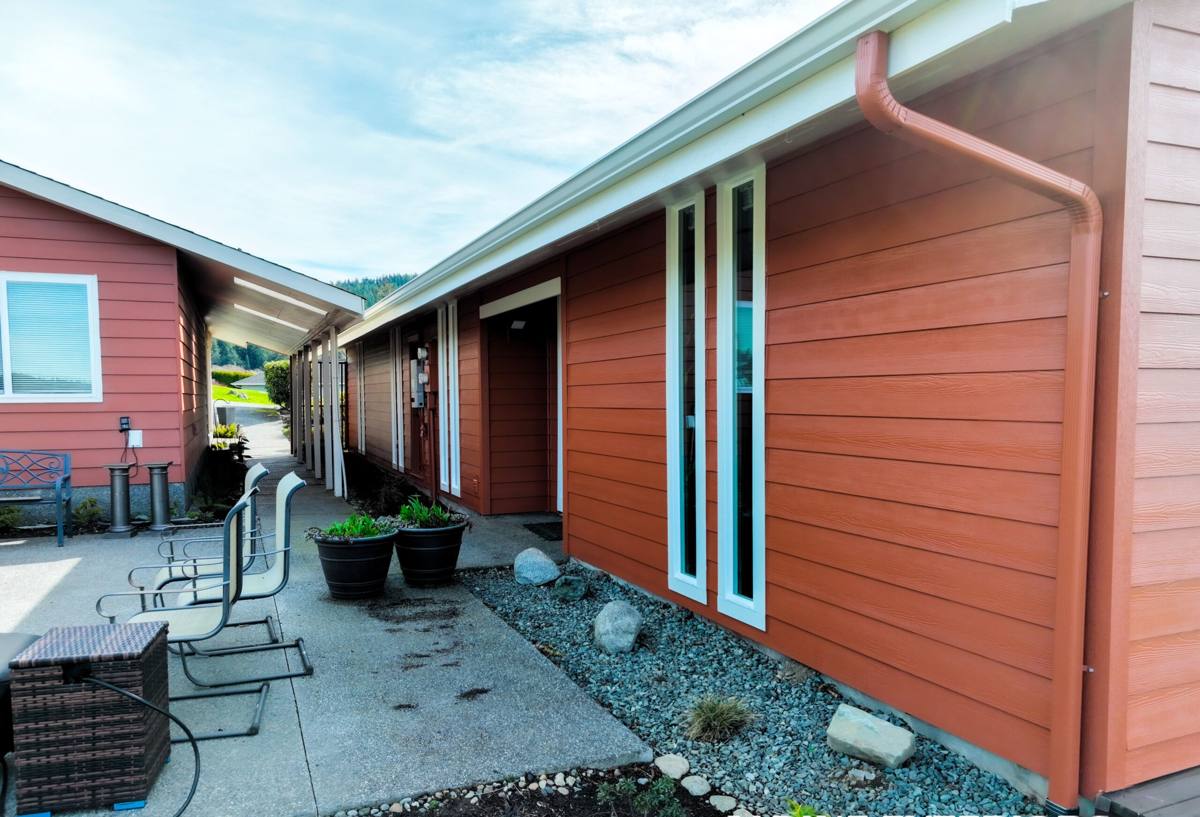
James Hardie fiber cement is engineered from cement, sand, and cellulose fiber — materials that don't absorb and swell the way wood or wood-composite products do. For this neighborhood, three things matter most:
- Non-combustible and rot-proof core — the board itself isn't a food source for moss, mildew, or rot fungi, unlike wood-based sidings.
- ColorPlus factory finish — a baked-on finish applied and cured in a controlled factory environment, which resists fading and holds up to sustained damp conditions far better than a field-applied paint job.
- HZ5 climate engineering — Hardie's HZ5 product line is formulated for wetter, colder regions like ours, with better resistance to moisture-related freeze-thaw stress than the HZ10 line built for hot, dry climates.
We don't install LP SmartSide, vinyl, Cemplank, Allura, primed spruce, or cedar. Each of those has legitimate uses somewhere, but for a damp, shaded, moss-prone lot in Whatcom County, we've made fiber cement — specifically Hardie — our standard, and we stand behind that with every job we quote.
What a Correct Installation Involves Here
Hardie siding performs the way it's supposed to only when it's installed to manufacturer spec — and in a climate like this, the details that get skipped on a rushed job are exactly the ones that cause problems in year three or four, not year one.
Water-resistive barrier and flashing first
Before a single board goes up, the wall needs a properly lapped weather-resistive barrier and correctly integrated flashing at every window, door, and penetration. Siding is the last line of defense, not the only one — if the drainage plane behind it is wrong, no siding product will save the wall.
Proper gapping and clearance
Hardie boards need clearance from rooflines, decks, and grade, and gaps at butt joints and trim per Hardie's published instructions. Skipping these clearances is one of the most common ways installers void the manufacturer warranty without the homeowner ever knowing.
Fastening and cut-edge sealing
Cut ends and drilled holes need to be sealed per spec, and fasteners need to be set correctly — not overdriven, not underdriven, in the right pattern. Done wrong, this is where water finds its way in years down the road.
Caulking done right, not everywhere
Hardie's trim system is designed to shed water in most locations without relying on caulk as the primary defense. Over-caulking can trap moisture in exactly the wrong place; under-caulking at true joints leaves gaps. Knowing the difference is part of the job.
Common Problems We See on Silver Beach Homes
| What we find | Usual cause | What it means for the homeowner |
|---|---|---|
| Moss staining along lower courses | Shade, poor airflow, splash-back from grade or landscaping | Cosmetic now, but holds moisture against the wall if untreated |
| Soft or swollen boards at corners | Wood-based siding absorbing moisture at end grain | Often a sign of hidden rot behind the surface |
| Peeling or chalky paint | Field-applied finish breaking down under sustained damp exposure | Repaint cycle needed every few years, rising cost over time |
| Gaps opening at trim and butt joints | Original installation didn't follow manufacturer clearance specs | Water intrusion point, warranty may already be void |
Our Process for a Silver Beach Project
We approach every Silver Beach home the same disciplined way, because the climate doesn't reward shortcuts:
- On-site inspection — we look at existing siding, trim, flashing, and any moisture damage before quoting anything.
- Scope and product selection — we walk through Hardie plank profiles, panel options, and ColorPlus color choices suited to the home and lot conditions.
- Prep and moisture barrier work — any damaged sheathing gets addressed and the drainage plane gets rebuilt correctly before new siding goes up.
- Installation to Hardie spec — correct fastening, gapping, and flashing integration at every opening.
- Final walkthrough — we go over the finished job with you before calling it done.
Color and Style Choices That Hold Up Here
ColorPlus finishes are baked on in a factory setting and formulated to resist the fading and chalking that field-applied paint struggles with in sustained damp conditions. That matters in a neighborhood like Silver Beach where shade and moisture make surfaces work harder. Lighter, smoother finishes tend to show moss growth more visibly than darker or slightly textured profiles, which is worth discussing when you're choosing a color — not because one is "better," but because it changes how often you'll want to hose down or gently clean the exterior.
What Affects Cost on a Home Like This
| Factor | Why it matters here |
|---|---|
| Existing siding removal | Wood-based siding with hidden rot often means sheathing repair before new siding goes on |
| Trim and architectural detail | More corners, windows, and trim profiles mean more flashing and cut work |
| Access and lot conditions | Sloped or wooded Silver Beach lots can affect staging, scaffolding, and material handling |
| Product line and profile | Lap siding, panel systems, and trim boards all price differently |
| Color selection | Standard ColorPlus colors vs. custom field-painted options |
We give straightforward, itemized quotes so you can see exactly where the cost is going — no vague allowances.
Why a Crew That Already Works This Neighborhood Matters
Every neighborhood in Whatcom County has its own quirks — soil drainage, prevailing wind direction, tree cover, how quickly moss takes hold on a given exposure. A crew that's already worked on Silver Beach homes has seen how the local conditions actually play out on a wall, not just in a manual. That shows up in small decisions: where extra flashing attention pays off, which exposures need a different color strategy, how to sequence work around wet weather windows so the wall isn't exposed longer than it needs to be.
It also means we already understand the realities of working on lots in this part of Bellingham — tighter access in places, drainage patterns tied to the slope toward the water, and the kind of tree cover that keeps a wall damp longer than a homeowner might expect.
Maintenance Checklist for Silver Beach Homeowners
- Rinse siding gently once or twice a year to clear moss spores and organic buildup before they take hold
- Keep landscaping and low branches trimmed back from exterior walls to improve airflow and sun exposure
- Check gutters and downspouts each fall — clogged gutters send water down the wall where it doesn't belong
- Inspect caulking at trim joints annually and have any cracked or missing sections addressed promptly
- Watch for soft spots, staining, or gaps at trim — catching an issue early is far cheaper than a repair later
If you're weighing a siding replacement on a Silver Beach home, we're happy to walk the property with you, look at what's there now, and give you a straightforward, no-pressure estimate for doing it right with James Hardie. Fill out the form below and we'll get in touch.