 Bellingham
 Windows Built for York's Version of Pacific Northwest Weather
York is one of Bellingham's older, established neighborhoods, and a lot of the homes here still carry their original windows — or a mismatched mix of replacements installed over the decades by whoever was cheapest at the time. That's a problem in Whatcom County, because our climate doesn't forgive shortcuts. Salt-laden air off the bay, driving rain that comes in sideways during winter storms, and long stretches of shade and dampness that keep moss and algae established most of the year all work against a window system that wasn't built or installed correctly for this environment.
Energy-efficient windows done right aren't just about a lower heating bill, though that's real. They're about keeping bulk water out of your wall assembly, keeping condensation off your glass in January, and not having to think about your windows again for a couple decades. That's the standard we hold ourselves to on every York job.
Salt Air and Coastal Exposure
Bellingham sits right on the water, and even a few miles inland, salt-bearing air reaches wood trim, aluminum components, and exposed fasteners. Salt accelerates corrosion on hardware and speeds up the breakdown of unprotected wood and some lower-grade vinyl compounds. It's a slow process, but over ten or fifteen years it shows up as pitted hardware, chalky or discolored frames, and trim that rots from the outside in.
Driving Rain and Wind-Driven Moisture
Our rain rarely falls straight down. Winter storms push moisture horizontally into wall openings, which means a window's flashing and sealant details matter as much as the window unit itself. A well-built window installed with poor flashing will still leak. We've opened up plenty of walls in this area where the window looked fine from the outside but the sheathing behind it was soft.
Moss, Shade, and Slow-Drying Conditions
Mature trees and long overcast stretches mean a lot of York properties have window and trim areas that stay damp longer than homes in sunnier climates. Moss and algae take hold on sills, trim, and anywhere water sits instead of shedding. That's less about the glass and more about drainage, slope, and material choice — details that get skipped when a job is rushed.
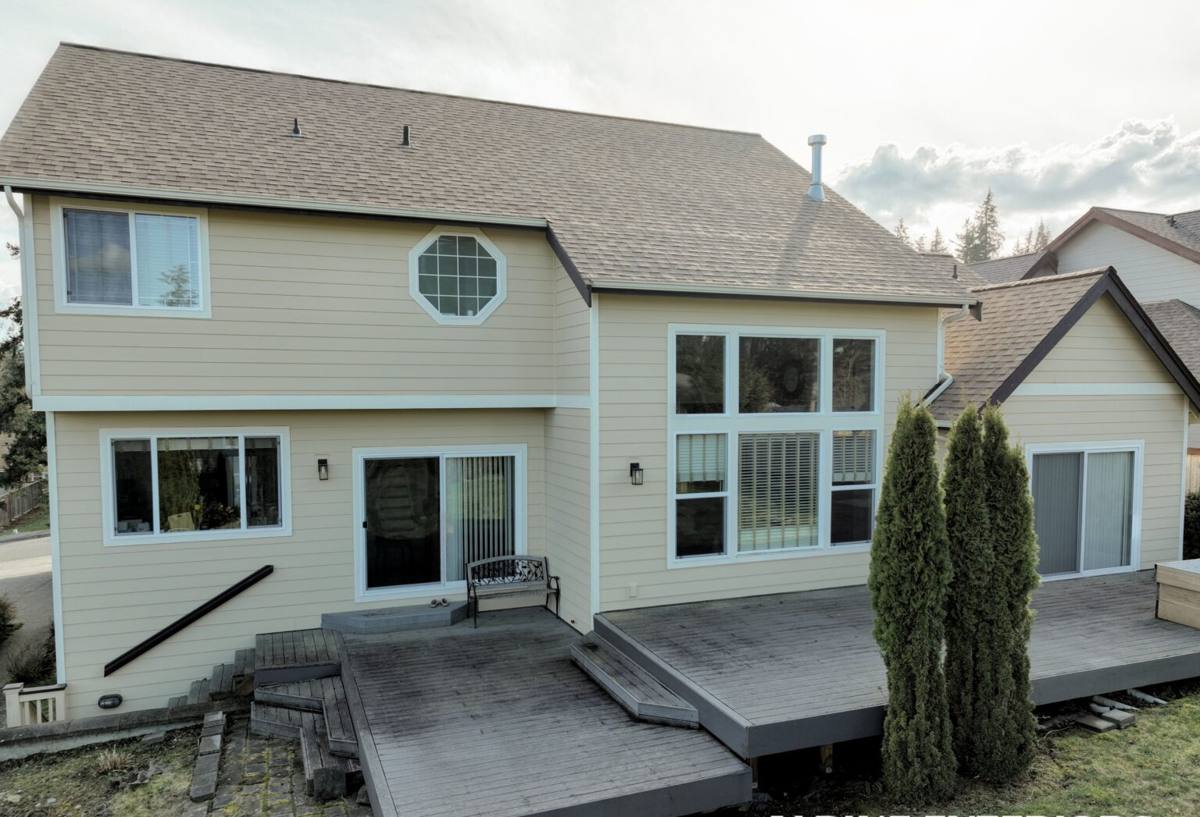
What "Energy-Efficient" Actually Means for a Bellingham Home
"Energy-efficient" gets used as a marketing word more than a technical one. For a marine climate like ours, two numbers matter most, and they don't always point the same direction as they would in a hot, sunny climate.
U-Factor and Solar Heat Gain in a Marine Climate
U-factor measures how well a window resists heat loss — lower is better, and it's the number that matters most here, since our heating season is longer and colder than our cooling season. Solar heat gain coefficient (SHGC) measures how much of the sun's warmth passes through the glass. In hot, sunny regions, installers push for low SHGC to keep heat out. In Bellingham, where sunshine is limited for much of the year, a moderate SHGC can actually help offset heating costs on the south- and west-facing sides of a home. We size glass packages to the specific elevation, not a one-size-fits-all spec sheet.
Frame Materials That Hold Up Here
Vinyl, fiberglass, and clad-wood frames each perform differently in a wet, salt-influenced climate. Vinyl is budget-friendly and low-maintenance but can expand and contract more with temperature swings, which matters for seal longevity over time. Fiberglass costs more up front but holds dimensional stability well and resists moisture-related degradation, which is a real advantage given how much of the year our siding and trim stay damp. Clad-wood windows offer a traditional interior look but require more attention to exterior sealant maintenance, since any breach in the cladding exposes wood to constant moisture. We'll walk you through the honest trade-offs for your home rather than pushing one material for every situation.
Signs Your York Home's Windows Are Costing You Money
Most homeowners don't think about their windows until something is visibly wrong, but a window can be quietly losing you money and letting moisture in long before you notice a problem. Walk through your home and check for these:
- Cold drafts near the window frame even when the sash is fully latched
- Condensation or fogging between the panes of a double-pane unit (a sign the seal has failed)
- Visible daylight or air movement around the frame when a door closes elsewhere in the house
- Soft, spongy, or discolored trim and sill wood on the interior or exterior
- Windows that are difficult to open, close, or lock, or that no longer sit flush in the frame
- Rising heating bills without a clear explanation elsewhere in the home
- Visible moss, algae, or persistent black staining on or around the sill
- Paint that's bubbling or peeling specifically around window openings, not the whole wall
Any one of these on its own might be minor. Several together usually mean the window and its surrounding flashing need a real look, not just a caulk touch-up.
What a Correct Window Installation Involves
The window unit itself is often the easy part. Most callback problems we see in this region trace back to the installation, not the product.
Flashing and Water Management
Every opening needs a drainage plane that directs water out and down, never trapping it behind the siding. That means correctly lapped flashing tape, a sloped sill pan so any water that gets past the window drains back outside instead of pooling, and integration with the existing weather-resistive barrier so the whole wall assembly sheds water as one system. Skipping the sill pan is one of the most common shortcuts we see on prior installs in this area, and it's usually invisible until there's rot.
Air Sealing and Insulation
The gap between the window frame and the rough opening needs to be filled with a proper low-expansion insulating foam or backer rod and sealant — not stuffed with fiberglass batting, which does little to stop air movement. Poor air sealing shows up as drafts and higher energy bills even with a brand-new, high-performance window.
Comparing Window Options for a York Home
| Factor | Vinyl | Fiberglass | Clad-Wood |
|---|---|---|---|
| Upfront cost | Lowest | Mid to higher | Highest |
| Moisture resistance | Good | Very good | Good, if cladding stays intact |
| Maintenance | Low | Low | Moderate — sealant checks needed |
| Interior appearance | Simple, functional | Clean, paintable | Traditional wood look |
| Best fit | Budget-conscious full replacements | Long-term, low-hassle performance | Homes prioritizing a traditional interior finish |
Our Process, Start to Finish
We keep the process straightforward because homeowners in York have usually already dealt with one contractor who overcomplicated it or disappeared mid-job.
- On-site assessment. We look at each window opening individually — not every window on a home needs the same fix, and we'll tell you honestly which ones do.
- Straightforward proposal. You get a written scope covering materials, flashing details, and timeline, not just a single lump-sum number.
- Proper removal. We check the rough opening and sheathing condition once the old window is out, before anything new goes in.
- Correct installation. Sill pan, flashing, insulation, and air sealing done in the right order — every time, not just when someone's watching.
- Final walkthrough. We test operation, check seals, and clean up before we consider the job done.
Repair, Replace, or Full Window Package? Cost Factors
Not every window needs full replacement. Sometimes a failed seal, damaged weatherstripping, or a rotted section of sill can be repaired for a fraction of the cost of a new unit. Full replacement makes more sense when the frame itself is compromised, when a home has a mix of aging single-pane and inefficient double-pane units, or when you're already doing siding or trim work and it makes sense to handle windows at the same time. Broad cost drivers include:
- Number of openings and their size — larger or custom shapes cost more than standard sizes
- Frame material chosen (vinyl, fiberglass, or clad-wood)
- Condition of the existing rough opening and any hidden rot repair needed
- Whether trim, siding, or interior casing needs to be replaced to match
- Access — second-story or hard-to-reach openings take more labor
We'll give you a real number after we've actually looked at your windows, not a guess over the phone.
Why a Crew That Already Works in York Matters
York's housing stock spans a range of ages and construction styles, and a crew that's worked in the neighborhood already has a feel for what's typically hiding behind the trim on a home of a given era — older single-pane sash windows, aluminum-frame replacements from past decades, or various vinyl retrofits. That familiarity means fewer surprises, a more accurate initial estimate, and a crew that isn't learning Bellingham's climate demands on your dime. We're not a national outfit passing through Whatcom County for a season — this is where we work, year-round, in the same rain and salt air your windows have to stand up to.
If your York home's windows are drafty, foggy, hard to operate, or just overdue for an honest evaluation, we're happy to take a look and give you a straightforward assessment. Reach out for a free, no-pressure estimate using the form below.