 Bellingham
 Why Decks in the Columbia Neighborhood Take Extra Punishment
Decks in Columbia deal with a combination most inland Whatcom County homes never have to think about. Proximity to Bellingham Bay means salt-laden air moving through the neighborhood on a regular basis, and that air is hard on anything metal — fasteners, joist hangers, railing brackets, even the heads on deck screws. Add in the driving rain that comes off the water for much of the year and a moss season that can stretch from fall through spring, and you have a recipe for decks that look fine on the surface while quietly losing structural integrity underneath.
None of this means a deck in Columbia is doomed to fail early. It means the repair work has to account for these conditions specifically, rather than treating every deck repair like it's happening in a dry inland climate. That's the difference between a repair that lasts one season and one that lasts fifteen.
Salt Air and Corrosion
Salt air accelerates corrosion on standard fasteners and hardware far faster than people expect. A joist hanger or bolt that would last decades in a drier, inland part of the county can start rusting and weakening within a handful of years near the water. Once fasteners corrode, they lose holding strength — and a deck is only as strong as the connections holding it together.
Driving Rain and Moss
Wind-driven rain finds its way into places a light, straight-down rain never would — under railing caps, behind ledger boards, into end-grain cuts on decking boards. Combined with the shade many Columbia lots get from mature trees, that moisture sits long enough for moss and algae to take hold. Moss holds water against wood surfaces and hardware, which is exactly the condition that causes slow, hidden rot.
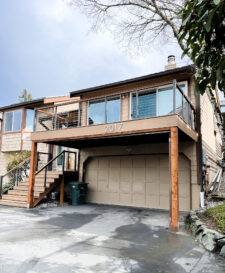
Repair or Replace? Reading the Signs
Most decks don't need to be torn out and rebuilt. The framing — the joists, beams, and posts underneath — often outlasts the decking boards on top, especially if it was built with pressure-treated lumber and reasonable drainage. The goal of a proper inspection is figuring out exactly which parts have failed and which parts are still sound, so you're not paying to replace what doesn't need it.
- Soft or spongy spots when you walk across the deck surface
- Boards that are visibly cupping, splitting, or have gone gray and fuzzy
- Railings or posts that wiggle or flex when pushed
- Rust streaks running down from screw heads or metal connectors
- Gaps opening up where the deck attaches to the house (the ledger board)
- Stairs that feel bouncy or have visibly sagging stringers
- Standing water or slow drainage after rain instead of water running off
- Moss or dark green-black staining building up on boards or in corners
If you're seeing one or two of these, it's usually a repair. If you're seeing several at once, especially structural ones like sagging stringers or a loose ledger connection, it's worth a full evaluation before deciding.
What a Correct Deck Repair Actually Involves
A repair that only replaces what's visible on top and ignores what's underneath is a repair that fails again in a few years. A proper job works from the structure outward.
Structural Framing and the Ledger Connection
The ledger board — the piece that bolts the deck to the house — is the single most important structural connection on most decks, and it's also the piece most likely to trap water against the house's framing if it wasn't flashed correctly to begin with. Any repair that touches this area needs to check the bolts, the flashing behind it, and the condition of the wood on both the deck side and the house side before anything gets closed back up.
Flashing and Moisture Management
Flashing is the metal or membrane barrier that keeps water from getting into seams and connection points. It's invisible once the job is done, which is exactly why it's the part most likely to get skipped by a rushed repair. In a climate with as much driving rain as Bellingham gets, flashing at the ledger, around posts, and under railing caps isn't optional — it's the difference between a repair that holds and one that just delays the same failure.
Fasteners and Hardware
Given the corrosion issue discussed above, hardware selection matters more in Columbia than it would a few miles inland. We match fastener and connector grade to how exposed the deck is — a fully covered deck under an eave has different needs than one sitting open to weather off the bay.
Common Deck Repairs We Handle in the Area
The specific repair scope varies by deck, but the issues we run into most often in Columbia and the surrounding neighborhoods fall into a fairly consistent pattern:
- Rotted or damaged decking boards — replacing individual boards or full sections without disturbing sound framing underneath
- Ledger board and flashing repair — re-securing and properly flashing the connection where the deck meets the house
- Joist and beam sistering or replacement — reinforcing or replacing weakened structural members
- Railing and baluster repair — fixing loose, rotted, or corroded railing systems for both safety and code compliance
- Stair stringer repair — addressing sag or rot in the framing that supports deck stairs
- Post base and footing issues — dealing with posts that have shifted, rotted at the base, or lost their connection to the footing
- Fastener and hardware replacement — swapping corroded connectors for hardware rated for the exposure
Repair vs. Full Replacement: Cost Factors
Every deck is different, but the factors that push a job toward repair versus full replacement are consistent. This table covers the general trade-offs — actual scope and cost depend on the specific deck.
| Factor | Repair | Full Replacement |
|---|---|---|
| Framing condition | Sound, only isolated damage | Widespread rot or undersized framing |
| Typical cost | Few hundred to a few thousand dollars, depending on scope | Several thousand dollars and up, sized to square footage |
| Timeline | Often completed in a day or two | Multiple days to a couple of weeks |
| Best fit | Deck is structurally sound with surface or connection issues | Deck is undersized, outdated, or failing in multiple structural areas |
| Long-term value | Extends useful life if framing is solid | Resets the clock with current materials and code |
Hardware Choices Matter More Near the Bay
Not all fasteners and connectors are built for the same conditions, and this matters more for Columbia decks than for decks further from the water. Standard electro-galvanized hardware is fine in a lot of situations, but it's not the right call for every location on every deck.
| Hardware Type | Corrosion Resistance | Where It Fits |
|---|---|---|
| Standard galvanized | Moderate | Covered, low-exposure areas |
| Hot-dip galvanized | Higher | General exterior use, most framing connections |
| Stainless steel | Highest | Fully exposed areas, near the water, treated lumber contact points |
We pick hardware grade based on where it sits on the deck and how exposed that spot is — not just whichever box happens to be on the truck.
Our Deck Repair Process
- Inspection — we get underneath the deck, not just walk the surface, to check framing, ledger connection, posts, and footings
- Scope and honest recommendation — we tell you what actually needs repair, what's still sound, and what to keep an eye on going forward
- Written estimate — clear scope and pricing before any work starts, no surprises added mid-job
- Repair work — structural fixes first, then decking, railing, and finish work, with proper flashing at every connection we open up
- Final walkthrough — we check the work with you and make sure the deck feels solid, not just looks finished
Choosing Materials for the Repair
Wood vs. Composite Decking Boards
For framing, pressure-treated lumber remains the standard for a reason — it's proven, cost-effective, and holds up well when properly flashed and fastened. For the decking surface itself, the choice between wood and composite comes down to maintenance appetite. Wood decking costs less up front but needs regular cleaning, moss treatment, and occasional refinishing to hold up through wet Whatcom County winters. Composite decking costs more initially but sheds moisture differently and doesn't need staining, which some homeowners prefer given how much moss pressure this area sees.
Matching New Material to Old
When we're repairing sections of an existing deck rather than replacing the whole thing, we also account for how new material will weather next to existing boards — a mismatch in how wood ages can be avoidable with the right species and finish choice up front.
Why Hire a Crew That Already Works in Columbia
A contractor who works this neighborhood regularly already knows what to expect before they climb underneath your deck — the salt air exposure, the drainage patterns on sloped lots near the bay, the moss buildup pattern typical of shaded yards in this part of Bellingham. That familiarity shows up in the details: the hardware grade they reach for by default, where they know to look for hidden ledger rot, how they sequence work around the wetter months.
It also means straightforward accountability. We're not driving in from out of the area for a one-time job — we're a local crew that expects to be back in this neighborhood, which is exactly the incentive that keeps a repair honest.
If you're seeing soft spots, rust streaks, a loose railing, or just want an honest read on whether your deck needs repair or replacement, we'd be glad to take a look. Fill out the form below for a free, no-pressure estimate — we'll tell you plainly what we find.