 Bellingham
 Decking in Fairhaven Has to Answer to the Bay
Fairhaven sits close enough to Bellingham Bay that salt-laden air, wind-driven rain, and long stretches of shade from mature trees all show up in how a deck ages. A deck built the same way you'd build one in a dry inland climate tends to disappoint here within a few seasons. Wood decking that isn't maintained on schedule checks and grays fast. Fasteners that aren't rated for coastal exposure streak and corrode. Framing that traps moisture instead of shedding it starts hosting moss and mildew before the deck is even five years old.
Composite decking, installed correctly for this specific environment, is one of the more sensible answers to that problem. It isn't maintenance-free — nothing exposed to Whatcom County weather truly is — but it removes the yearly sanding-and-sealing cycle that wood demands, and it handles moisture cycling and shade far better than natural lumber when the substructure underneath is built right.
This page is specifically about composite decking for Fairhaven properties: what the neighborhood's conditions demand, what a correct installation actually involves, and why the details matter more here than they would somewhere drier and sunnier.
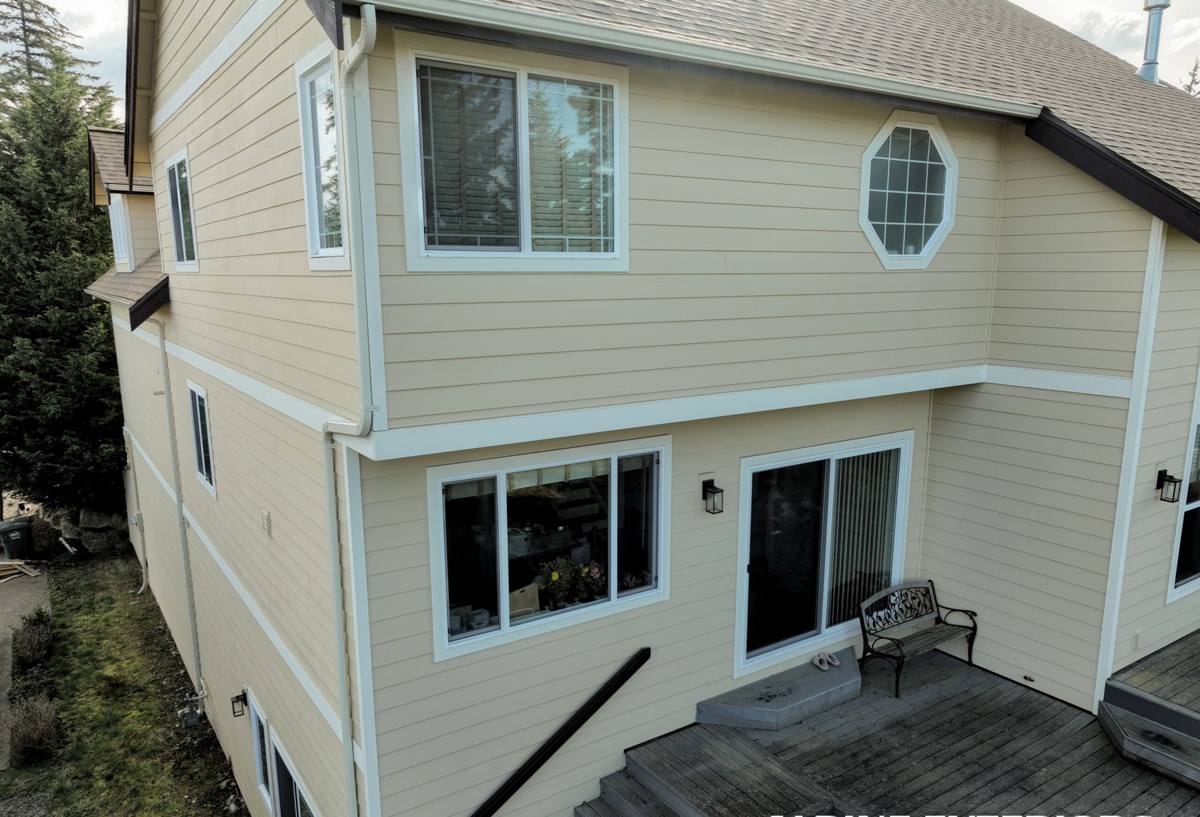
What Fairhaven's Climate Does to a Deck
Salt Air and Metal Fasteners
Proximity to the bay means airborne salt settles on outdoor surfaces more than it would further inland in Bellingham. Over time, standard fasteners and hardware corrode faster, streak the decking surface, and can weaken structural connections. Coastal-rated, corrosion-resistant fasteners and hidden fastening systems matter more here than the manufacturer's minimum spec would suggest for a typical inland install.
Driving Rain and Standing Water
Whatcom County's wet season isn't just steady drizzle — it includes wind-driven rain that gets pushed sideways into ledger connections, under railings, and along board ends where composite material is most vulnerable if it isn't properly capped or sealed. Decks that don't shed water efficiently end up with standing puddles on the surface and damp framing underneath, both of which shorten the life of everything from the joists to the fascia.
Moss, Algae, and Shade
Fairhaven's tree cover is part of what makes the neighborhood attractive, but shaded, damp decking is exactly where moss and algae take hold. Composite surfaces resist rot the way wood can't, but a slick, moss-covered composite board is still a slip hazard and still needs airflow and drainage design to keep organic growth from building up season after season.
Why Composite Makes Sense Here Specifically
We don't push composite decking on every homeowner as a blanket rule — it's a legitimate trade-off, not a magic fix, and we'll say so plainly. But for a Fairhaven property dealing with salt exposure, shade, and heavy annual rainfall, composite has real advantages over solid wood decking:
- No annual sanding, staining, or sealing cycle to keep ahead of moisture damage
- Consistent resistance to rot and insect damage across the entire board, not just the treated surface
- Color and texture that don't rely on a maintained finish to look good
- More predictable long-term performance in a climate where wood decking often gets neglected during the wettest months
The trade-offs are real too: composite costs more upfront than standard pressure-treated wood, board expansion and contraction with temperature swings has to be accounted for in the installation, and not every composite product handles algae and mildew the same way. Part of doing this job right is picking a product line and installation method suited to a wet, shaded, coastal-influenced lot — not just installing whatever's cheapest or most available.
What a Correct Installation Involves
Substructure First
The framing underneath a composite deck matters as much as the decking itself, arguably more in a climate like this one. Joists need proper spacing for the specific composite product being used — many composite boards require tighter joist spacing than wood, especially on angled or diagonal patterns. Framing should be pressure-treated lumber or an equivalent rot-resistant material, properly flashed at the ledger board where the deck meets the house, since that connection is one of the most common sources of hidden water damage.
Ventilation and Drainage
Composite decking doesn't rot, but the framing beneath it can if moisture gets trapped with nowhere to go. Correct installs leave adequate airflow under the deck, grade the ground below for drainage rather than pooling, and avoid enclosing the underside in a way that traps humidity against untreated wood.
Fastening and Board Gapping
Composite boards expand and contract more than wood with temperature changes, and Whatcom County sees enough seasonal swing that gapping has to be calculated correctly at installation, not eyeballed. Hidden fastener systems, when used, need to be rated for the specific board profile and spaced to allow that movement without buckling or gapping unevenly over time.
Rail, Post, and Stair Details
The places a deck actually fails first are usually the connection points — post bases, stair stringers, and railing anchors — not the open field of decking. These get built with the same attention to water shedding and corrosion resistance as the decking surface itself.
Our Process for a Fairhaven Composite Deck
- On-site assessment. We look at sun exposure, tree cover, drainage slope, and how close the property sits to salt air influence, since all of that affects material choice and structural detailing.
- Material selection. We walk through composite product options with honest trade-offs — cost, color retention, mildew resistance, and warranty terms — rather than defaulting to one brand.
- Framing and structural work. Any needed repairs or upgrades to the substructure happen before a single composite board goes down. A composite deck is only as good as what's underneath it.
- Installation. Boards, fasteners, and rail systems are installed to the manufacturer's spec adjusted for local conditions — proper gapping, coastal-rated hardware, and correct ventilation.
- Final walkthrough. We go over what maintenance the specific product does and doesn't need, so there are no surprises the first wet winter.
Composite Decking Options: A Practical Comparison
| Factor | Capped Composite | Uncapped / Basic Composite | Solid Wood (for reference) |
|---|---|---|---|
| Moisture resistance | Strong — protective shell resists staining and swelling | Moderate — more prone to moisture absorption over time | Requires annual sealing to resist moisture |
| Moss/algae resistance | Better surface resistance, still needs airflow | More porous, can hold organic growth longer | Prone to moss in shaded, damp areas |
| Upfront cost | Highest | Mid-range | Lowest |
| Ongoing maintenance | Occasional cleaning | Occasional cleaning, more attentive care near board ends | Annual sanding/staining/sealing |
| Typical warranty | 25+ years, product-dependent | Shorter, product-dependent | No manufacturer warranty on the wood itself |
None of these is universally "right" — the honest answer depends on your budget, how much sun and shade the site gets, and how much upkeep you're actually willing to do. We'll give you a straight read on which fits your Fairhaven property rather than steering you toward the highest-margin option.
Signs Your Existing Deck Needs Attention
If you're deciding whether to repair an aging wood deck or replace it with composite, a few signs tip the scale toward replacement:
- Soft or spongy spots in the decking boards, especially near the house or at board ends
- Persistent moss or algae that returns within weeks of cleaning
- Visible rust streaking from fasteners or hardware
- Gaps or movement at the ledger board connection to the house
- Railings or posts that feel loose or flex under normal use
- A finish that no longer holds a stain or sealer for more than a season
Any of these can usually be diagnosed in a single visit, and it's worth having someone look before the next wet season does more damage to the framing underneath.
Why a Local Crew Matters for This Job
Composite decking installation isn't exotic work, but doing it correctly in a bay-adjacent, tree-shaded neighborhood like Fairhaven takes more judgment than following a generic install manual. A crew that already works Whatcom County jobs knows how much board gapping to leave for our actual temperature swings, which fastener grades hold up against salt air over years rather than months, and how to grade and ventilate a substructure so it doesn't trap moisture through a typical Bellingham winter.
That local knowledge shows up in details a homeowner might never think to ask about — flashing choices at the ledger, drainage slope under the deck, hardware selection — but those are exactly the details that determine whether a composite deck looks and performs well ten years in, or starts showing problems in year three.
Maintenance: What Composite Still Requires
Composite decking is lower-maintenance than wood, not maintenance-free. In this climate, a realistic upkeep routine includes:
- Periodic sweeping and rinsing to keep organic debris from building up in shaded areas
- Cleaning moss or algae promptly with a manufacturer-approved cleaner rather than a pressure washer at close range
- Checking gaps between boards each fall to make sure debris hasn't packed in ahead of the wet season
- Inspecting fasteners, rail connections, and stair hardware annually for corrosion or movement
- Keeping gutters and downspouts near the deck clear so runoff isn't dumping directly onto the decking or framing
None of this is heavy work, but skipping it entirely is how even a good composite deck ends up looking neglected faster than it should in a wet, shaded environment like Fairhaven's.
Getting an Honest Estimate
Every Fairhaven property is a little different — sun exposure, tree cover, existing framing condition, and how close you are to the water all factor into the right approach and the right price range. We'd rather walk your specific site and give you a straight answer than quote a number sight unseen.
If you're weighing composite decking for a Fairhaven home, we're happy to come take a look and talk through your options with no pressure and no obligation — just fill out the form below to get started.