 Bellingham
 Why Happy Valley's Setting Is Hard on Siding
Happy Valley sits close enough to Bellingham Bay that salt-laden air is a fact of life for the homes here, and it doesn't take a waterfront lot to feel the effects. Salt air accelerates corrosion on fasteners and trim, and it works into any gap in a siding system that wasn't sealed correctly the first time. Add in the driving rain that blows in off the water during fall and winter storms, and you have a combination that punishes weak points in a home's exterior fast.
The neighborhood's mature tree cover and hillside streets add a second problem: shade. Homes tucked under trees or facing north dry out slower after every rain, which is exactly the condition moss and mildew need to take hold. In Whatcom County, moss season isn't a few weeks — it's realistically fall through spring, and on a shaded wall it can be closer to year-round. Siding that can't shed water quickly or resist organic growth is going to show it within a few years, not decades.
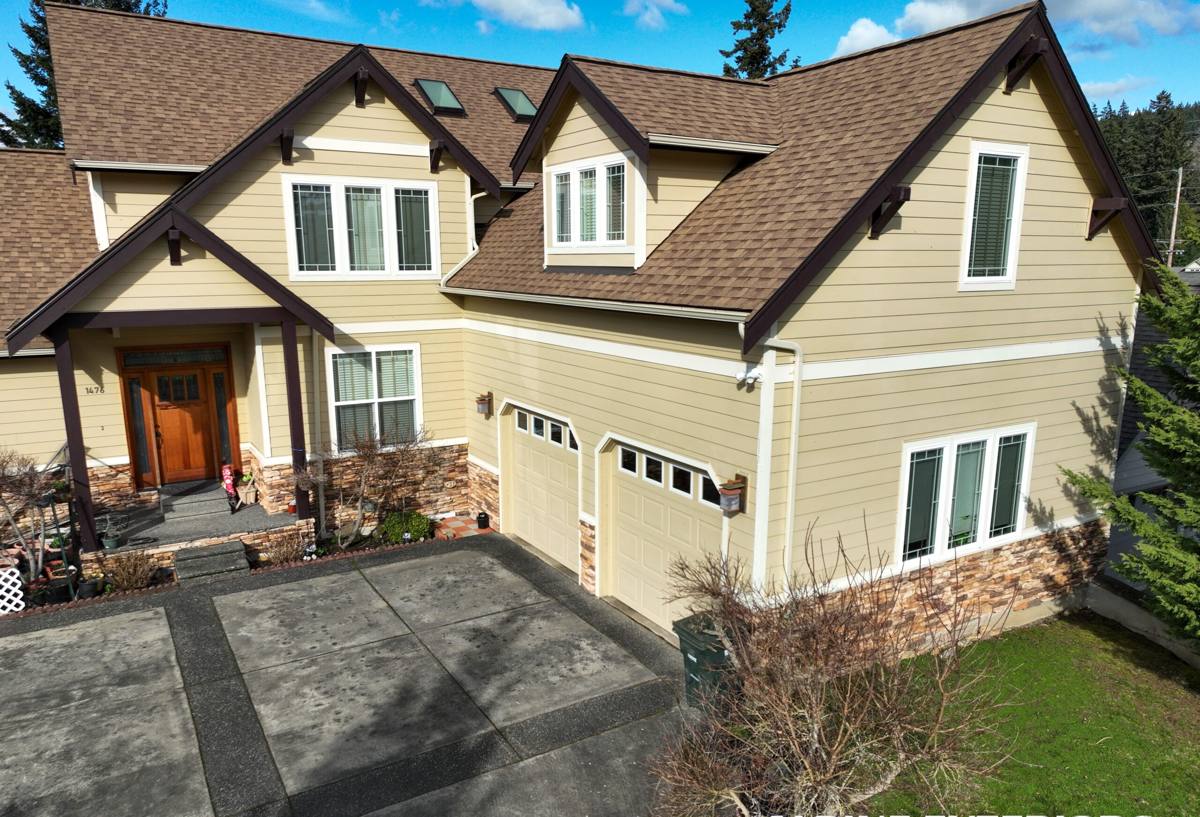
What Fiber Cement Siding Has to Do Here, Specifically
Shed water fast, even in shade
A siding system on a shaded Happy Valley wall needs a real drainage plane behind it — a gap that lets bulk water and moisture vapor escape instead of sitting against the sheathing. This matters more here than it does on a sunny, exposed wall that dries out between storms.
Resist moss and mildew without constant babysitting
No siding material is moss-proof — moss will grow on almost anything given enough shade and moisture. What matters is whether the material and finish resist staining and surface breakdown while that moss is present, and whether it can be cleaned without damaging the finish underneath.
Hold its finish without repeated repainting
Shaded, damp walls are hardest on paint. A factory-applied finish that's baked on and warranted against fading and peeling holds up far better here than field-applied paint, which tends to fail first in exactly these conditions.
Handle wind-driven rain at every joint
Storms coming off Bellingham Bay don't fall straight down — they hit the wall at an angle, which pushes water into butt joints, corner trim, and window flashing. Every seam is a potential entry point if it isn't detailed correctly.
Why We Only Install James Hardie Fiber Cement
We don't install vinyl, LP SmartSide, primed spruce, or cedar, and we're upfront about why: fiber cement from James Hardie is the material we trust to hold up to this specific climate over the long haul. It's non-combustible, it doesn't rot or swell the way wood-based products can when moisture gets past the finish, and Hardie's ColorPlus factory finish is baked on and backed by its own finish warranty — which matters on a wall that stays damp for months at a time. Hardie also engineers its HardieZone product lines for regional climate demands, so what we install here is matched to Pacific Northwest moisture exposure rather than a one-size-fits-all spec. That's a standard we hold across every job, not just the ones on the water.
How Fiber Cement Compares for This Climate
| Factor | James Hardie Fiber Cement | Vinyl | Cedar / Untreated Wood |
|---|---|---|---|
| Moisture & rot resistance | Engineered to resist moisture damage; won't rot | Won't rot itself, but traps moisture behind it | Absorbs water; prone to rot without diligent upkeep |
| Moss & mildew staining | Resists staining; can be cleaned without stripping finish | Can stain and gets brittle; cleaning can crack panels | Stains easily; moss can accelerate wood breakdown |
| Finish longevity in shade | Factory finish, warranted against fade/peel | Color molded in but can chalk and fade over time | Needs repainting or staining every few years |
| Wind-driven rain performance | Rigid, holds tight seams when installed to spec | Can flex and gap at seams over time | Seams and joints are ongoing maintenance points |
| Fire resistance | Non-combustible | Combustible, can melt/deform | Combustible |
What a Correct Installation Involves
Fiber cement is only as good as the install behind it. A rushed or under-detailed job will fail in this climate regardless of the siding brand on the wall. On every Happy Valley project we treat these steps as non-negotiable:
- A drainage gap (rain screen) between the siding and the weather-resistant barrier, so water and vapor have somewhere to go
- Correct flashing at every window, door, and roofline intersection — the majority of siding failures start at these transitions, not on the flat wall field
- Proper fastening pattern and fastener type, since undriven or overdriven nails compromise the panel's water resistance
- Caulked and back-primed cut edges wherever a factory edge isn't used, so exposed fiber cement can't wick moisture
- Correct clearance from grade, roofs, decks, and patios so the bottom edge of the siding never sits in standing water or snow
- Trim and joint details built for wind-driven rain, not just vertical rainfall
Our Process for a Happy Valley Project
- On-site assessment. We look at sun exposure, tree cover, drainage around the foundation, and the condition of the existing siding and trim before we talk product.
- Check what's underneath. Where old siding is coming off, we check the sheathing and framing for hidden moisture damage before anything new goes up — covering a wet wall with new siding just delays the problem.
- Product and color selection. We help you choose the right Hardie panel or lap profile and ColorPlus color, factoring in how the wall's exposure will affect it over time.
- Prep and tear-off. Removal of old material, repair of any compromised sheathing, and installation of a proper weather-resistant barrier and drainage gap.
- Installation to spec. Flashing, fastening, and joint detailing done to manufacturer and code requirements — not shortcuts to save a day of labor.
- Final walk-through. We inspect the finished work with you and cover basic care before we consider the job done.
Trouble Spots We Watch for in This Neighborhood
When we're evaluating an existing home in Happy Valley, these are the signs we look for first — they tend to show up here before anywhere else on the property:
- Dark green or black staining concentrated on north-facing or tree-shaded walls
- Soft or spongy siding near the bottom courses, especially close to grade or planter beds
- Paint that's peeling or bubbling in patches rather than fading evenly
- Gaps or cracking at butt joints and corner trim
- Rust streaking below fasteners or metal flashing
- Moss buildup thick enough to hold moisture against the wall rather than just sitting on the surface
None of these mean a home needs full replacement automatically, but they're worth having looked at before they spread into the sheathing.
What Drives Cost on a Project Like This
Every home is different, so we won't quote a number without seeing the house, but these are the factors that typically move a Happy Valley project up or down in scope:
| Factor | Tends to increase scope | Tends to keep scope simpler |
|---|---|---|
| Existing wall condition | Hidden moisture damage requiring sheathing repair | Dry, sound sheathing underneath |
| Home height and access | Multi-story walls, steep or tight hillside lots | Single-story, open access on all sides |
| Trim and detail complexity | Multiple gables, dormers, mixed siding profiles | Simpler roofline and fewer transitions |
| Tear-off vs. new construction | Full removal of old siding and disposal | New construction with no removal needed |
| Shade and drainage grading | Heavy tree cover, poor site drainage to correct | Good sun exposure and existing drainage |
Why It Matters to Hire a Crew That Already Works This Neighborhood
A crew that's worked other homes in and around Happy Valley already knows what the shade patterns, salt exposure, and local drainage tend to do to a wall over time — that's not something you can fully judge from a single walk-through on a sunny day. Familiarity with Bellingham's permitting process and Whatcom County's building requirements also keeps a project moving instead of stalling on paperwork. And a local crew is accountable in a way an out-of-town operation isn't: if a detail needs a second look after a hard winter storm, we're not far away.
Questions Worth Asking Before You Hire
- Do you install a proper drainage gap behind the siding, or does it go directly over the existing wall?
- How do you flash windows, doors, and rooflines — and can you explain it, not just point at a brochure?
- Will you check the sheathing for moisture damage before covering it with new siding?
- What warranty covers the material, and what warranty covers your labor separately?
- Have you worked on homes in this neighborhood or similar shaded, coastal-exposed lots before?
If your Happy Valley home's siding is showing moss staining, soft spots, or peeling paint — or you're planning ahead before it gets there — we're happy to take a look. The estimate is free, there's no pressure, and you'll get a straight answer about what your home actually needs.