 Bellingham
 Roof Repair in Barkley: What This Corner of Whatcom County Roofs Up Against
Barkley sits within the Bellingham area, inside the same marine weather system that shapes exterior work across Whatcom County. That means salt-tinged air drifting in off the water, rain that gets pushed sideways by wind more often than it falls straight down, and a moss season that runs long enough to become a year-round maintenance issue rather than a fall chore. None of that shows up as a dramatic, single-day event. It shows up as a roof that starts leaking two or three years before it should, or a repair that was patched once and is now back.
Roof repair is a different job than a full replacement, and it demands a different kind of attention. Instead of building one system from scratch, a repair means finding exactly where an aging or damaged roof has actually failed, understanding why it failed in this specific climate, and fixing that point correctly so the rest of the roof isn't compromised by a shortcut. That's the work we do for homes throughout Barkley and the surrounding Bellingham area, and it's worth understanding what a correct repair actually involves before you hire anyone to do it.
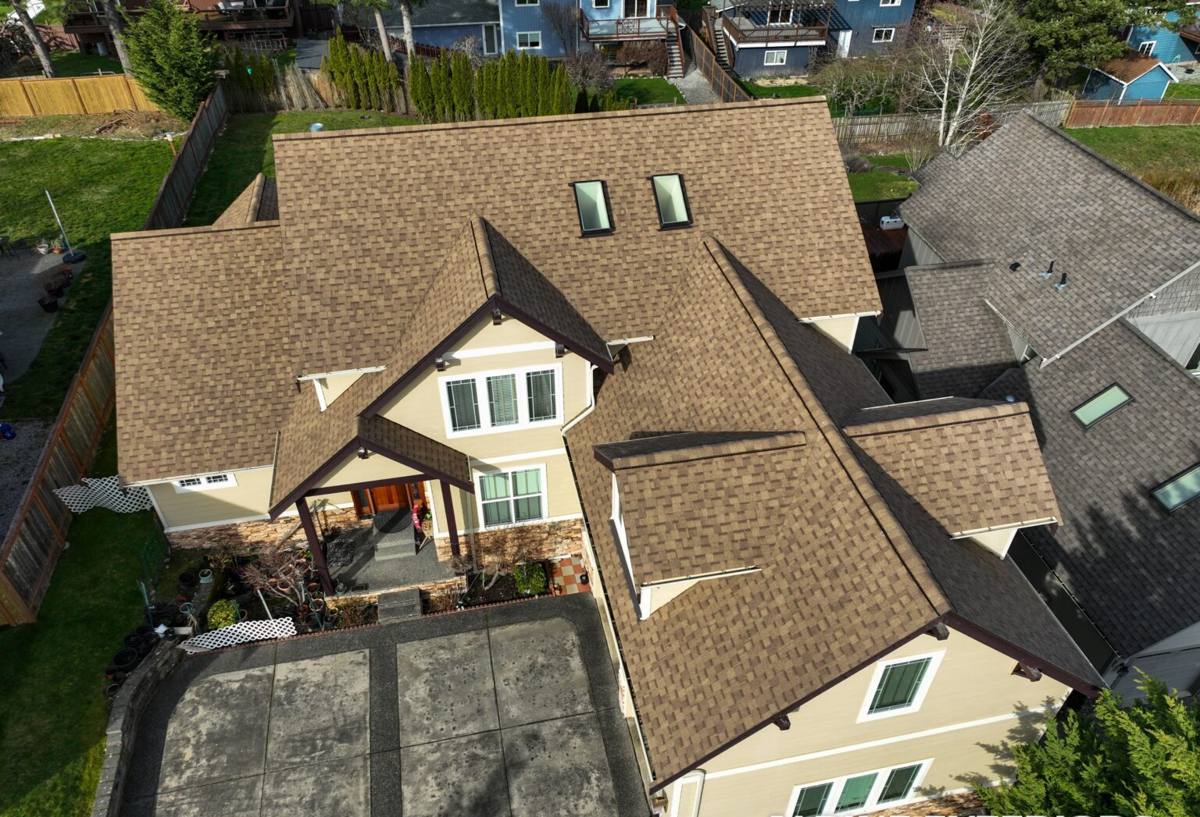
What Salt Air, Driving Rain, and a Long Moss Season Do to a Damaged Roof
Salt Air Accelerates Small Problems
Airborne salt moving through the Bellingham area speeds up corrosion on exposed fasteners, flashing, and vent hardware. A nail head or flashing seam that would hold up for decades in a drier inland climate can start rusting within a few years here, and a rusted fastener rarely fails quietly — it loosens, lets water track underneath it, and turns a pinhole-sized weak point into a real leak.
Driving Rain Finds Every Gap
Rain in this part of Whatcom County doesn't arrive straight down as often as homeowners assume. Wind pushes it sideways, which forces water into valleys, around penetrations, and under shingle edges that a calmer rain event would never test. A repair that only addresses the visible damage without accounting for how wind-driven rain moves across that section of roof tends to leak again at the first real storm.
Moss Extends the Damage Season
Shaded slopes, north-facing sections, and anything under tree cover stay damp long enough here to support moss growth for most of the year, not just a few wet months. Moss does more than stain a roof cosmetically — it holds water against the roofing material, works under shingle tabs, and gradually lifts and loosens sections that were otherwise sound. A repair on a roof with active moss growth nearby usually needs to address the moss itself, or the same spot fails again within a season or two.
Signs a Barkley Roof Needs Repair
Some of these are obvious from the ground. Others only show up once you know what to look for, which is part of why a second opinion from someone who works this climate regularly is worth having before a small problem becomes a big one.
- Water staining on an interior ceiling or wall, especially near an exterior wall, chimney, or skylight
- Shingles that are curling, cupping, cracked, or missing after a windstorm
- Granules collecting in gutters or at the base of downspouts in larger-than-normal amounts
- Moss or dark streaking concentrated on one slope or section rather than spread evenly
- Flashing around a chimney, vent pipe, or skylight that looks lifted, rusted, or gapped
- Daylight visible through the roof deck from inside the attic
- A soft, spongy feel underfoot in one area of an otherwise solid roof
- A leak that only shows up during storms with strong wind, rather than every time it rains
Any one of these on its own is usually a repair, not a replacement. It's when several of them show up at once, spread across multiple roof planes, that the conversation shifts toward whether repair is still the right call.
Repair or Replace: How We Help You Decide
We don't default to recommending the bigger job. Most of the roofs we look at in Barkley are still good candidates for a targeted repair, and we'll tell you that plainly when it's true. What actually drives the decision is a handful of specific factors: the age of the roof relative to its material's expected service life, how much of the total roof area is affected, whether the deck underneath the damaged section has soft spots or rot from long-term moisture, and how many times that same area has already been patched.
A localized leak at one flashing point on a roof that's otherwise in decent shape is almost always a repair. A roof nearing the end of its rated life, with moss-related damage spread across more than one slope or a deck that's showing soft spots when we get up there, is usually more honestly addressed with a replacement rather than a third or fourth round of patchwork on the same roof. We'll walk you through exactly what we find and why, and give you the real trade-offs rather than steering toward whichever option happens to be more profitable for us.
What a Correct Roof Repair Actually Involves
Finding the Real Source of the Leak
Water rarely enters a roof at the same spot where it shows up on a ceiling — it can travel along rafters, sheathing, or underlayment before finding a path inside. A repair that only patches the visible interior stain without tracing the leak back to its actual entry point is a repair that fails again, often somewhere new. Getting this step right is the difference between a fix that lasts and one that just buys a season.
Matching Materials Correctly
Shingles fade with age and sun exposure, so a repair patch cut from brand-new material rarely blends in seamlessly with a roof that's been up for ten or fifteen years. We're upfront about that reality rather than pretending an exact match is always possible, and we source the closest reasonable match while prioritizing that the repair performs correctly over that it's invisible.
Flashing Repair Done Right
A large share of the repair calls we see trace back to flashing — at chimneys, skylights, vent pipes, and roof-to-wall transitions — rather than the field of the roof itself. Flashing has to be properly lapped and integrated with the underlayment beneath it, not just re-caulked over the top. Sealant alone is a short-term fix in a climate with this much sustained wind-driven rain; it dries out, cracks, and lets the same leak return within a year or two.
Checking the Deck Underneath
Whenever a repair involves removing shingles or flashing, we take the opportunity to check the roof deck underneath for soft spots or moisture damage. Patching new roofing material over a compromised deck just hides a bigger problem for a little while longer, and it's far cheaper to catch and address deck rot during a repair than to discover it later as part of an emergency call.
Common Roof Repairs We Handle in Barkley
Not every repair call is the same problem. Here's how the most common ones tend to break down and what actually fixes them.
| Problem | Typical Cause in This Climate | What a Correct Fix Involves |
|---|---|---|
| Leak at chimney or skylight | Flashing lifted, cracked, or corroded by sustained moisture and salt air | Remove and re-flash with corrosion-resistant material, properly lapped with underlayment |
| Missing or damaged shingles after a windstorm | Wind-driven rain and gusts off the water lifting improperly sealed edges | Replace affected shingles and confirm surrounding fasteners and seals are still sound |
| Recurring moss on one slope | Shade or north-facing exposure keeping that section damp longer than the rest of the roof | Careful moss removal, targeted treatment, and addressing ventilation or shade contributing to it |
| Soft or spongy deck in a localized area | Long-term moisture intrusion through a failed flashing or shingle point | Cut back to sound decking, replace damaged sheathing, then re-roof that section correctly |
| Interior water stain with no obvious roof damage | Water traveling along the deck from a leak point elsewhere on the roof | Trace the actual entry point rather than patching at the visible stain location |
Our Roof Repair Process
- On-site inspection. We get on the roof, not just in the attic, to see the actual condition of the shingles, flashing, and deck rather than guessing from photos or a ground-level look.
- Leak tracing. If the source isn't obvious, we trace the path water is actually taking before recommending a fix, rather than patching the first thing we see.
- Honest scope and estimate. We explain what we found, whether it's a repair or something more, and give a clear estimate before any work starts.
- The repair itself. Damaged material comes off, the deck underneath gets checked, and the fix goes in with correct flashing, fastening, and material choices for this climate.
- Surrounding area check. We look at the roof area immediately around the repair, since a problem severe enough to cause one failure point often has a neighbor nearby that hasn't failed yet.
- Final walk-through. We show you what was done and talk through anything worth keeping an eye on going forward.
Cost Factors in a Barkley Roof Repair
Repair costs vary more than replacement costs do, since so much depends on what's actually found once we're on the roof. These are the main factors that move a repair estimate up or down.
| Factor | Why It Matters |
|---|---|
| Size and location of the damaged area | A single flashing point costs less to fix than damage spread across a full slope |
| Roof pitch and access | Steep or hard-to-reach sections take longer and require more safety setup |
| Deck condition underneath | Rot or soft sheathing found once shingles come off adds material and labor not visible beforehand |
| Material match and availability | Matching an older or discontinued shingle style can affect sourcing and cost |
| Number of penetrations involved | Repairs touching chimneys, skylights, or multiple vent pipes involve more flashing work than a plain shingle section |
| How many times the area has been patched before | Repeated prior patches sometimes need to be fully removed before a lasting fix can go in |
Why a Crew That Already Works Barkley Matters
A roofer who mainly works drier, inland jobs isn't wrong about roofing in general — they're just working from a different set of defaults. Flashing specs, fastener choices, and underlayment coverage that hold up fine somewhere with less rain and less salt exposure are often undersized for what a Bellingham-area roof takes on year after year. A crew that already works Barkley and the surrounding Whatcom County area has seen which repair shortcuts actually fail here, not just which ones fail in general.
That familiarity shows up in decisions homeowners rarely notice directly: which flashing details are worth the extra time rather than relying on sealant, where moss is likely to return based on a roof's shade and orientation, and how a repair on one section should account for how water actually moves across the whole roof during a real Whatcom County storm rather than a calm test day.
After the Repair: Staying Ahead of the Next Wet Season
A correctly done repair still benefits from some basic upkeep given the climate it has to perform in.
- Keep gutters and downspouts clear so water isn't backing up under roof edges during heavy rain
- Have moss addressed while it's still a light growth rather than waiting until it's established
- Trim back tree limbs that keep a section of roof shaded and slow to dry
- Take a look at flashing points after any major windstorm, especially around chimneys and skylights
- Get a small leak looked at right away rather than waiting to see if it happens again
If you're dealing with a leak, storm damage, or a roof that's just starting to show its age, we're happy to take a look and give you an honest read on what it actually needs. Reach out using the form below to schedule a free, no-pressure estimate.