 Bellingham
 New-Construction Windows: What "Correct" Actually Means Here
New-construction windows are installed during framing, before siding goes on, using a nailing flange that fastens directly to the sheathing. That's different from a replacement window, which gets inserted into an existing opening with the old frame left in place. Because the wall is still open when new-construction windows go in, you get one real chance to build a proper water-management system around every opening — flashing, weather-resistive barrier laps, sill pans, all of it done in the correct order. Get that sequence wrong on a new build in Sehome, and you're not dealing with a cosmetic issue years later. You're dealing with water intrusion behind siding that's already painted and finished, which is a much more expensive problem to fix than it would have been to prevent.
We treat new-construction window installation as a systems job, not a "set the window and caulk it" job. The window itself is only one part of a assembly that has to shed water for decades in a marine climate.
Why Sehome's Site Conditions Matter for Window Installation
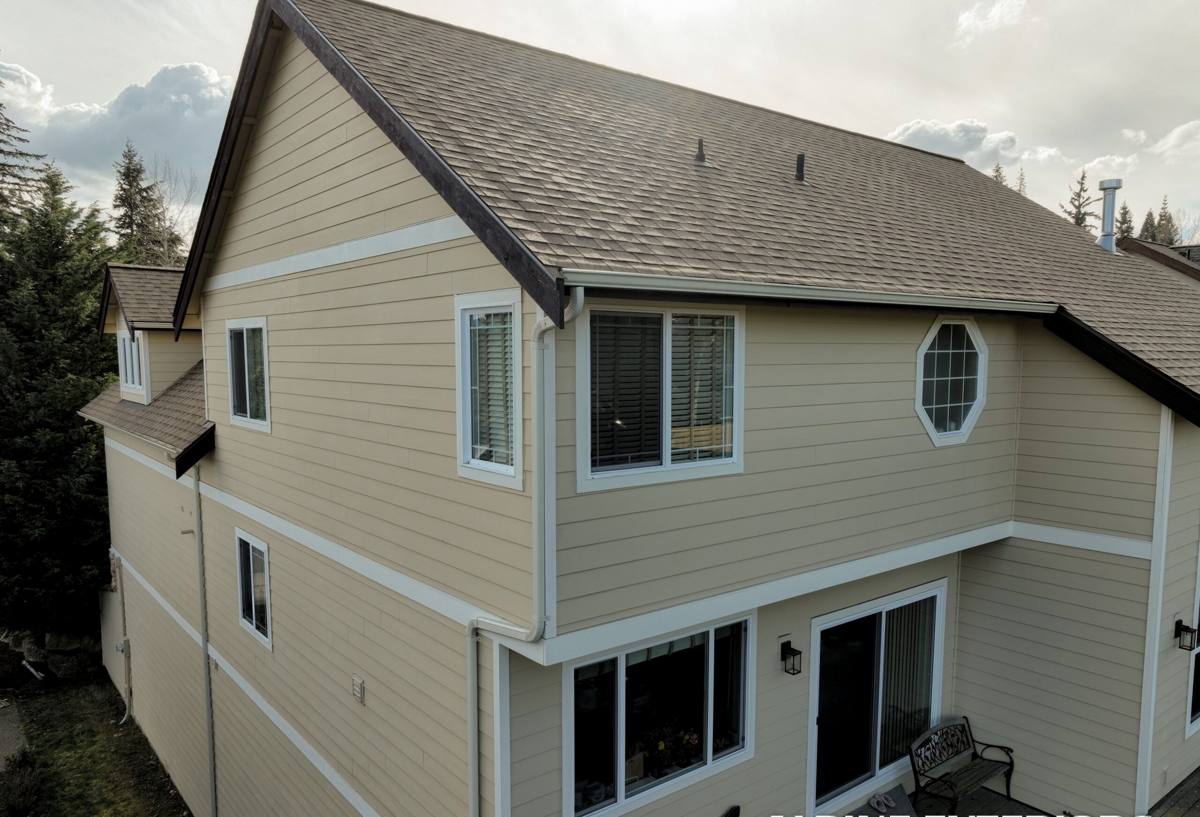
Sehome sits close enough to Bellingham Bay that salt-laden air is a real factor for exterior materials, and it shares the wooded, hilly character common near Sehome Hill — which means more shade, slower drying times, and longer moss season on north- and west-facing walls than you'd see on an open, sunny lot. None of that is unique to any one property, but it adds up:
- Salt air accelerates corrosion on unprotected fasteners, cheap flashing tape, and lower-grade window hardware over time.
- Driving rain off Pacific storm systems pushes water sideways into wall assemblies, not just straight down — which is exactly the scenario window flashing is designed to handle, if it's installed correctly.
- Tree cover and shaded exposures around Sehome's more wooded lots keep siding and trim damp longer after a storm, which is when poor flashing details show their weaknesses first — usually as staining or soft trim before you ever see interior damage.
None of this means new-construction windows in Sehome need to be exotic or over-built. It means the basics — sill pans, flashing laps, sealant selection, and fastener quality — have to be done right every single time, because this climate doesn't forgive shortcuts the way a drier region might.
The Window Opening: What Has to Happen Before Glass Goes In
The window itself is often the easy part. The opening is where jobs succeed or fail. A correct sequence, from the framing stage forward, looks like this:
- Rough opening check — squared, level, and sized to the manufacturer's specified tolerance, not "close enough."
- Sill pan flashing — a sloped, back-dammed pan at the bottom of the opening so any water that gets past the window has somewhere to go besides into the wall framing.
- Weather-resistive barrier integration — the WRB (house wrap) is lapped in shingle-fashion around the opening so water always drains down and over, never into a seam.
- Window installation — set to manufacturer instructions, shimmed correctly so the frame isn't racked, and fastened through the nailing flange per spec.
- Flashing tape at jambs and head — integrated with the WRB in the correct order (sides before top) so the head flashing laps over everything below it.
- Sealant at the right points only — interior air seal, and select exterior joints — never a fully sealed perimeter, which traps moisture instead of letting it drain.
Every one of these steps depends on the one before it. Skip the sill pan and the best window in the world still has nowhere for water to go if a seal ever fails decades from now. This is why we don't treat window installation as a standalone trade — it has to be coordinated with framing and siding sequencing on the build.
Choosing Window Products for New Builds in This Climate
Frame material matters more in a marine climate than in a dry one, mainly because of how each material handles sustained moisture exposure and temperature swings. Here's how the common options compare for a new build in this area:
| Frame Material | Moisture Behavior | Maintenance | Typical Fit for Sehome |
|---|---|---|---|
| Vinyl | Doesn't absorb water; won't rot | Low — occasional cleaning | Solid value option; verify weld quality on corners |
| Fiberglass | Dimensionally stable in wet/dry cycles | Low | Strong long-term choice; higher upfront cost |
| Wood-clad | Vulnerable if cladding or sealant fails | Higher — cladding seams need monitoring | Works if detailing and upkeep are taken seriously |
| Aluminum | Conducts cold, can condense; corrosion risk near salt air without proper coating | Moderate | Best reserved for specific design needs, not general use here |
We don't push one brand as universally "best" — we size the product to the wall assembly, the budget, and the exposure of that particular elevation. A north-facing wall shaded by trees and a south-facing wall in full sun on the same house can reasonably use different glazing packages. What we won't do is install a product whose flashing and drainage requirements we can't execute correctly, or one whose warranty structure puts the burden of proof on the homeowner if something goes wrong. That's a standard we hold regardless of brand.
Our New-Construction Window Installation Process
On a typical new build or major addition in Sehome, here's how we run it:
- Framing review — we check rough openings against window schedules before anything is ordered, catching sizing conflicts early.
- Product selection walkthrough — we go over frame material, glazing package, and performance ratings against your budget and each elevation's exposure.
- Flashing and WRB coordination — we work directly with the framing and siding sequence so sill pans and laps happen in the right order, not around whatever's already been installed.
- Installation — set to manufacturer spec, checked for square, level, and proper reveal before fastening.
- Documentation — we note flashing details as installed, which matters for warranty claims and for future owners.
- Final inspection — operation, seal, and exterior detailing checked before the crew leaves the opening.
Whatcom County building departments will also have their own inspection points for window rough-ins and flashing on new construction — we build our sequencing around passing those inspections the first time, not scrambling to fix something after a failed inspection holds up the job.
Common Mistakes We See in New Construction (and How We Avoid Them)
Most window problems on new builds don't come from a bad window. They come from installation sequencing errors that are invisible once siding goes on:
- Flashing installed out of order — head flashing that goes in before the jamb flashing, so water is directed into the wall instead of over it.
- Fully caulked perimeters — sealing every gap traps any moisture that does get in, instead of giving it a path to drain back out.
- Undersized or missing sill pans — the single most common source of long-term rot at window openings in wet climates.
- Rushed fastening — over-driven or under-driven nailing flange fasteners that either crack vinyl frames or leave the window loose in the opening.
- Poor coordination between trades — framers, window installers, and siding crews working in isolation instead of to one shared sequence.
We avoid these by keeping window installation on our own crew's schedule rather than subbing it out piecemeal, so the same team that understands the flashing plan is the one executing it.
Cost Factors for New-Construction Window Packages
Pricing for a new-construction window package depends on more than just window count. Rough, honest ranges depend heavily on:
| Factor | Why It Moves the Price |
|---|---|
| Frame material | Vinyl is generally the most economical; fiberglass and wood-clad cost more upfront |
| Glazing package | Double- vs. triple-pane, and low-E/gas-fill options, add cost but affect comfort and energy use |
| Number and size of openings | Larger openings and specialty shapes (bays, arches) increase labor and material cost |
| Exposure per elevation | Higher-exposure walls may warrant upgraded flashing details or products, adding modest cost |
| Site access and building stage | Coordinating install timing with framing/siding sequence affects labor efficiency |
We'll always give you a specific number for your actual window schedule rather than a rough estimate that doesn't reflect your build — but these are the variables that actually move the price up or down.
What to Ask Any Contractor Before They Install Your New-Construction Windows
- Do you install sill pan flashing at every opening, and can you describe the sequence you use?
- How do you integrate window flashing with the house wrap or WRB?
- Will you fully seal the exterior perimeter, or leave a drainage path — and why?
- Who coordinates your window install timing with the framing and siding crews?
- Do you document flashing details for warranty and future reference?
- Are you familiar with Whatcom County's inspection requirements for window rough-ins on new builds?
- What frame materials do you recommend for this specific site, and why?
Why a Crew That Already Works Sehome Matters
A lot of window installation problems come down to a crew treating every job the same, regardless of exposure, tree cover, or local wind and rain patterns. We work Sehome and the surrounding Bellingham area regularly, so we're not guessing at how a given elevation will hold up — we've seen how marine air, shaded lots, and heavy seasonal rain actually play out on window installations here over time. That local familiarity shows up in small decisions during the build: which elevations get extra attention to flashing detail, how sill pans are sized for the amount of water this area actually sees, and which product lines hold up without excessive maintenance in a Whatcom County climate. It's the difference between windows installed to a generic spec and windows installed for the specific conditions they'll face on your lot.
If you're framing a new build or planning an addition in Sehome, we're happy to walk your window schedule with you and give you a straight, no-pressure estimate — just fill out the form below to get started.