 Bellingham
 Siding Repair for South Hill Homes
South Hill sits up on the slope above downtown Bellingham, and that elevation cuts both ways. The views are part of why people love living there, but the same exposure that gives you a clear line of sight toward the bay also means the wind, rain, and salt-tinged marine air coming off the Salish Sea hit these homes with less to slow them down first. The neighborhood's housing stock is a genuine mix — older homes with decades of siding history layered under multiple repaints, alongside newer construction that hasn't been tested by a full run of Bellingham winters yet. Both kinds of homes end up needing siding repair for different reasons, but the climate driving the damage is the same one.
Not every siding problem calls for tearing a wall down to the studs. A lot of what we get called out for on South Hill is a section of damaged, rotted, or failed siding that needs to come off and be correctly repaired or replaced, while the rest of the wall is sound. Doing that well takes more judgment than a full re-side does, because every repair has to tie into existing material, existing flashing, and an existing weather barrier that may or may not still be doing its job.
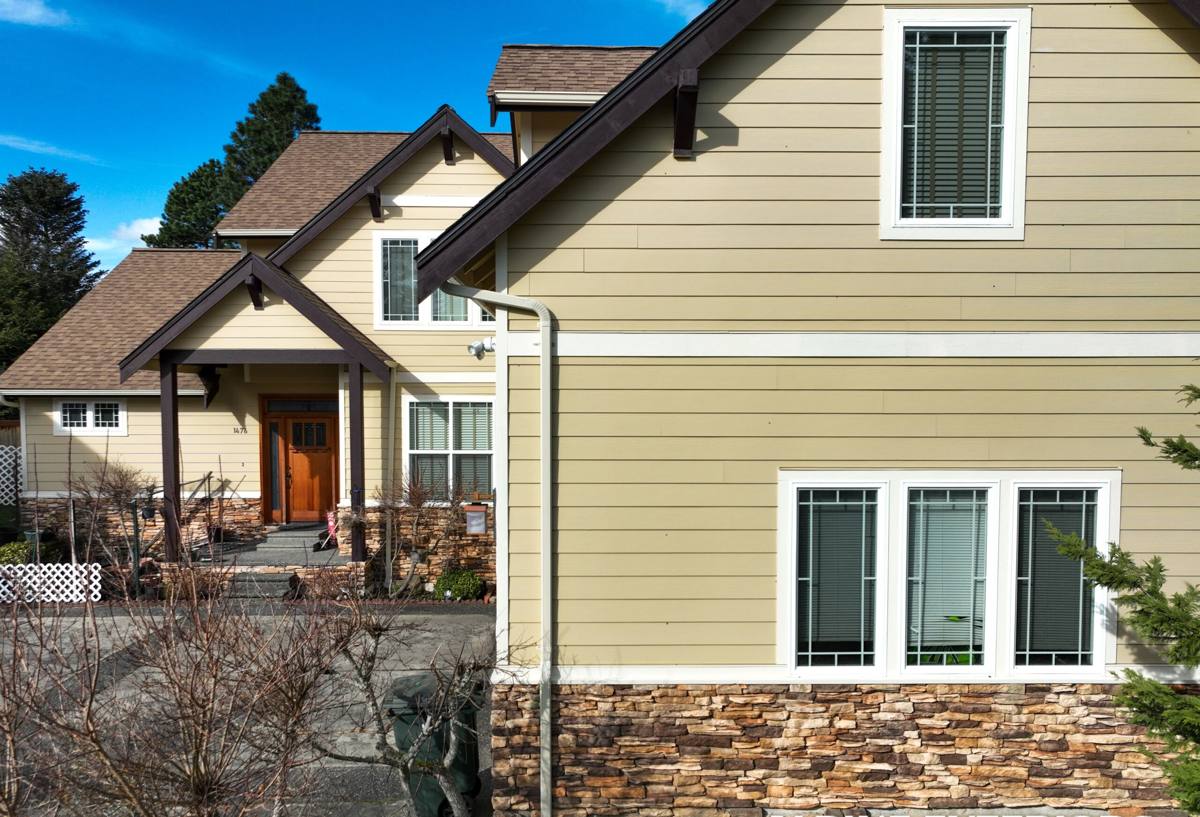
What Bellingham's Climate Does to Siding on South Hill
Salt Air and Corrosion at the Repair Points
The steady salt exposure common to this part of Whatcom County works on exposed metal year-round, not just during storms. Fasteners, flashing, and trim pieces that were fine when a wall went up can be corroded and failing years later, and a repair that reuses compromised fasteners or skips new flashing is a repair that's already on borrowed time.
Driving Rain and Elevation
Wind off the bay tends to push rain sideways rather than straight down, and South Hill's elevation puts homes there in a more direct path of that wind than blocks closer to sea level. Driving rain finds every gap in a wall assembly — a loose butt joint, a cracked board, a piece of trim that's pulled away half an inch — and it doesn't take much of a gap for water to start working its way behind the siding.
A Long Moss Season on Shaded Walls
Bellingham's moss season runs most of the year on north-facing and tree-shaded walls, and South Hill has plenty of both between mature trees and homes built close together on sloped lots. Moss holds moisture against the siding surface far longer than an open, sun-exposed wall would dry out on its own, and that sustained dampness is what turns a cosmetic staining issue into a substrate problem underneath.
Signs Your South Hill Home Needs Siding Repair, Not Just Paint
A fresh coat of paint can hide a lot for a season or two, which is exactly why some siding problems get missed until they're expensive. Watch for:
- Boards that feel soft or spongy when you press on them, especially near the bottom of the wall or under windows
- Cracked, split, or visibly buckled boards, particularly after a hard freeze or a windstorm
- Paint that keeps failing in the same localized spot no matter how many times it's repainted
- Staining or discoloration concentrated at seams, corners, or below window sills
- Gaps opening up at trim boards or corner pieces that used to sit tight
- Moss or mildew that keeps coming back on the same section of wall within a season of cleaning it
- Nails or fasteners visibly popped or backing out of the siding face
- A musty smell or visible staining on interior walls that share an exterior wall with a suspect area
Any one of these on its own might be minor. Several of them clustered in the same area, or any of them paired with softness you can feel by hand, usually means water has already gotten past the surface.
Repair or Replace? How We Make the Call
Homeowners often assume any siding damage means a full re-side, and just as often assume a small visible crack is a quick, cheap fix. Neither assumption holds up on its own — the right call depends on how far the damage actually extends once we can see behind the surface.
| What We Find | What It Usually Means | Typical Approach |
|---|---|---|
| One or two boards cracked from impact, surrounding wall dry and sound | Localized, contained damage | Targeted repair of the affected boards and flashing |
| Soft or rotted boards concentrated around one window or corner | A failed flashing detail at that specific point | Repair the section and correct the flashing that caused it |
| Scattered soft spots and staining across multiple walls | A wall assembly or drainage problem, not an isolated event | Broader repair or partial re-side of the affected walls |
| Widespread moss staining and material failure on siding past 20-25 years old | The siding is at or near the end of its service life | Full replacement usually makes more sense than repeated repairs |
We don't default to the most expensive answer. If a contained repair genuinely solves the problem, that's what we recommend — but we'll also tell you plainly when repeated patching is throwing money at a wall that needs to be replaced.
Why the Repair Material Matters
A lot of South Hill homes we look at aren't currently sided in James Hardie — plenty are cedar, vinyl, or an engineered wood product installed at some point in the home's history. When a repair is genuinely isolated, we'll talk through whether patching in the existing material makes sense for that specific spot. But when a section of siding is coming off and being replaced anyway, we install James Hardie fiber cement in that section, not LP SmartSide, vinyl, Cemplank, Allura, primed spruce, or cedar. That's a standard we hold to on repairs the same as on full installs.
The reasoning is straightforward. A repair patch is under more stress than the rest of the wall — it has to tie into existing trim, existing paint lines, and an existing weather barrier that's already been through years of Bellingham weather. Fiber cement's dimensional stability means a repaired section isn't fighting the surrounding material as temperatures and moisture levels shift with the seasons. Wood-based products expand, contract, and absorb moisture differently than an aged wall around them, which is exactly the kind of mismatch that turns a repair into a recurring one.
What a Correct Siding Repair Actually Involves
A repair that just covers the visible damage and stops there is the most common way a small problem turns into a big one later. A repair done right includes:
- Removing enough surrounding material to see the actual extent of the damage, not just the piece that looks bad
- Checking the sheathing and framing behind the removed siding for rot before anything new goes back on
- Identifying and correcting whatever let water in to begin with — a flashing gap, a failed sealant joint, a missing drip cap — not just replacing the board that got wet
- Installing new weather-resistive barrier and flashing at the repair, lapped correctly with what's already on the wall
- Priming any field-cut edges before the new material goes up
- Matching butt joints, reveal, and trim lines so the repair reads as part of the wall rather than a visible patch
Skipping the diagnosis step is the most common shortcut we see from prior work — replacing the damaged board without ever figuring out why it failed. That gets you a repair that looks fine for a year and fails again in the same spot once the underlying cause has had time to do its work a second time.
Our Process for a South Hill Repair
Walkthrough and Diagnosis
We start by looking at the damaged area and the wall around it, including orientation, shade, and drainage, to understand why that particular spot failed and whether the cause is isolated or likely to show up elsewhere on the same wall.
Scope and Options
Once we know what we're dealing with, we walk you through what a contained repair would involve versus a broader repair or partial re-side, with honest reasoning behind the recommendation rather than a push toward the bigger job by default.
Repair Execution
We remove the affected material, address the underlying cause, and rebuild the wall assembly at that section to current standards — correct weather barrier, correct flashing, correct fastening — before the new siding goes back on.
Final Walkthrough
We walk the finished repair with you, point out what was actually causing the problem, and let you know what, if anything, is worth keeping an eye on elsewhere on the home.
Why Hire a Crew That Already Works South Hill
Repair work rewards local experience more than new construction does, because diagnosing why a wall failed takes knowing how this specific neighborhood's weather behaves. A crew that's repaired siding across South Hill through multiple wet seasons already knows which orientations catch the worst of the wind-driven rain coming off the bay, which shaded and tree-covered walls hold moss and moisture the longest, and where sloped lots tend to create drainage problems that show up as siding damage higher on a wall than you'd expect. That judgment shortens the diagnosis and lowers the odds of a repair addressing the symptom instead of the cause.
Cost Factors for Siding Repair in This Area
Repair costs on South Hill vary more than new-construction siding costs do, mainly because the extent of hidden damage isn't fully known until material comes off the wall. A few things tend to move the price on a given repair:
| Factor | Why It Matters |
|---|---|
| Extent of hidden rot or damage found once boards are removed | Framing or sheathing repair adds cost beyond the siding itself |
| Wall height and access on sloped or hillside lots | Steeper South Hill lots can require more setup and safety equipment |
| Age and availability of matching material | Older siding profiles or discontinued colors can affect how closely a patch blends in |
| Number and spread of repair locations | Several small repairs across a home cost differently than one concentrated area |
| Flashing and trim work required | Correcting the underlying cause often means more than just replacing boards |
We give real numbers after we've actually looked at the damage, not a phone estimate based on a description alone — with repair work especially, what's visible and what's actually wrong are often two different things.
If you're seeing signs of siding damage on a South Hill home, we're glad to come take a look, diagnose what's actually going on, and give you a straightforward, no-pressure estimate for what fixing it right would involve. There's a form below — reach out and we'll set up a time to take a look.