 Bellingham
 Composite Decking Built for Sudden Valley's Conditions
Sudden Valley sits back in the trees along Lake Whatcom, and that setting is exactly why decks here wear out faster than decks in more open parts of Whatcom County. Heavy tree canopy means less direct sun on most lots, which means decking surfaces stay damp longer after rain. Add in the lake's humidity and the moss spores that blow through the area constantly, and you've got a recipe for a deck surface that stays green and slick most of the year if it isn't built and maintained correctly. Composite decking is a strong answer to that problem, but only when it's installed with the local conditions in mind — not just dropped in using a generic install method.
We work on decks throughout the Bellingham area, and Sudden Valley's shaded, moisture-heavy lots are their own category. This page covers what actually matters for a composite deck built here: material selection, substructure decisions, drainage, and the maintenance reality homeowners should expect.
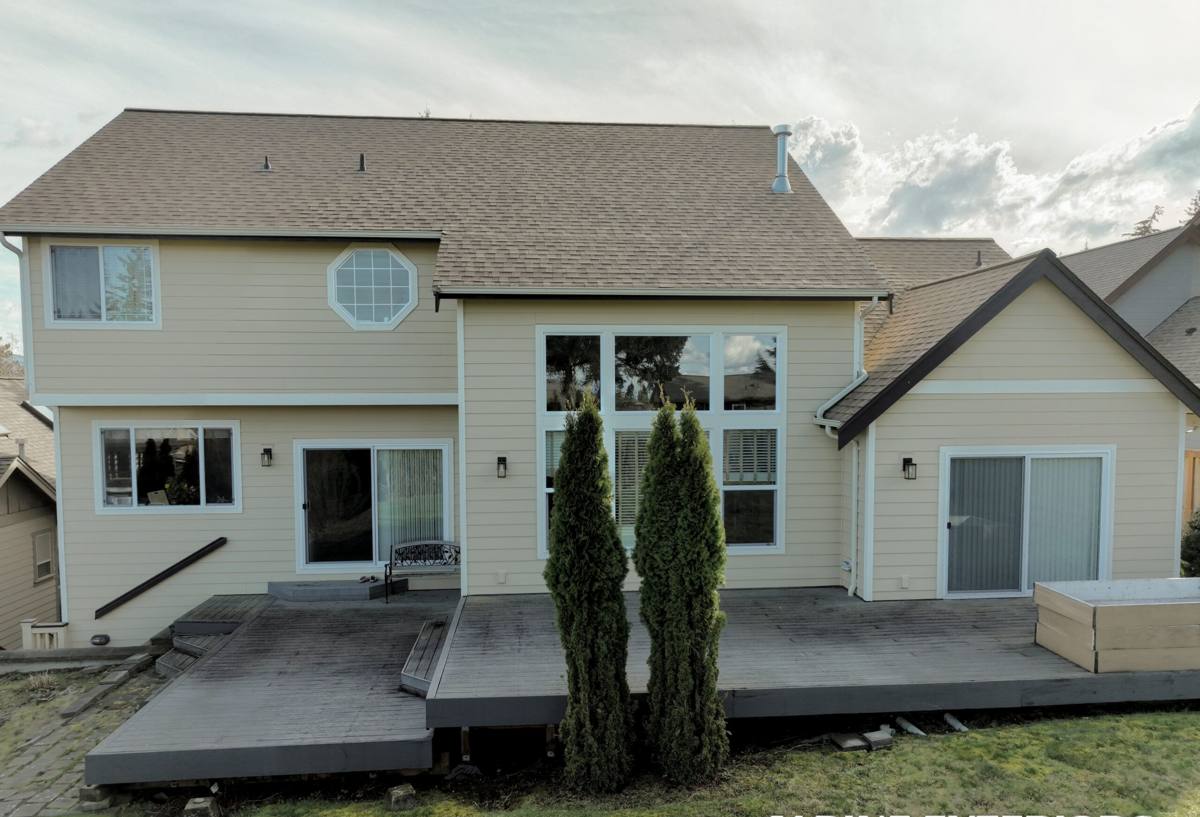
Why Sudden Valley's Climate Is Tougher on Decks Than It Looks
Bellingham and Whatcom County get a lot of driving rain off the Salish Sea and Cascade foothills, but Sudden Valley adds two extra factors most other neighborhoods don't deal with together:
- Tree cover and shade — many lots back up to forest or have mature trees close to the house, cutting the amount of direct sun that would otherwise dry the deck surface between rain events.
- Lake-adjacent humidity — proximity to Lake Whatcom keeps ambient moisture higher than in drier parts of the county, especially in low-lying or tree-shaded yards.
- Moss and organic debris — needles, leaves, and pollen collect in deck board gaps and railing joints, holding moisture against the material and feeding moss growth if it isn't cleared regularly.
None of this makes composite decking a bad choice — it actually makes it a better choice than wood, which absorbs moisture directly into the fiber. But it does change how the deck needs to be built. A composite deck installed the same way you'd build one on a sunny, open lot in south Bellingham will underperform on a shaded Sudden Valley lot.
What Goes Wrong When Local Conditions Are Ignored
The most common issues we see on composite decks in shaded, moisture-heavy settings aren't failures of the composite material itself — they're installation shortcuts that don't account for the environment:
- Boards laid tight against the house or landscaping with no airflow underneath, trapping moisture
- Framing that isn't properly spaced or vented, so the underside of the deck never fully dries
- Fastener systems that trap debris in the gaps between boards instead of letting water and needles flush through
- Railing posts and ledger connections sealed poorly, letting water track into the structural wood underneath the composite skin
What a Correct Composite Deck Build Looks Like Here
Substructure First
The composite decking itself is only as good as what's underneath it. On shaded, damp Sudden Valley lots, we pay close attention to:
- Joist spacing — tighter spacing than the manufacturer's bare minimum, especially on angled or picture-frame layouts, to reduce flex and keep boards from cupping over time
- Ventilation underneath — enough clearance and airflow beneath the deck that the framing and the underside of the boards can actually dry out between rain events, not just after a rare sunny stretch
- Flashing at the ledger board — proper metal flashing where the deck attaches to the house, since this is the single most common point of hidden rot on any deck, composite surface or not
- Fasteners rated for wet climates — corrosion-resistant hardware throughout, since humid, shaded conditions accelerate corrosion on lower-grade screws and brackets
Drainage and Grading
Composite boards don't absorb water, but water still has to go somewhere. If the ground under and around the deck doesn't drain, you end up with standing moisture that keeps the whole structure damp and speeds up moss growth on the surface above. Part of a correct install is confirming the grade slopes away from the foundation and that the space under the deck isn't acting as a moisture trap.
Choosing the Right Composite Board for a Shaded Lot
Not all composite decking performs the same way in low-light, high-moisture settings. The differences that matter most for a Sudden Valley install:
| Factor | Why It Matters Here |
|---|---|
| Capped vs. uncapped composite | Fully capped boards (a protective polymer shell around the whole board) resist moisture absorption and mold far better than older-style uncapped composite, which can wick water at cut ends and edges. |
| Surface texture | A board with some texture or grain sheds standing water and resists the slick, glassy feel that shows up fast on smooth boards once moss and algae start to grow. |
| Color | Darker boards show less green staining between cleanings but run hotter in direct sun; on shaded lots, heat isn't a real concern, so darker tones are often a practical choice here. |
| Board profile (grooved vs. square edge) | Grooved-edge boards with hidden fastener clips leave a small gap between boards for airflow and drainage — useful in a debris-heavy, tree-covered yard. |
We'll walk through actual manufacturer options and their warranty terms during the estimate — we're not going to push a specific brand on this page, because the right choice depends on your budget and how the deck will be used.
Why We Don't Cut Corners on Wood-Composite Hybrids in This Setting
Some lower-cost composite products are more wood fiber than polymer, which keeps the price down but leaves the board more absorbent than a fully capped composite. In a sunny, dry yard that trade-off might be acceptable. On a shaded Sudden Valley lot where the board rarely gets a chance to fully dry, that same product will hold moisture longer, stain faster, and support moss growth sooner. It's not that these products are defective — it's that they're a poor match for this specific environment. Our standard for lake-adjacent, tree-shaded lots is fully capped composite, because it's the option that actually holds up to the conditions instead of just meeting a lower price point.
Our Process for a Sudden Valley Composite Deck
- On-site assessment — we look at sun exposure, tree cover, existing drainage, and the condition of any structure we'd be building on or replacing.
- Substructure evaluation — if we're replacing an old deck, we check ledger attachment, framing condition, and footings before deciding what can be reused versus what needs to be rebuilt.
- Material selection — we go over board options, colors, and railing systems based on your budget and how shaded the specific lot is.
- Build with ventilation and drainage as priorities — proper joist spacing, flashing, corrosion-resistant hardware, and airflow underneath, not just a surface install.
- Walkthrough and maintenance guidance — we explain what upkeep the specific product you chose actually needs, since composite still requires periodic cleaning even though it doesn't need staining or sealing.
Realistic Maintenance Expectations
Composite decking is marketed as low-maintenance, and compared to wood it is — no sanding, staining, or sealing. But "low-maintenance" doesn't mean "no maintenance," especially under tree cover near the lake. A practical seasonal checklist for a Sudden Valley composite deck:
- Sweep needles, leaves, and debris out of board gaps regularly during fall and through the wet months
- Rinse the surface periodically to keep pollen and organic buildup from feeding moss growth
- Scrub visible moss or algae with a soft-bristle brush and a composite-safe cleaner as soon as it appears, rather than letting it establish
- Check railing posts and stair connections once a year for any movement or water staining at the base
- Confirm gutters and downspouts near the deck are directing water away, not onto the deck surface or framing below
None of this is heavy labor, but skipping it on a shaded lot lets moss get a foothold faster than most homeowners expect.
Cost Factors for a Sudden Valley Composite Deck
Every deck is different, so we won't quote a number without seeing the site, but the factors that move the price most on jobs in this area are:
| Factor | Impact |
|---|---|
| Deck size and shape | Larger decks and complex layouts (angles, multiple levels) increase both material and labor |
| Substructure condition | Rebuilding rotted framing versus reusing sound existing framing changes cost significantly |
| Site access | Wooded, sloped, or hard-to-reach lots — common in Sudden Valley — can add labor time for material staging and equipment access |
| Board tier | Fully capped, premium composite costs more upfront than entry-level boards but needs less attention over time |
| Railing and stair systems | Composite or metal railing systems vary widely in cost depending on style and code requirements for height and spacing |
Why Hire a Crew That Already Works This Neighborhood
Sudden Valley's terrain, tree cover, and lake-driven moisture aren't the same as building a deck in an open subdivision closer to downtown Bellingham. A crew that hasn't worked lots like these can miss the ventilation and drainage details that actually matter here — details that don't show up as a problem until a year or two later when moss and moisture damage start showing up. We're familiar with the access challenges, the grading concerns, and the amount of tree debris a deck in this area needs to be built to handle. That's the difference between a deck that looks fine at handoff and one that still looks and performs well five winters from now.
If you're planning a new composite deck or replacing an aging one in Sudden Valley, we're happy to take a look and give you a straightforward, no-pressure estimate. Use the form below to get started.