 Bellingham
 Siding Replacement in Columbia: What Bellingham Homes Are Up Against
Columbia is one of Bellingham's established residential neighborhoods, and like most of the city, it sits inside a climate pattern that's steadily hard on exterior siding even when nothing dramatic ever happens. Salt-tinged air moving in off the water, driving rain that gets pushed sideways by wind more often than it falls straight down, and a moss season that runs long through fall, winter, and much of spring all add up over the years. None of it shows up overnight. It shows up as a siding job that was fine for a decade and then starts failing faster than anyone expected, because the cumulative moisture load finally caught up with a material or an installation detail that wasn't built for it.
We work on siding replacement throughout Columbia and the rest of Bellingham and Whatcom County, and a replacement project here is a different job than the same scope would be in a drier, calmer climate. What matters most is what's actually happening underneath the old siding once it comes off, and what goes back on has to be specified and installed to handle sustained dampness, not just look right on installation day.
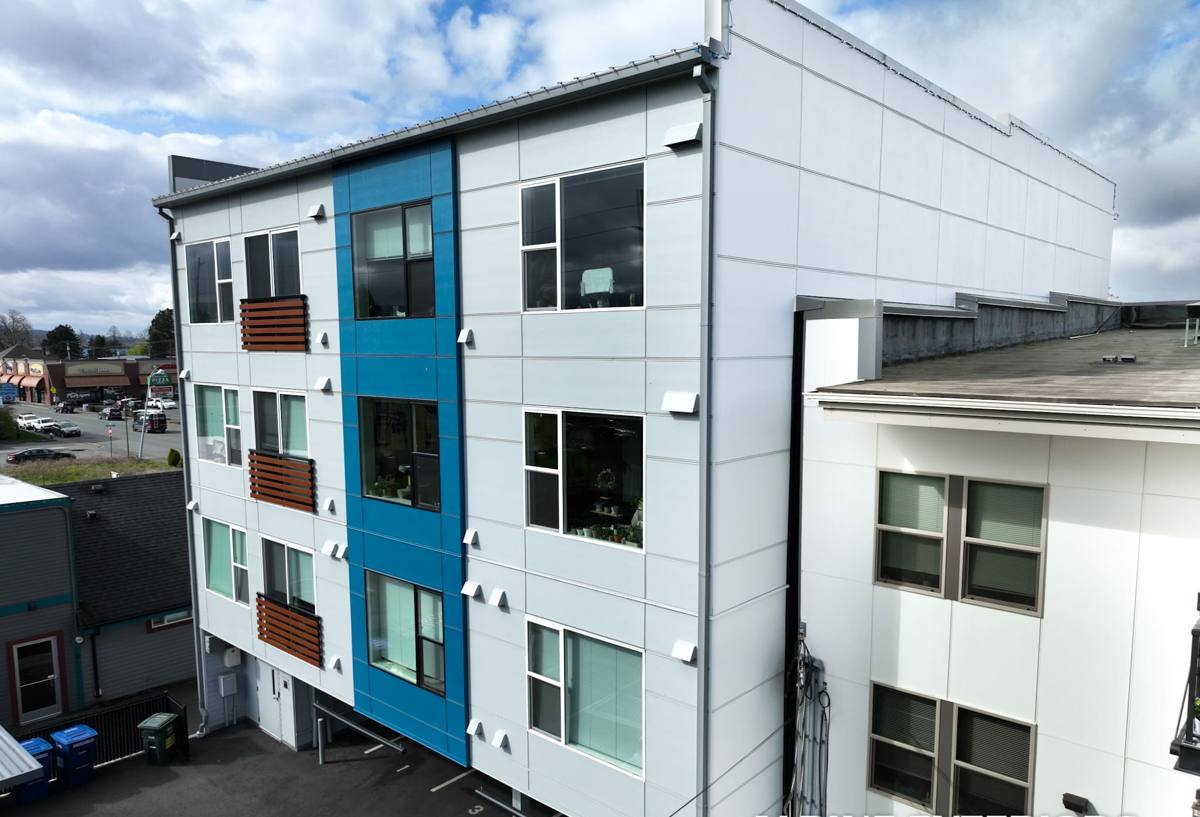
What Salt Air, Driving Rain, and Moss Do to Siding Over Time
Salt Air and Hardware Corrosion
Salt-laden air doesn't need to come straight off open water to matter — it travels inland and settles onto exterior surfaces, keeping them damp longer than they'd stay in a drier region and speeding up corrosion on exposed fasteners, trim hardware, and any coating that isn't built for sustained exposure. Nails and fasteners that would hold up fine somewhere else start bleeding rust stains or losing their grip years earlier out here.
Wind-Driven Rain and Failed Seams
Rain that's pushed sideways by wind behaves differently than a calm, straight-down shower. It gets forced into laps, seams, and fastener penetrations that a dry-climate installation would never have to account for. On older siding, this is usually where failure actually starts — not on the flat face of a panel, but at a seam, a butt joint, or a fastener hole where water has been working its way in for years before anyone notices a problem from the ground.
Moss, Mildew, and Sustained Moisture
Shaded walls, north-facing exposures, and anything under tree cover stay damp for extended stretches through the wet months, and that's exactly the condition moss and mildew need to take hold. On wood-based or wood-look siding, that ongoing dampness isn't just a cosmetic staining issue — sustained moisture against a moisture-absorbent material eventually leads to swelling, softening, and rot, usually starting at cut edges, seams, and the bottom courses closest to grade.
Signs a Columbia Home Needs Siding Replacement
Most homeowners call because something specific caught their eye, not because they've been tracking every inch of their siding's condition. Here's what's actually worth paying attention to:
- Visible moss or green-black staining that keeps coming back on shaded or north-facing walls
- Siding that's cupping, bowing, or separating at seams and butt joints
- Soft spots, or a slight give when you press near the base of a wall or below a window
- Paint that keeps failing or peeling within a year or two of repainting, even on surfaces that were properly prepped
- Rust streaks bleeding down from fasteners or trim hardware
- Visible gaps, warping, or daylight where siding meets window and door trim
- A musty smell near exterior walls, especially in a crawlspace or basement below a shaded elevation
Any single item on that list doesn't automatically mean full replacement is the right call — but it's worth having someone actually look at the wall assembly rather than assuming a problem will stay cosmetic, since moisture damage in this climate tends to compound rather than plateau.
Replacement vs. Repair: How We Make the Call
Not every siding complaint on a Columbia property needs a full tear-off. Localized damage on an otherwise sound wall is sometimes a legitimate spot-repair. Widespread failure, or damage that traces back to the sheathing underneath, usually isn't.
| Condition Found | Repair Often Makes Sense | Replacement Usually Makes Sense |
|---|---|---|
| One or two damaged boards, sound sheathing behind them | Yes — spot repair and repaint/refinish | Not necessary on its own |
| Failing paint across most of the exterior | Only if siding underneath is still structurally sound | Often, if paint failure signals the substrate is saturating |
| Soft or rotted sheathing discovered on inspection | Rarely a lasting fix | Yes |
| Moss recurring within a year of cleaning | Sometimes, if it's a drainage or shading fix | Yes, if the siding material itself is retaining moisture |
| Widespread cupping, warping, or seam separation | Rarely worth it long-term | Yes |
Why We Install Only James Hardie Fiber Cement
We don't install vinyl, LP SmartSide, other fiber cement brands, primed spruce, or cedar. That's a professional standard we hold ourselves to, not a reflection of what we're capable of installing. In a climate like Whatcom County's, the materials that tend to struggle over the long run share a common thread: they either absorb moisture directly, depend on a coating to keep water out indefinitely, or expand and contract enough with temperature and humidity swings that seams gradually work themselves loose.
James Hardie fiber cement is engineered specifically against that kind of exposure. It's non-combustible, it doesn't swell, rot, or feed moss the way wood-based products can, and its ColorPlus factory finish is baked on under controlled conditions and warrantied against the fading and chalking that constant moisture and UV cycling cause over time. Hardie also builds climate-specific HZ formulations rather than one universal board, which matters in a region that stays this damp for this much of the year. Combined with a strong transferable warranty and installation done to the manufacturer's actual specifications, it's the system we're comfortable putting our name behind on a Columbia replacement job.
What We Ask Homeowners to Weigh Before Choosing Something Else
Cheaper alternatives aren't dishonest products — vinyl, engineered wood, and primed wood all have legitimate uses in the right climate and budget. But in a salt-air, high-rain, long-moss environment, the maintenance burden and moisture risk on those materials tends to land back on the homeowner within a decade or two, in the form of repainting, caulking, or panel replacement that a properly installed fiber cement system simply doesn't ask for as often.
Comparing Siding Materials for This Climate
Most homeowners planning a replacement have already come across several material options, so it's worth being direct about how they actually perform here rather than treating the decision as already settled.
| Material | Moisture Behavior in This Climate | Typical Long-Term Maintenance |
|---|---|---|
| James Hardie fiber cement | Non-combustible, doesn't absorb moisture or feed rot the way wood-based products can | Low — factory finish holds up well against sustained damp and salt exposure |
| Vinyl | Doesn't rot, but can warp, crack, or bow under wind-driven rain and temperature swings | Low upfront, but full-panel replacement rather than repair when it fails |
| LP SmartSide / engineered wood | Wood-based core is more moisture-sensitive at cut edges and seams than fiber cement | Moderate — edge sealing and coating upkeep matter more in sustained damp |
| Primed spruce or cedar | Natural wood absorbs moisture readily and is a preferred surface for moss growth | Highest — regular repainting, caulking, and moss treatment to hold up |
This isn't a claim that every alternative fails outright — it's why our own standard, for the climate we replace siding in every day, is fiber cement installed correctly rather than a material that trades a lower price today for a heavier maintenance load later.
What a Correct Siding Replacement Actually Involves
A full tear-off gives us something a re-side over existing siding never can: a direct look at the sheathing and framing underneath. On older Columbia-area homes, that inspection matters — sheathing that's been slowly absorbing moisture behind failing siding for years often isn't visible until the old material comes off, and installing new siding over a compromised substrate just locks the problem in behind a fresh face. If a home was built with cement-asbestos siding underneath a later layer, which does turn up on older homes in this region from time to time, that's handled with the appropriate care and disposal procedures rather than treated as a routine tear-off.
Once the wall is open, correct installation means a properly lapped and sealed weather-resistive barrier, flashing detailed at every window, door, and penetration so water is directed out rather than trapped behind the cladding, correct clearance above grade and any hardscape, and fastener type and spacing matched to the manufacturer's specification for this exposure. James Hardie only performs the way it's engineered to when every one of those details is done right — skipping or shortcutting any single step can undercut the material's real-world performance regardless of how good the board itself is.
Matching Existing Trim and Details
On a replacement project, we also account for what has to tie back into existing trim, corner boards, and roofline details so the finished result reads as one coherent exterior rather than a patched-together mix of old and new profiles.
Our Process for a Columbia Siding Replacement Project
We start with an on-site inspection — not just of the siding itself, but of trim, flashing, and any accessible sheathing, so the scope we hand a homeowner reflects what's actually happening at the wall rather than a guess from the driveway. From there we give a straightforward read on whether full replacement is warranted now or whether targeted repair will reasonably hold, along with a written scope before anything is scheduled.
During the tear-off, we document what we find underneath, since that changes the plan on a meaningful share of older-home projects — a section of rotted sheathing or a moisture-damaged stud isn't something we paper over, it gets repaired as part of the job with the homeowner informed before we close the wall back up. New James Hardie siding goes on to manufacturer specification: weather-resistive barrier, flashing, fastening, and clearance all set for this specific climate rather than a generic install.
A Checklist Before Hiring for Siding Replacement in Columbia
- Confirm current Washington state contractor licensing and active liability insurance
- Ask specifically how they handle flashing and moisture barrier detail, not just which siding brand they sell
- Ask whether a full tear-off is included, or whether they're proposing to install over existing siding
- Get a written scope that spells out what happens if hidden sheathing damage is found
- Ask how many years they've worked Bellingham and Whatcom County specifically, since local exposure experience shows up in the details
Why a Local Crew Matters in Columbia
A lot of what makes a siding replacement hold up here comes down to details a generic, out-of-area crew tends to overlook: how much wind-driven rain a given wall orientation actually takes, where moss is likely to re-establish based on shade and drainage, how much clearance new siding needs above grade given how consistently damp the ground stays through a Whatcom County winter, and how flashing needs to be layered so it sheds water through an entire wet season rather than just passing a dry-day walkthrough.
A crew that replaces siding in Bellingham neighborhoods like Columbia regularly starts to recognize these patterns from one property to the next. That familiarity shows up in on-site decisions — where a J-channel actually needs to go, where caulk is appropriate versus where flashing is required, how fastener spacing should account for local wind exposure — that homeowners rarely notice directly but absolutely feel in how the new siding performs over the following decade.
If your Columbia-area home needs siding replacement, or you're not sure yet whether repair or full replacement is the right call, we're glad to take a look and give you a straightforward, no-pressure read. Reach out using the form below for a free estimate.