 Bellingham
 Building Decks for Puget's Particular Climate
Puget sits close enough to the water that homes here deal with a specific combination most inland Whatcom County properties don't face as heavily: salt-laden air, long stretches of driving rain, and a moss season that can run from fall clear through spring. Any deck material has to hold up to all three at once, not just one of them. That's the lens we use when we're out at a Puget property talking through decking options — not just "what looks good" but "what survives this exact yard, this exact exposure, this exact roofline shading pattern."
Composite decking has become the default recommendation for a lot of Bellingham homeowners for good reason, but it's not automatically the right call for every deck, and it's not installed the same way everywhere. A deck facing open water exposure needs different fastening, ventilation, and board selection than one tucked under mature trees on the shaded side of a Puget lot. We treat those as different jobs because they behave differently over ten and twenty years.
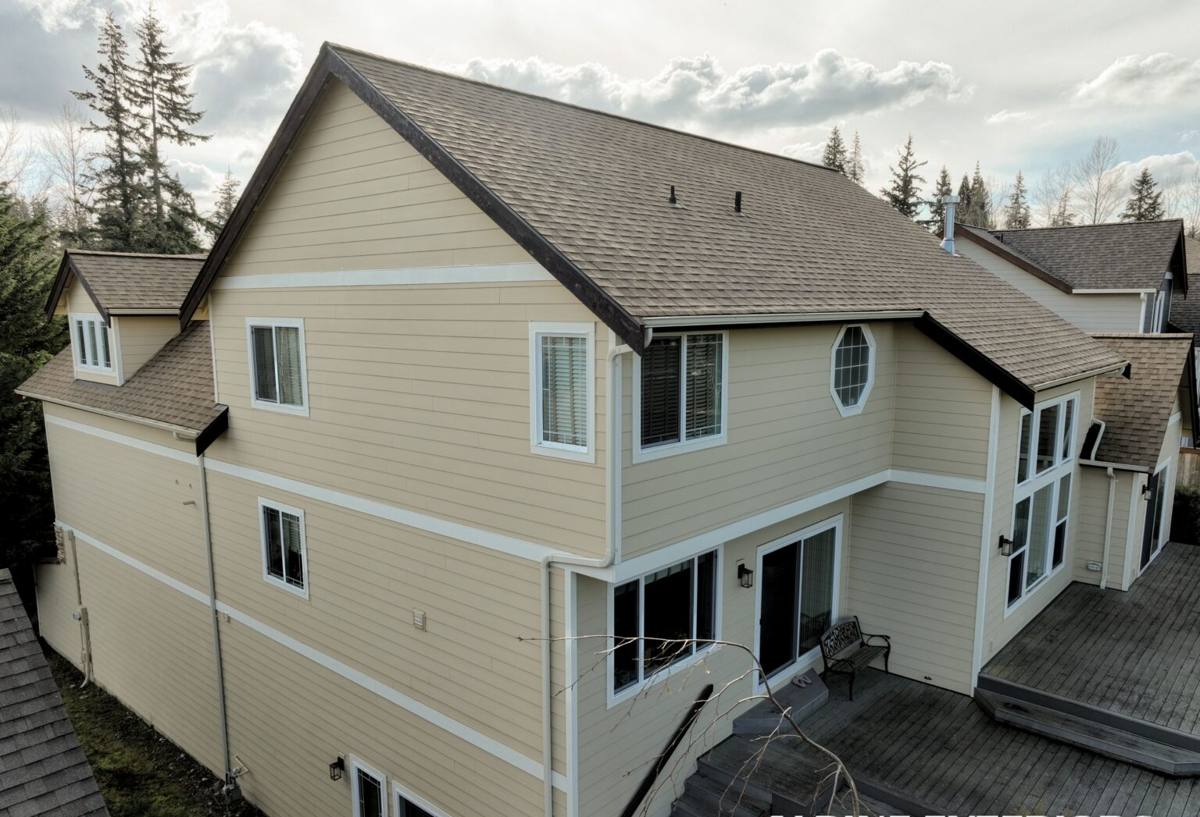
What Salt Air and Driving Rain Actually Do to a Deck
Salt Air
Salt-carrying air doesn't just sit on a surface — it works into fasteners, connectors, and any exposed metal hardware. Over years, that's where failures usually start: not in the decking boards themselves, but in the screws, joist hangers, and structural connectors underneath. A deck can look fine on top while the hardware holding it together is corroding out of sight.
Driving Rain
Wind-driven rain in this part of Whatcom County doesn't fall straight down — it gets pushed sideways under rail caps, into board gaps, and against house-to-deck ledger connections. That means flashing detail and drainage planning matter as much as the decking material itself. A beautiful composite deck with a poorly flashed ledger board is still a deck that will eventually cause a moisture problem at the house.
Moss and Sustained Dampness
Bellingham's moss season is long, and shaded or low-airflow areas of a deck stay damp for extended stretches even when it isn't actively raining. Moss and algae need that sustained moisture to establish, and once they do, a deck surface gets slick and starts holding even more water against the board.
Why Composite Makes Sense for Puget Homes — With Honest Caveats
Composite decking's main advantage in this climate is that the boards themselves don't absorb water the way wood does, so they don't cup, splinter, or rot from moisture cycling. That's a real advantage given how much sustained dampness Puget properties see through the wet months. But composite isn't maintenance-free, and we don't sell it that way.
- Composite surfaces still need periodic cleaning to stay ahead of moss and algae, especially on shaded sections of a deck.
- Not all composite boards handle sustained moisture and salt exposure the same way — board density and capping quality matter more here than in a drier inland climate.
- The substructure (joists, hardware, ledger flashing) is still the part most exposed to failure, regardless of what decking material sits on top.
- Color and finish do fade somewhat over years of UV and weather exposure, even with capped boards — it's slower than wood finish failure, but it isn't zero.
We install capped composite boards as our standard for Puget projects because the capping layer resists moisture absorption and staining better than uncapped composite, which matters more here than it would somewhere drier. That's a professional standard we hold to, not a claim that other products can't perform — it's about matching material to what this specific climate demands over the life of the deck.
Composite vs. Other Common Decking Choices for This Climate
| Material | Moisture Behavior Here | Maintenance Load | Long-Term Fit for Puget |
|---|---|---|---|
| Capped Composite | Doesn't absorb moisture into the board core; surface can still hold algae if not cleaned | Periodic cleaning, no refinishing | Strong fit for salt air and sustained damp exposure |
| Pressure-Treated Wood | Absorbs and releases moisture constantly; cupping and checking over time | Regular sealing/staining required | Workable but higher upkeep in this climate |
| Cedar | Naturally moisture-resistant but still an organic material that weathers | Periodic oiling to hold color and grain | Good for homeowners who want a natural look and accept the upkeep |
| Uncapped Composite | More prone to surface moisture absorption and staining than capped boards | Moderate — surface care matters more | Workable, but we favor capped boards for this exposure |
What a Correct Composite Deck Build Looks Like Here
The decking material is maybe a third of what determines how long a deck lasts on a Puget property. The rest is in details that don't show up in a photo but show up in year eight or year twelve.
Substructure and Hardware
We use corrosion-resistant fasteners and connectors throughout — this isn't optional close to salt air exposure, it's the difference between hardware that lasts the life of the deck and hardware that needs replacing under boards that are otherwise fine. Joists get proper spacing for the specific composite product being installed, since composite boards can have different span requirements than wood.
Ledger Flashing and Drainage
Where the deck attaches to the house, correct flashing keeps driving rain from working its way behind the ledger board and into the wall assembly. We also plan for water to actually get off the deck surface and away from the foundation, rather than pooling against the house.
Airflow Underneath
Low decks with poor underside ventilation stay damp longer after rain, which feeds moss and slows drying. We account for clearance and airflow at the design stage, not as an afterthought once boards are already down.
Board Layout and Gapping
Correct gapping lets composite boards expand and contract with temperature and moisture without buckling, and it helps water shed through rather than sitting on the surface. Getting this wrong is one of the most common mistakes we see on deck rebuilds — a deck that was never quite gapped right for this climate.
Signs a Puget Deck Needs Attention
- Green or black staining that keeps coming back within weeks of cleaning, especially in shaded corners
- Soft spots or slight give underfoot, which usually points to the substructure rather than the decking surface
- Rust staining around fasteners or hardware visible from underneath the deck
- Water pooling on the surface after rain instead of draining off
- Gaps between boards that have closed up tight or widened unevenly, suggesting movement or fastening issues
- Any separation or gapping at the point where the deck meets the house
Any of these are worth a look before they turn into a bigger repair. Composite decking hides some problems well on the surface, which is part of why substructure inspection matters even on decks that still look fine from a distance.
How Our Process Works on a Puget Deck Project
1. On-Site Assessment
We walk the property, look at sun and shade exposure, wind direction relative to the water, existing drainage patterns, and — for rebuilds — the condition of the existing substructure before assuming it can be reused.
2. Material Selection Conversation
We talk through composite board options honestly, including where a given product line performs well and where it has trade-offs, so the decision is based on what fits the specific deck rather than a generic recommendation.
3. Structural and Flashing Plan
Before any decking goes down, we confirm joist spacing, fastener specification, and ledger flashing detail are correct for the climate exposure at that specific location on the property.
4. Installation
Boards go down with manufacturer-specified gapping and fastening, and we account for expansion behavior across the length of the deck rather than treating every board the same regardless of position.
5. Walkthrough
We go over basic care — what cleaning schedule makes sense given the deck's sun and shade exposure, and what to watch for as the seasons change.
Why a Crew That Already Works Puget Matters
A contractor who mostly builds decks in drier, inland parts of Washington can still build a technically fine deck — but they may not default to the fastener grade, flashing detail, or airflow planning that this specific stretch of Bellingham's coastline demands, because they haven't had to solve for it repeatedly. Working Puget regularly means we've seen which details actually matter here versus which ones are just generic best practice from a manual.
That local pattern recognition shows up in small decisions — how much clearance to leave under a deck given a particular yard's drainage, which corners of a build are going to catch the worst of the wind-driven rain, how a specific composite product has actually performed on other Whatcom County decks after a few wet seasons. None of that replaces a proper on-site assessment, but it means we're not guessing.
Get a Straight Answer for Your Deck
If you're weighing a new composite deck or wondering whether an existing one in Puget needs repair versus replacement, we're happy to take a look and give you an honest read — no pressure, no upsell. Reach out for a free estimate and we'll walk the property with you and talk through what actually makes sense for your home.