 Bellingham
 Why Decks in Sehome Take a Beating
Sehome sits on a hillside close to Bellingham Bay, mixing established single-family homes with mature tree cover and a lot of shade that never fully dries out between storms. That combination — proximity to salt water, a tree canopy that traps moisture, and a rainy season that stretches most of the year — is hard on any deck. It's harder on decks that were built to a minimum standard twenty or thirty years ago, before builders paid much attention to flashing details or fastener corrosion.
We replace decks all over Whatcom County, but Sehome has its own personality: older housing stock, sloped lots, and a lot of shade from established trees. A deck replacement here needs to account for all three, not just swap out old boards for new ones.
Salt Air and Metal Fasteners
Being close to Bellingham Bay means a steady low-level exposure to salt-laden air, which accelerates corrosion on anything that isn't rated for coastal use. Standard carbon-steel nails and screws will rust and weaken well before the wood around them fails. Once fasteners start failing, boards work loose, railings get wobbly, and the deck starts feeling less solid underfoot — often years before it actually looks worn out.
Driving Rain and Ledger Board Rot
Wind-driven rain off the Strait doesn't just fall straight down — it gets pushed sideways into ledger boards, stair stringers, and any spot where the deck meets the house. The ledger board, where the deck attaches to the structure, is the single most common place we find hidden rot on older Sehome decks. It's usually the last thing a homeowner notices, because it's hidden behind the decking and rim joist, and often the first thing that actually fails structurally.
Moss, Shade, and Slow-Drying Surfaces
Whatcom County's moss season runs long — realistically fall through spring — and a shaded deck under tree cover can stay damp for days after a storm has passed elsewhere in town. That constant dampness feeds moss and algae growth on the decking surface, which isn't just cosmetic. Moss holds water against the wood, and on composite boards it can work into the surface texture and become a slip hazard on stairs and landings.
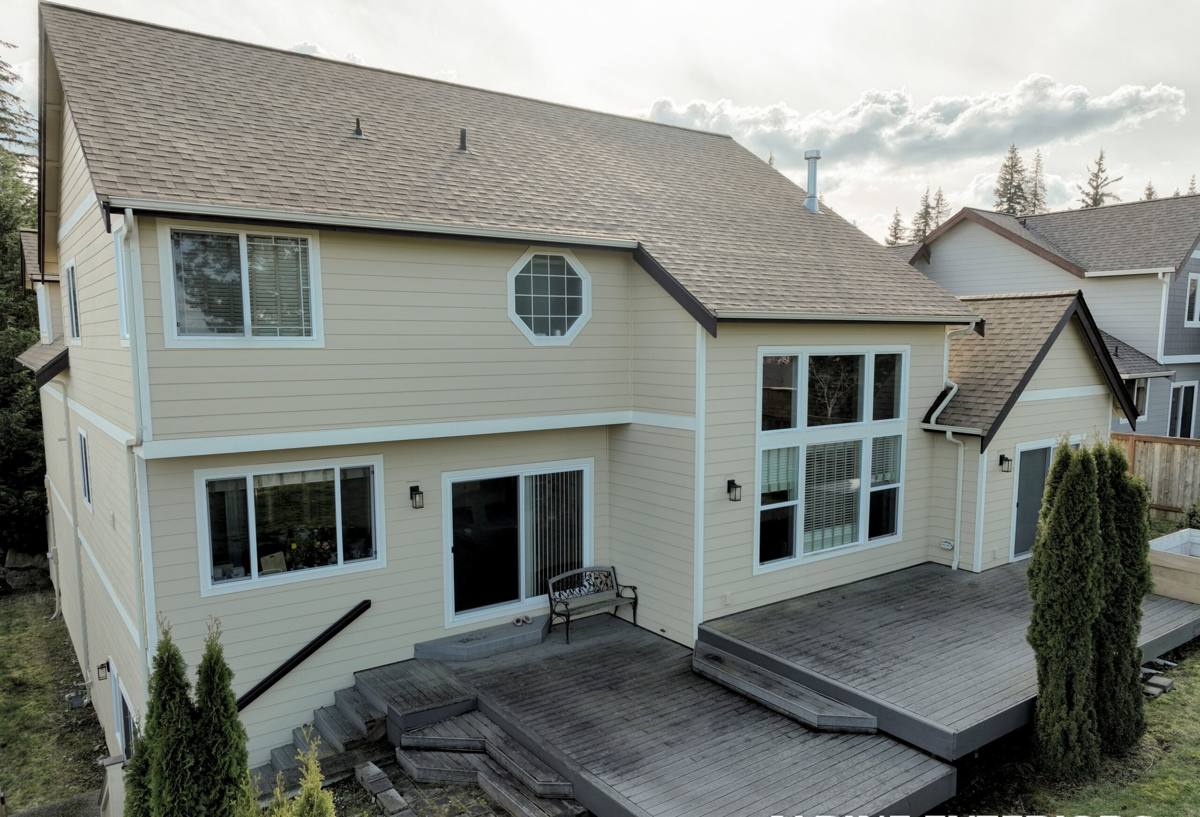
Signs Your Deck Has Reached the End of Its Life
Not every tired-looking deck needs full replacement — but there's a point where repair stops being the honest recommendation. Here's what we look for:
- Soft or spongy spots in the decking, especially near the house or at board ends
- Visible separation or a gap between the ledger board and the house siding
- Rust streaks bleeding out from screw or nail heads
- Stairs or railings that flex or feel loose when you put weight on them
- Persistent moss or black staining that comes back within weeks of cleaning
- A musty smell coming from underneath the deck, which often points to trapped moisture in the framing
- Joists or beams you can probe with a screwdriver and feel give beneath the surface
If you're seeing two or more of these, especially anything involving the ledger board or framing, replacement is almost always the more honest answer than another round of patching.
Repair vs. Replace: How We Make the Call
We don't default to replacement just because it's more work. If the framing is sound and the problem is limited to worn or discolored surface boards, resurfacing can be a legitimate option. But once rot has reached the ledger, joists, or main support posts, repair becomes a temporary fix on a structure that's already compromised — and on a hillside lot with a lot of moisture exposure, that failure tends to come back faster the second time. We'll tell you plainly which category your deck falls into, and why.
What a Correct Deck Replacement Actually Involves
A deck replacement done right starts below the surface, not with the decking boards. The visible part is the easy part.
Tear-Off and Assessment
We remove the old decking and take a real look at the framing, ledger, footings, and posts before deciding what gets reused and what doesn't. On older Sehome homes this is often where we find the ledger rot or undersized footings that the original build never addressed.
Ledger Flashing Done Properly
This is the detail that fails most often on older decks, and it's the one we're most careful about. A correct ledger installation uses proper flashing — typically a metal Z-flashing integrated with the house's water-resistive barrier — to route water away from the connection point instead of letting it pool against the house framing. It's not a step that shows once the deck is finished, which is exactly why it's the step most likely to get skipped on a cheap job.
Framing, Fasteners, and Footings
We use structural screws or bolts rather than nails at load-bearing connections, corrosion-resistant hardware appropriate for our coastal exposure, and joist hangers rated for the framing lumber we're using. Footings are set to the required depth for frost and load, which matters more on sloped Sehome lots where drainage and soil conditions vary from one yard to the next.
Decking, Railings, and Stairs
Once the structure is sound, decking goes down with a fastening method suited to the material — hidden clips for most composites, coated screws for wood — followed by code-compliant railings and stair stringers sized for the actual rise and run of your site, not a generic template.
Decking Material Options for Sehome's Climate
There's no single "best" decking material — there's a best material for your budget, your sun exposure, and how much upkeep you actually want to do. Here's how the common options hold up under shade, damp, and moss pressure:
| Material | Moisture / Moss Resistance | Maintenance | Notes |
|---|---|---|---|
| Pressure-treated wood | Fair — treatment resists rot but surface still absorbs water | Annual cleaning and periodic sealing | Lowest upfront cost; needs consistent upkeep in shaded, damp spots |
| Cedar | Good natural rot resistance, but softens faster in constant shade | Regular sealing to hold color and resist moss | Attractive natural look; more sensitive to install quality |
| Capped composite | Very good — the cap layer resists moisture absorption and staining | Occasional washing, no sealing or staining | Higher upfront cost, longer expected service life |
| PVC decking | Excellent — doesn't absorb moisture at all | Lowest maintenance of the group | Highest upfront cost; performs well on shaded, wet sites |
For a shaded Sehome lot that stays damp longer than an open sunny yard, we usually steer homeowners toward capped composite or PVC if the budget allows, simply because they don't give moss and mildew the same foothold that raw wood surfaces do. That's a maintenance-and-moisture judgment, not a claim that wood decking is a bad product — plenty of homeowners are happy to do the seasonal upkeep wood requires, and we build with it regularly.
Our Deck Replacement Process
- On-site assessment — we inspect the existing deck, framing, and ledger connection, and give you a straight answer on repair versus replacement.
- Design and material selection — we walk through decking, railing, and layout options based on your budget and how the space gets used.
- Permitting — we handle the paperwork with the City of Bellingham or Whatcom County, whichever applies to your property.
- Tear-off and disposal — the old deck comes down and off the site; we don't leave debris piled in the yard.
- Framing and structural work — footings, posts, beams, joists, and ledger flashing get built or replaced to current code.
- Decking installation — boards go down with the fastening system appropriate to the material.
- Railings and stairs — built to code height and baluster spacing requirements, sized to your actual site.
- Final walkthrough — we go over the finished deck with you before calling the job done.
Permits and Code Considerations
Most deck replacements in Bellingham and Whatcom County require a permit, particularly when the deck is attached to the house, elevated above a certain height, or involves new footings. Requirements cover things like guardrail height, baluster spacing, stair rise and run, and footing depth — details that are easy to get wrong if you're not building to them regularly. We pull permits and coordinate inspections as part of the job rather than leaving that step to the homeowner, which also protects you at resale, since an unpermitted deck can become a problem during a future home sale or refinance appraisal.
What Affects the Cost of a Deck Replacement
Every deck is different, so we price off a site visit rather than a phone estimate. That said, a handful of factors consistently move the number the most:
| Factor | Why It Matters |
|---|---|
| Deck size and shape | More square footage and more corners or angles increase material and labor time |
| Framing condition | A full structural rebuild costs more than a project where the framing is sound and reusable |
| Decking material | Composite and PVC cost more upfront than wood but reduce long-term maintenance |
| Height and stairs | Elevated decks and multi-flight stairs add framing, railing, and code complexity |
| Site access | Sloped or tight Sehome lots can make material delivery and debris removal slower |
| Ledger and flashing repair | Rot at the house connection often means opening up siding, which adds scope |
We'll walk you through exactly which of these apply to your project and why, so the estimate makes sense rather than arriving as a flat number with no explanation.
Why Hire a Crew That Already Works in Sehome
A lot of general contractors will build a deck. Fewer have spent real time on Sehome's specific mix of older homes, sloped lots, and shaded yards, where the failure points aren't always where you'd expect. Knowing that ledger rot shows up earlier here than on a sunny, open lot across town — or that a sloped backyard needs a different footing approach than a flat one — comes from doing the work locally, not from a general framing manual.
There's also a practical scheduling advantage. Framing and footing work goes faster and holds up better when it's done during a stretch of dry weather, and a crew that works this area regularly has a better read on when those windows open up through a Whatcom County fall or spring.
Maintaining Your New Deck Through Bellingham's Wet Season
A well-built deck still needs some seasonal attention in this climate. A few habits go a long way:
- Sweep leaves and debris off the surface regularly in fall, especially under tree cover
- Rinse off moss and algae buildup before it has a chance to stain or get slick
- Check that gutters and downspouts route water away from the deck footings, not onto them
- Reseal wood decking on the manufacturer's recommended schedule, typically every one to two years
- Inspect railings and stair connections once a year for movement or corrosion
Composite and PVC decking cut down on most of this list, but even those benefit from an occasional wash to keep moss from getting a foothold in shaded corners.
Get a Free, No-Pressure Estimate
If your deck is showing soft spots, rust streaks, or a ledger board that doesn't look right, it's worth having someone take an honest look before another wet season sets in. We'll walk the site, tell you plainly what we find, and give you a straightforward estimate — no pressure, no upsell. Use the form below to get started.