 Bellingham
 Why Happy Valley Siding Takes More Punishment Than It Looks Like It Should
Happy Valley is close enough to Bellingham Bay that salt-tinged air reaches house walls on a regular basis, especially on homes with any western or southwestern exposure. Add Whatcom County's long wet season — months of driving rain pushed sideways by wind off the water — and siding here is doing more work than siding in a drier inland climate ever has to. Then there's the shade. Mature tree cover throughout the neighborhood keeps a lot of exterior walls damp and out of direct sun for long stretches, which is exactly the combination moss and algae need to take hold.
None of this is unusual for Bellingham. It's just concentrated. Salt exposure accelerates corrosion on fasteners and trim. Driving rain finds every gap in flashing and caulk that a calmer climate would never expose. And moss doesn't just look bad — it holds moisture against the siding surface, which is the one thing you don't want happening for months at a stretch. The siding material and the installation both have to be built for that reality, not just tolerant of it.
Why We Standardized on James Hardie for This Kind of Climate
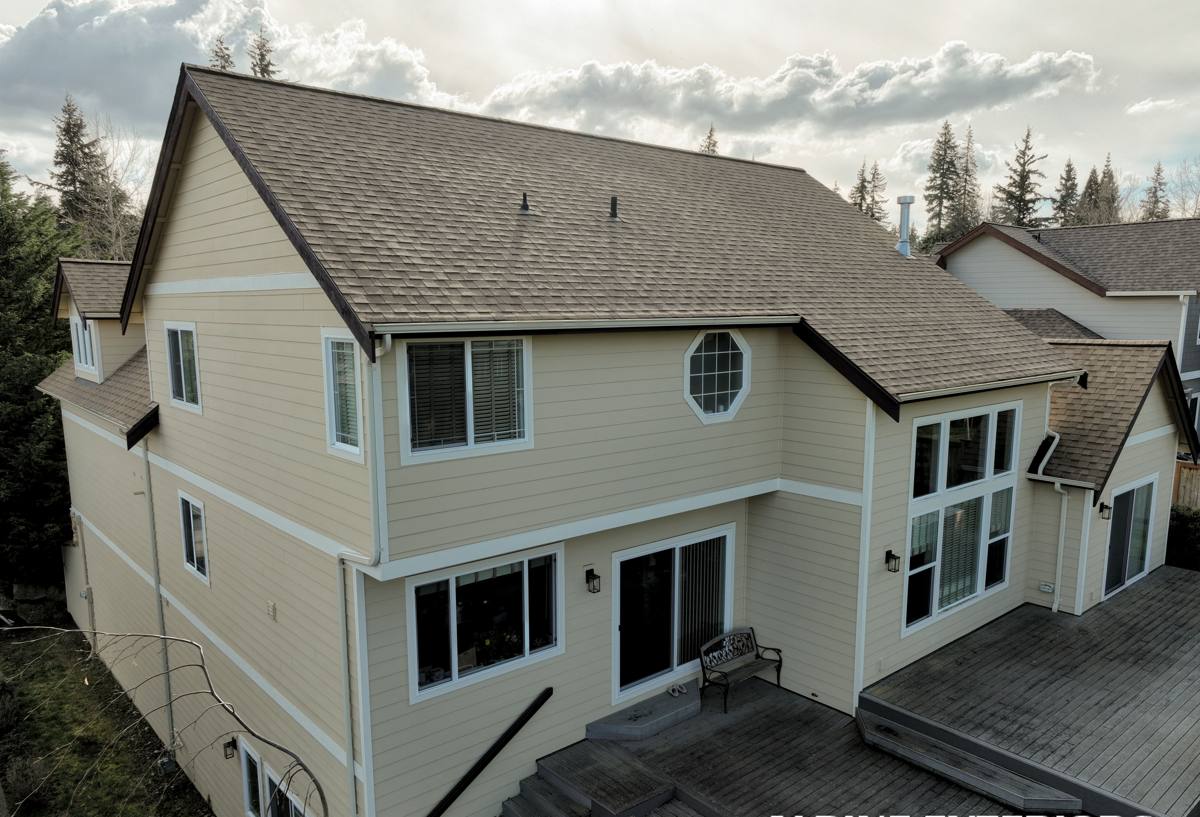
We install James Hardie fiber cement siding exclusively. We don't install vinyl, LP SmartSide, Cemplank, Allura, primed spruce, or cedar. That's not a marketing position — it's a decision based on what holds up in exactly the conditions Happy Valley sees year after year.
A Product Line Engineered for This Region
James Hardie makes climate-specific product lines, and the HZ5 formulation is engineered for regions with prolonged moisture exposure like the Pacific Northwest. Fiber cement doesn't absorb water the way wood-based products can, it won't feed rot, and it's non-combustible — a genuine advantage during wildfire smoke and ember seasons that have become more common in Washington summers. It also doesn't expand and contract the way vinyl does in temperature swings, which matters less for heat here and more for keeping seams tight through a long, damp winter.
Factory Finish vs. Field-Painted
Hardie's ColorPlus finish is baked on at the factory under controlled conditions, not brushed or sprayed on-site. That matters in a climate where field-applied paint has to cure in whatever weather shows up that week. A factory finish resists fading and chipping better than field paint, and it comes backed by its own finish warranty separate from the substrate warranty — two layers of coverage instead of one.
What a Correct James Hardie Installation Actually Involves
The product only performs as well as the install. Fiber cement siding installed wrong will trap moisture and fail early, the same as any other material — the difference is that a correctly installed Hardie system is designed with that risk in mind from the ground up.
Moisture Management Comes First
Before a single plank goes up, the wall needs a continuous weather-resistant barrier, correctly lapped and taped at every seam, with flashing integrated at every window, door, and roof-to-wall intersection. Behind the siding itself, a drainage gap lets any moisture that does get past the cladding drain and dry out instead of sitting against the sheathing. This is the part of the job a homeowner never sees once it's done, and it's the part that determines whether the wall stays dry for the next thirty years or starts rotting from the inside in five.
Fastening, Clearances, and Caulk
Hardie specifies fastener type, spacing, and placement for a reason — get it wrong and you either split the board or leave it able to shift and crack the finish. Ground clearance and gaps at inside/outside corners aren't cosmetic details; they keep splashback and standing water away from the bottom edge of the siding, which is the single most common failure point we see on older installs in wetter neighborhoods. Caulking gets used at transitions and penetrations, not as a substitute for proper flashing.
Mistakes We Regularly Correct on Older Homes
On homes we've re-sided in and around Bellingham, the recurring problems are rarely the siding material itself. They're missing or reversed flashing, boards nailed tight to trim with no expansion gap, siding run straight down to grade with no clearance, and caulk used to paper over gaps that needed real flashing. A correct install avoids all of that from day one.
Comparing Siding Options for a Salt Air, High-Moss Climate
| Factor | James Hardie Fiber Cement | Vinyl | Wood / Primed Spruce / Cedar |
|---|---|---|---|
| Moisture behavior | Doesn't absorb water; won't rot | Doesn't rot but can trap moisture behind panels | Absorbs moisture; vulnerable to rot without diligent upkeep |
| Salt air / corrosion resistance | Cement-based, unaffected by salt | Resistant but can chalk and fade near water | Finish breaks down faster near salt air |
| Moss and algae resistance | Hard surface, cleans without damaging substrate | Similar surface durability | Porous surface holds moisture, feeds growth |
| Finish durability | Factory-baked ColorPlus finish | Color molded through material, can fade/chalk | Field-applied paint or stain, needs recoating |
| Fire performance | Non-combustible | Combustible | Combustible |
| Typical maintenance cycle | Occasional wash; repaint only if custom color used | Occasional wash | Repaint or restain every few years |
Every material on that list has a role somewhere. In a neighborhood dealing with sustained damp shade, occasional salt air, and a long moss season, fiber cement with a factory finish is the one that asks the least of the homeowner over time.
How Our Process Works on a Happy Valley Home
We start with a walk-around assessment of the existing siding and the wall assembly behind it, paying particular attention to shaded sides, grade clearance, and any spots where past moisture has already left marks. From there:
- Full removal of the existing siding and inspection of the sheathing for hidden rot before anything new goes on
- Repair of any damaged sheathing or framing found underneath — this gets flagged and discussed before we cover it back up
- Installation of a continuous weather-resistant barrier with properly lapped seams and integrated flashing at every penetration
- A drainage gap behind the siding so incidental moisture can escape instead of collecting
- Hardie plank, panel, or shingle installation to manufacturer fastening specs, with correct clearances at grade, trim, and corners
- Final inspection of seams, caulking points, and trim details before we call the job done
We don't shortcut the tear-off and moisture-barrier stage to save time. On a home in a climate like this, that's the stage that decides whether the siding lasts.
Living With James Hardie Siding in a Moss-Prone, Salt-Air Neighborhood
Fiber cement is genuinely low-maintenance, but "low" isn't "none." A few habits keep it performing the way it's designed to:
- Rinse the siding down once or twice a year, focusing on shaded north- and west-facing walls where moss and algae take hold first
- Keep gutters clear so overflow doesn't run down the wall face and stay wet longer than it should
- Trim back tree and shrub growth that keeps a wall in constant shade or brushes against the siding
- Check caulking at trim and penetration points every year or two and have gaps re-sealed before they become entry points
- Address any impact damage or chipped finish promptly rather than letting exposed edges sit through a wet winter
None of this compares to the upkeep a wood-based or field-painted product demands in the same environment. It's maintenance, not restoration.
Why It Matters That We Already Work This Neighborhood
A crew that's worked Happy Valley and the surrounding Bellingham neighborhoods knows which walls take the worst of the weather, what Whatcom County's permitting and inspection process expects, and how the local moisture pattern actually behaves against a house rather than how it behaves in a manufacturer's spec sheet written for a national audience. That local familiarity shows up in small decisions — where to add extra flashing attention, which sides need a tighter caulk-check schedule, how to sequence a tear-off around a wet forecast — that a crew unfamiliar with the area is more likely to miss.
It also means we're not guessing at how a James Hardie system performs here. We've installed it on homes dealing with the same salt air, the same driving rain, and the same moss pressure, and we install to the same standard on every one of them, backed by Hardie's transferable warranty on the material and finish.
Get a Straight Answer for Your Home
If your siding is showing moss buildup, soft spots, peeling paint, or you're just planning ahead for a replacement, we're happy to take a look and give you an honest read on what your home actually needs. Request a free, no-pressure estimate below and we'll walk the property with you before recommending anything.