 Bellingham
 Edgemoor's Waterfront Setting Is Hard on Siding
Edgemoor sits close to the water on Bellingham Bay, and that proximity shapes what a home's exterior has to put up with year after year. Salt-laden air moves off the bay and settles onto siding, trim, and fasteners. Add Whatcom County's long wet season — months of driving rain pushed sideways by wind off the water — and you have an environment that punishes anything less than a fully weather-tight, corrosion-resistant siding system. Many Edgemoor lots also carry mature tree cover, which keeps north- and east-facing walls shaded and damp well after the rest of the neighborhood has dried out.
That combination — salt exposure, sustained moisture, and shade — is exactly what drives moss and mildew growth on siding, and it's exactly the kind of climate that separates siding products that hold up from products that don't.
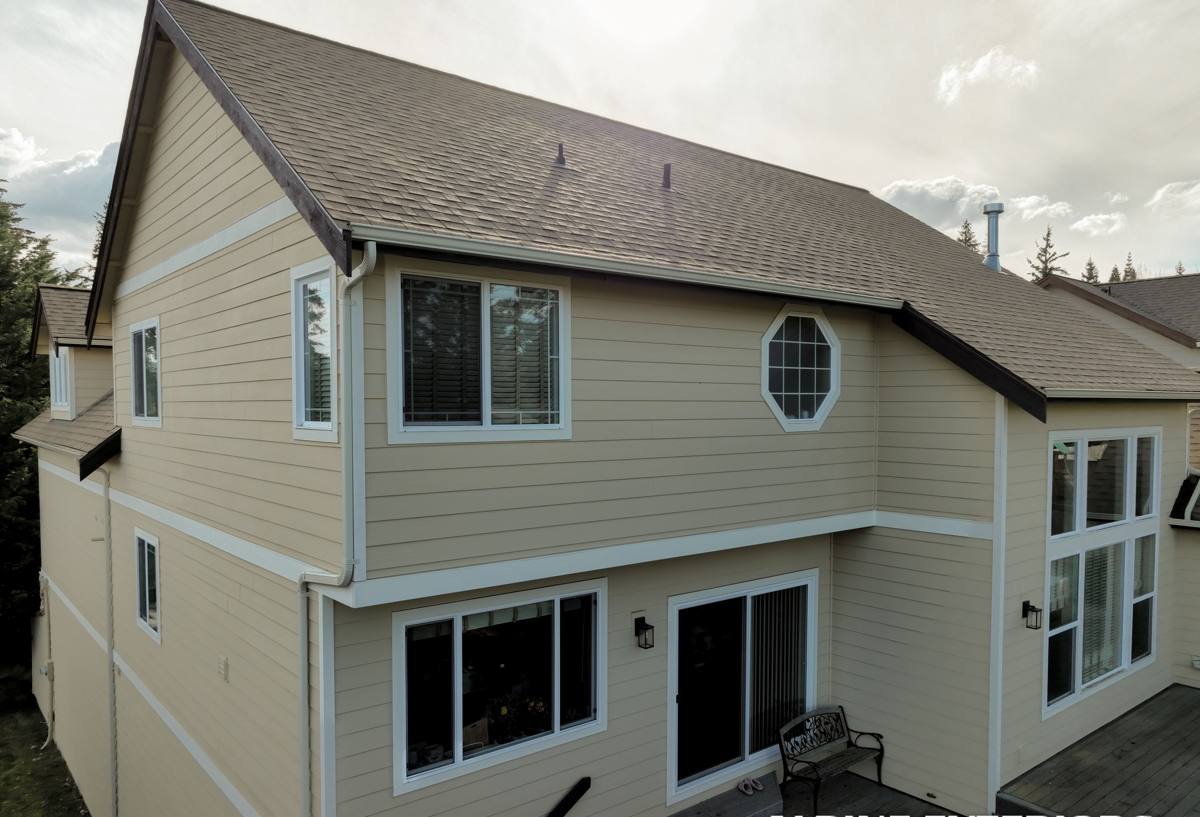
Why Fiber Cement Fits This Kind of Exposure
Siding choice matters more here than it does in a dry, sheltered inland location. Wood-based products absorb moisture and are a food source for the mold and moss spores that thrive in a shaded, damp yard. Vinyl doesn't rot, but it flexes and gaps in wind, and it doesn't hold paint if a homeowner ever wants to change the color. Fiber cement — specifically James Hardie's engineered version of it — is dimensionally stable, doesn't feed mold growth, and takes a factory finish that's built to handle UV and moisture without chalking or peeling.
| Material | Salt Air Resistance | Moss/Mildew Resistance | Maintenance Burden |
|---|---|---|---|
| Vinyl | Doesn't corrode, but seams and fasteners can | Moderate — surface film needs washing | Low, but can't be refinished if damaged |
| Cedar / wood | Poor without constant upkeep | Poor — organic material feeds growth | High — recoating and spot repairs |
| James Hardie fiber cement | Non-combustible, engineered for coastal moisture | Strong — factory finish resists organic growth | Low — periodic rinsing, no repainting cycle |
This is why we don't install LP SmartSide, vinyl, primed spruce, or cedar on Edgemoor homes. Each of those products has legitimate uses somewhere, but none of them hold up to this specific mix of salt air, standing moisture, and shade the way engineered fiber cement does, and we'd rather stand behind one system we trust than split our attention across several.
The James Hardie Product Lines We Use Here
HardiePlank Lap Siding
The most common choice for Edgemoor's mix of traditional and updated home styles. It gives a clean horizontal lap look in a range of textures, from smooth to a subtle cedar-grain finish, and it's available in the widths that match older homes' existing reveal if you're matching into an addition.
HardieShingle and HardiePanel
Shingle-style Hardie siding works well on gables and accent walls where a homeowner wants a shingled look without the maintenance a real wood shingle demands in this climate. HardiePanel is used for vertical board-and-batten sections, often paired with lap siding on the same home for a two-material look that's still one product system underneath.
Engineered for This Climate Zone
James Hardie manufactures its products in different formulations for different regions, under what it calls the HardieZone system. Western Washington falls under the HZ5 formulation, engineered for freeze-thaw cycles and sustained moisture exposure rather than the hot, humid formulation used in the South. That distinction matters — it's part of why we only order and install the Northwest-engineered product, not a generic version.
The ColorPlus Finish Advantage
Almost every Edgemoor job we look at uses ColorPlus, James Hardie's factory-applied finish, rather than field-applied paint. The finish is baked on under controlled conditions, which gives it better adhesion and UV resistance than a coat of paint applied on-site in variable weather. In a shaded, damp yard, that finish also resists the kind of surface staining that gives cheaper siding a permanently dirty look within a few years. It comes with its own finish warranty separate from the substrate warranty, and it means no repainting cycle for the life of the finish.
What a Correct Installation Actually Involves
Fiber cement siding is only as good as the installation behind it, and in a high-moisture environment like Edgemoor, installation mistakes show up faster and worse than they would somewhere drier. A correct job includes:
- A weather-resistant barrier installed with proper lapping, sealed at every penetration
- Rain screen or drainage gap detailing on walls that face prevailing wind and driving rain
- Flashing at every window, door, and roof-to-wall intersection — not caulk used as a substitute for flashing
- Correct nailing pattern and fastener depth, using fasteners rated for coastal/corrosive exposure
- Minimum clearance from the siding's bottom edge to grade, decks, and roof lines so water can't wick up into the plank
- Factory-cut and factory-sealed edges wherever possible, with any field cuts back-primed before installation
Where Installations Go Wrong
The most common failures we see in this climate trace back to a handful of shortcuts: siding installed tight to a deck or grade with no clearance, caulk relied on instead of flashing at penetrations, and butt joints left unsealed where two boards meet. None of these show up on day one. They show up two or three wet seasons later, as swelling, staining, or moisture damage behind the siding — which is exactly what a warranty won't fully cover if the installation, not the product, was the cause.
Our Process for an Edgemoor Job
We start with a walk-around assessment of the home's specific exposure — which walls take the worst of the wind-driven rain, where tree cover keeps a section shaded and slow to dry, and where the existing siding or trim is already showing moss, staining, or moisture damage. From there:
- Assessment and measurement, including a look at existing flashing, trim, and any moisture damage under the current siding
- Removal of old siding and inspection of the sheathing underneath for rot or damage before anything new goes on
- Installation of the weather-resistant barrier and any rain screen detailing the walls need
- Flashing at every penetration, then HardiePlank, HardieShingle, or HardiePanel installation to spec
- Trim, caulking, and touch-up work on any field-cut edges
- Final walk-through and warranty registration
Living With Fiber Cement Siding in a Moss-Prone Yard
James Hardie siding is low-maintenance, not zero-maintenance. In a shaded, damp Edgemoor yard, a few simple habits keep it looking right for the long haul:
- Rinse the siding annually with a garden hose, focusing on shaded and north-facing walls where moss and algae take hold first
- Keep gutters clear so overflow doesn't run down the face of the siding and keep it perpetually wet
- Trim back shrubs and low branches touching the siding so air can circulate and walls can dry between rains
- Inspect caulking at trim and penetrations every year or two and have any cracked or missing caulk redone before wet season
- Avoid pressure washing directly at joints and edges — a low-pressure rinse is enough and won't force water behind the boards
What Affects Cost on an Edgemoor Home
| Factor | Why It Matters |
|---|---|
| Wind/rain exposure of the lot | Wind-facing walls need more rain screen and flashing detail |
| Tear-off vs. new construction | Removing old siding and repairing sheathing adds labor and sometimes rot repair |
| Home size and wall complexity | Dormers, gables, and multiple materials (plank plus shingle or panel accents) add cutting and trim time |
| Product line and texture | Smooth, cedar-grain, and shingle-profile products carry different material costs |
| Existing moisture damage | Rotted sheathing or framing found during tear-off needs repair before new siding goes on |
We give a firm number after that walk-around assessment, once we've actually seen the walls, the exposure, and the condition of what's underneath — not a phone estimate based on square footage alone.
Why It Helps to Hire a Crew That Already Works This Neighborhood
Edgemoor's mix of waterfront exposure, wooded lots, and older housing stock means the right approach on one wall of a home can be wrong on the wall thirty feet away, depending on which direction it faces and how much tree cover sits over it. A crew that has already worked this part of Bellingham knows to look for that variation instead of treating every wall the same, knows what moisture damage from years of wind-driven rain actually looks like when it's opened up, and is familiar with the permitting expectations that come with work in the City of Bellingham and Whatcom County. That local pattern-recognition is part of what keeps a job from missing something that only shows up after the next wet season.
If you're weighing a siding project on an Edgemoor home, we're happy to take a look and give you a straightforward, no-pressure estimate — just fill out the form below.