 Bellingham
 Why Decks in Puget Wear Out Faster Than You'd Think
If you live in the Puget area of Bellingham, you already know your deck takes more abuse than a deck in a drier inland town. Three things are working against it at the same time: salt-laden air coming off the water, driving rain that hits at an angle instead of falling straight down, and a moss season that can stretch from fall through spring. Individually, any one of these is manageable. Together, they're what turns a 12-15 year deck lifespan into an 8-10 year one if the original build didn't account for them.
Salt air accelerates corrosion on fasteners, joist hangers, and any exposed metal hardware. Once a hidden fastener or hanger starts rusting, it's working from the inside of the structure where you can't see it until something feels spongy or a board starts to lift. Driving rain gets pushed sideways by wind off the water, which means it finds its way under flashing, around ledger boards, and into end-grain cuts that a straight-down rain would never reach. And moss doesn't just look bad — it holds moisture against wood and decking surfaces for weeks at a time, which is exactly the environment rot and mildew need to take hold.
A deck replacement done right for a Puget home isn't the same job as a deck replacement in a dry climate. The structure, the fasteners, the flashing details, and the material choice all need to answer to what this specific stretch of Bellingham weather actually does to a deck year over year.
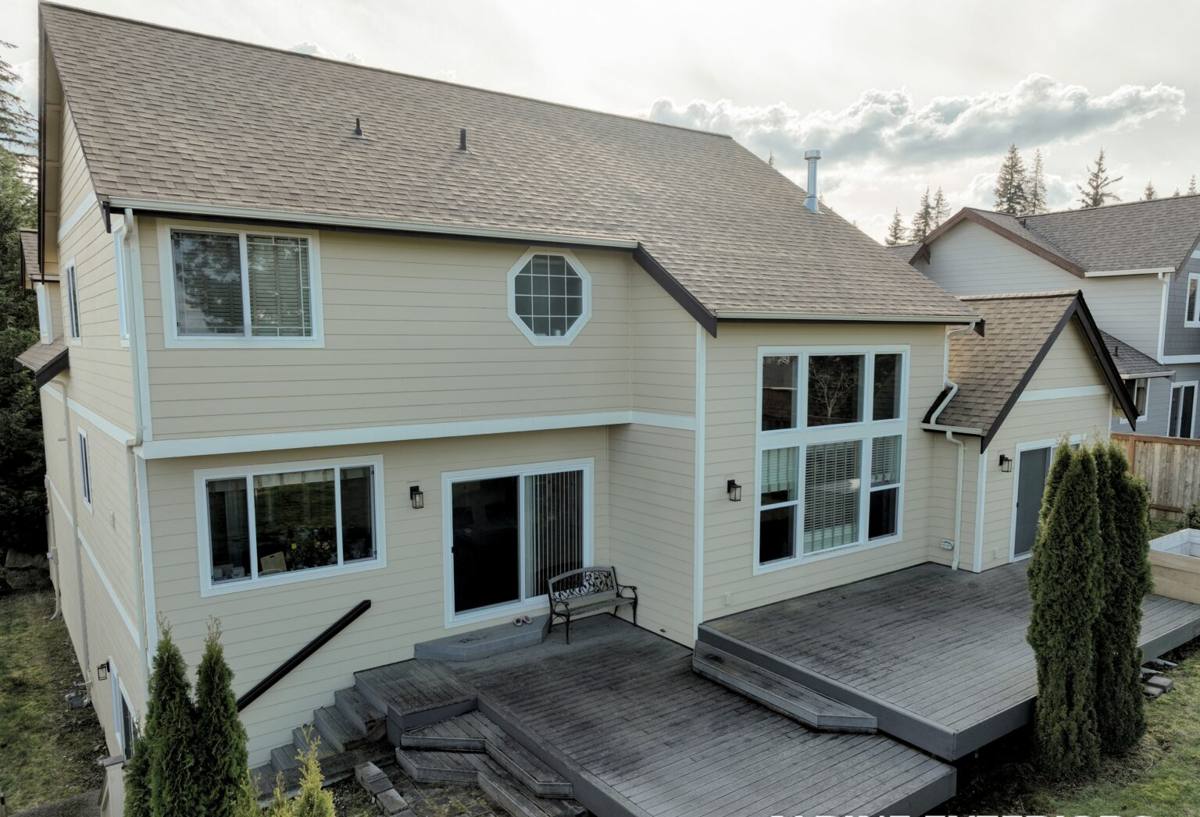
Signs You Need Replacement, Not Just Repair
Not every tired deck needs a full tear-off. Sometimes a few boards, a repainted railing, or new fasteners will buy you several more good years. But there's a point where patching becomes false economy — you're spending money on a structure that's still failing underneath. Here's how we tell the difference on a Puget-area inspection:
- Soft or spongy spots in the decking that give slightly underfoot, especially near the house or at board ends
- Rust staining bleeding through around fastener heads or ledger bolts
- Visible gaps or movement where the ledger board meets the house — a sign water has been getting behind it
- Persistent moss or algae that comes right back within weeks of cleaning, even on a sealed deck
- Posts or footings that feel loose when you push on the railing
- Any structural member (joist, beam, post) with soft, crumbling wood you can pick apart by hand
- A deck built more than 15-20 years ago with galvanized (not stainless or coated) hardware, in a spot exposed to wind off the water
If you're seeing two or more of these, it's worth having someone look at the framing underneath, not just the surface boards. Surface rot is often the visible tip of a problem that's been developing in the structure for a while.
What a Correct Deck Replacement Actually Involves
The Structure Comes First
The decking boards are the part everyone sees, but the framing underneath is what determines whether the deck lasts. A proper replacement means checking and, where needed, replacing ledger boards, joists, beams, and posts — not just laying new boards over old bones. In a climate with this much moisture exposure, we pay particular attention to the ledger connection to the house, since that's the single most common point of hidden water damage on any deck in this region.
Footings and Ground Contact
Whatcom County's clay-heavy, often waterlogged soil doesn't drain the way sandy or gravelly soil does. Footings need to be sized and set below frost depth and clear of standing water pockets, or you end up with posts that shift over a few wet winters. This is one of the most-skipped steps in a quick patch job, and it's usually the reason a "repaired" deck fails again within a couple of years.
Fasteners and Hardware
Standard galvanized fasteners corrode faster in salt air than most homeowners expect. For Puget-area decks, we use stainless steel or coated fasteners rated for coastal exposure, along with joist hangers and structural connectors built for the same conditions. It costs a bit more up front and it's the difference between hardware that lasts the life of the deck and hardware that starts staining and weakening within a few seasons.
Flashing and Water Management
Where the deck meets the house is the most important water-management detail on the whole project. Proper ledger flashing — installed correctly, not just caulked — keeps driving rain from working its way behind the siding and into the rim joist. This is a detail that's invisible once the deck is finished, but it's the one most likely to cause an expensive repeat problem if it's done wrong or skipped.
Choosing the Right Decking Material for This Climate
There's no single "best" decking material — there's a best material for your budget, your maintenance appetite, and how exposed your specific deck is to wind, rain, and moss. Here's how the common options actually perform in Puget's conditions:
| Material | Moss/Moisture Resistance | Maintenance | Typical Lifespan Here |
|---|---|---|---|
| Pressure-treated wood | Fair — needs regular sealing to resist moss and rot | Annual cleaning and re-sealing recommended | 10-15 years with upkeep |
| Cedar | Good natural rot resistance, but still holds moss without upkeep | Periodic oiling or sealing to maintain appearance and resistance | 15-20 years with upkeep |
| Composite decking | Very good — doesn't absorb water like wood, resists rot | Occasional washing; no sealing or staining | 20-25+ years, manufacturer-dependent |
| PVC/capped polymer | Excellent — fully moisture-resistant surface | Lowest — mostly just washing off moss and pollen | 25+ years, manufacturer-dependent |
Wood is a legitimate choice if you're comfortable with a yearly maintenance routine and like the traditional look. Composite and PVC decking cost more up front but take moss and rain almost entirely out of the maintenance equation, which matters a lot in a climate where moss season is a real, recurring event rather than an occasional nuisance. We'll walk through the honest trade-offs for your specific deck rather than push whatever's easiest for us to install.
Our Deck Replacement Process
- On-site assessment — we inspect the existing deck's framing, footings, and ledger connection, not just the surface, so you know exactly what's failing and why.
- Honest scope and options — you get a clear picture of what needs full replacement versus what could be salvaged, along with material options that fit your budget and maintenance preference.
- Permitting — we handle the permit application with the City of Bellingham or Whatcom County, depending on your property, so the work is inspected and documented correctly.
- Demolition and disposal — full removal of the old structure, including hauling away old lumber and hardware.
- Framing rebuild — new footings, posts, beams, joists, and ledger flashing installed to hold up against wind-driven rain and salt air exposure.
- Decking and railing installation — your chosen material installed with corrosion-resistant fasteners throughout.
- Final walkthrough — we go over the finished deck with you, including what maintenance (if any) it needs going forward.
Permits and Code in Bellingham and Whatcom County
Deck replacement projects above a certain size or height typically require a building permit, and if the ledger attachment or footings are being redone, that's almost always the case regardless of deck size. Pulling a permit isn't a formality to skip — it means your framing and footings get inspected against current code, which matters most for a structure that's going to be standing in wet, exposed ground for the next couple of decades. We handle the permit process as part of the job so you're not the one tracking down inspections.
Maintenance After Replacement
Even a well-built deck needs some seasonal attention in this climate, and how much depends on the material you chose:
- Clear leaves and debris from between boards regularly through fall, before moss has a chance to establish
- Rinse or lightly scrub moss and algae growth off the surface at the start of moss season rather than waiting until it's established
- Check that gutters and downspouts near the deck are directing water away, not onto it
- For wood decking, plan on resealing on the schedule your contractor recommends — usually every 1-2 years depending on exposure
- Glance at railing posts and stair connections once a year for any looseness
A deck built with the right materials and details for this climate needs far less babying than one that wasn't — but "low maintenance" isn't the same as "no maintenance" anywhere on the water.
Why a Crew That Already Works Puget Matters
Deck framing details that work fine in a dry inland town aren't automatically right for a property exposed to salt air and driving rain off the water. A crew that already works in Puget and around Bellingham knows which fastener grades hold up, where flashing tends to fail first, and how aggressive the moss season really gets on decking surfaces here versus elsewhere in Whatcom County. That local experience shows up in the parts of the job you won't see once it's finished — the flashing behind the ledger, the hardware inside the joists — which are exactly the parts that determine whether you're back to repairs in five years or not.
If your deck is showing its age, or you're just not sure whether it needs a repair or a full replacement, we're happy to take a look. Reach out for a free, no-pressure estimate using the form below, and we'll give you a straight answer about what your deck actually needs.