 Bellingham
 Sehome's Siding Has a Harder Job Than Most Neighborhoods
Sehome sits close to downtown Bellingham, wrapped around Sehome Hill and its arboretum, with a mix of older craftsman-era homes and newer infill construction on sloped, tree-shaded lots. That combination — mature tree canopy, hillside drainage, and proximity to Bellingham Bay — creates a tougher environment for exterior siding than a flat, open subdivision would. Shade from the hillside keeps siding damp longer after rain. Salt-laced air off the bay accelerates corrosion on fasteners and trim. And Whatcom County's long, wet stretch from fall through spring means moss and algae get months to establish themselves on any surface that holds moisture.
None of that is unusual for Western Washington. But it does mean the siding material and the installation details matter more here than they would in a drier climate. A product or install method that's "fine" in Arizona can fail early in Sehome. This page covers what fiber cement siding specifically needs to hold up on Sehome homes, what a correct installation actually involves, and why we standardized on James Hardie products rather than the alternatives.
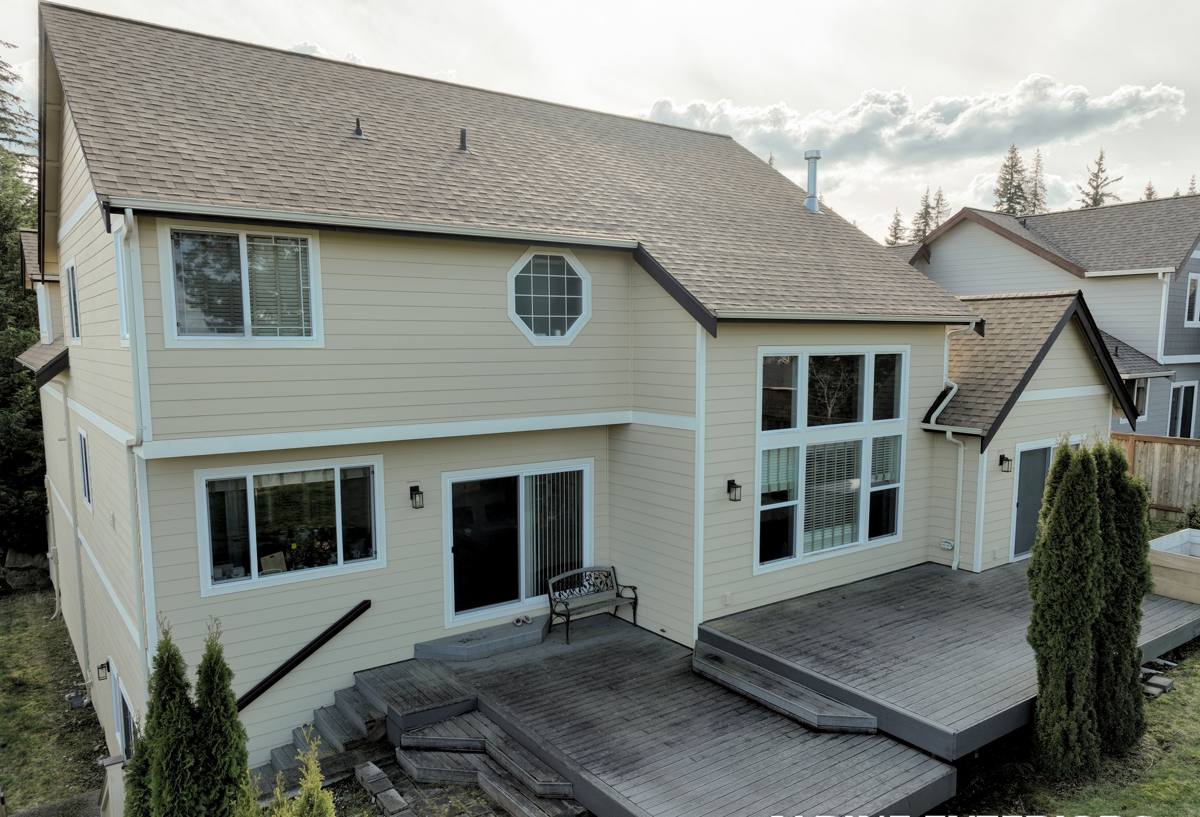
Why We Install Only James Hardie Fiber Cement
We don't install vinyl, LP SmartSide, primed wood, cedar, or other fiber cement brands like Allura or Cemplank. That's a deliberate standard, not a lack of options. Fiber cement — specifically James Hardie's engineered product line — is non-combustible, dimensionally stable in wet-dry cycling, and backed by a factory-applied finish system (ColorPlus) that holds color and resists the fade and chalking that plague field-painted siding. In a neighborhood like Sehome, where siding spends a large share of the year in shade and moisture, that stability matters more than in drier parts of the state.
We're not going to tell you every other product is worthless — each has legitimate uses. But we've made a professional decision to put only one material on the homes we work on, because it's the one we can stand behind for the long term in this climate. If you want the detailed reasoning on any specific alternative, we cover that on our other product pages — this page focuses on what Hardie fiber cement specifically means for a Sehome home.
What Fiber Cement Actually Resists
- Moisture absorption and swelling — unlike wood-based products, it doesn't take on water and expand
- Pest damage — no food value for carpenter ants, woodpeckers, or rot fungi
- Fire spread — fiber cement is non-combustible, which matters for insurance and for homes with tight tree clearance
- UV and color fade — ColorPlus finish is baked on in a controlled factory process, not brushed on outdoors
What a Correct Fiber Cement Job Requires
Fiber cement siding is only as good as the installation behind it. The board itself is durable, but the water management system underneath it is what actually keeps a Sehome home dry through a wet Whatcom County winter. A rushed or undertrained install is the most common reason fiber cement siding underperforms — not the material.
The Details That Matter
A correct James Hardie installation on a home like the ones in Sehome includes:
- A drainage plane (rain screen or weather-resistant barrier) installed continuously behind the siding, so any moisture that gets past the boards has somewhere to go besides your sheathing
- Proper flashing at every window, door, deck ledger, and roof-to-wall intersection — these are the spots where most real-world leaks start
- Correct fastener spacing and type — corrosion-resistant fasteners driven to Hardie's specified depth, not overdriven or underdriven
- Manufacturer-specified gaps and clearances at trim, corners, and the bottom of the wall so the material can move slightly with temperature and humidity changes without cracking
- Factory-cut and factory-primed edges kept intact wherever possible, with any field cuts properly sealed per Hardie's install guide
Skipping any one of these doesn't usually cause an immediate, visible problem. It shows up two, five, or ten years later as a soft spot, a stain, or paint failure at a seam — often after the shade and moss have had time to work on the weak point.
James Hardie Product Lines Suited to This Climate
James Hardie engineers its siding in different formulations for different climate zones (HZ5 for colder, wetter regions like ours). For a Sehome home, we typically discuss:
| Product | Best Use | Why It Fits Sehome |
|---|---|---|
| HardiePlank lap siding | Most home exteriors | Traditional look, wide color range, proven long-term performance in wet climates |
| HardieShingle | Accent gables, craftsman-style homes | Matches the shingle-style detailing common on Sehome's older housing stock |
| HardiePanel | Modern facades, board-and-batten accents | Clean lines for newer infill construction in the neighborhood |
| HardieTrim | Corners, fascia, window surrounds | Matches the siding's moisture and finish performance so trim doesn't fail first |
ColorPlus finishes come pre-matched in a curated palette and include a longer finish warranty than field-applied paint. For homes under heavy tree cover, we'll often talk through color choice too — very dark, low-reflectance colors show water spotting and pollen film differently than mid-tone colors, which is a practical consideration under a canopy like Sehome's, not just an aesthetic one.
How Moss and Shade Actually Affect Siding
Moss and algae don't damage fiber cement the way they can damage wood, but they're not harmless either. Sustained organic growth holds moisture against the surface longer, can stain the ColorPlus finish over time, and — more importantly — is often a symptom of a bigger issue: poor sun exposure combined with inadequate drainage or overhanging vegetation too close to the wall. On a hillside, tree-shaded lot like many in Sehome, some of this is unavoidable. The goal isn't to eliminate all moss exposure; it's to make sure the siding and the wall assembly behind it are built to shed water fast and dry out between rain events.
Simple Maintenance Habits for Shaded Sehome Lots
- Keep tree branches and shrubs trimmed back at least a foot or two from siding to improve airflow and sun exposure
- Rinse siding with a garden hose once or twice a year — avoid high-pressure washing directly at seams and edges
- Check and clear gutters before the fall rains start, so overflow doesn't run down the wall face
- Look at north- and west-facing walls (typically the shadiest and most exposed to weather) for early moss or discoloration
- Address any caulking cracks or gaps at trim promptly — small gaps are easy fixes, water intrusion is not
Salt Air and Fastener Corrosion
Bellingham Bay isn't far from Sehome, and coastal air carries salt further inland than people expect, especially with prevailing wind patterns off the water. Salt exposure mostly threatens metal components — fasteners, flashing, and any exposed trim hardware — rather than the fiber cement board itself. This is another reason installation quality matters as much as material choice: corrosion-resistant fasteners and properly sealed metal flashing hold up under salt exposure; standard hardware can start showing rust streaks and weakening well before the siding itself shows its age.
Our Process for Sehome Homes
The steps are the same for every home, but we adjust the details to the site:
- On-site assessment — we look at existing siding condition, moisture damage, tree cover, drainage patterns, and slope, since a hillside lot in Sehome drains differently than a flat lot elsewhere in Bellingham
- Tear-off and sheathing inspection — we don't cover up rot or existing moisture damage; anything compromised gets repaired before new siding goes on
- Weather-resistant barrier and drainage plane installation — this is the layer that does the real water management work
- Flashing at every penetration and transition — windows, doors, roof lines, and any deck or porch attachments
- Hardie product installation to manufacturer spec — correct fastener pattern, gaps, and clearances
- Trim, caulking, and final detail work — the finishing steps that determine how the job ages, not just how it looks on install day
- Walkthrough — we go over the finished work with you before we consider the job done
What Affects Your Quote
Every Sehome home is different, and pricing depends on real, visible factors rather than a flat per-square-foot number pulled out of thin air. The main drivers we look at:
| Factor | Why It Matters |
|---|---|
| Home size and wall complexity | More corners, gables, and dormers mean more cutting, flashing, and labor time |
| Current siding condition | Rot or moisture damage found during tear-off adds sheathing repair before new siding goes up |
| Site access and slope | Hillside lots and tight tree cover in Sehome can require more setup time and careful staging |
| Product selection | Lap, shingle, and panel styles, plus trim upgrades, carry different material costs |
| Color and finish | Standard ColorPlus colors versus premium or custom options |
We'd rather walk your property and give you real numbers than guess over the phone. Every estimate is free and comes with no pressure to sign anything on the spot — if fiber cement isn't the right fit for your situation, we'll tell you that too.
Why Local, Sehome-Familiar Experience Matters
A crew that's worked on hillside, tree-shaded lots around Sehome already knows to check drainage patterns before starting tear-off, to expect softer sheathing on north-facing walls, and to plan around limited street access on some of the neighborhood's older, narrower lots. That's not something you get from a crew that mostly works flat suburban tracts elsewhere in Whatcom County. It shows up in fewer surprises mid-project and a finished install that's actually built for the conditions your home sits in — not a generic install dropped onto a site that needed a different approach.
If you're planning a siding project in Sehome, we're happy to take a look at your home and walk you through what correct fiber cement installation looks like for your specific lot. Reach out below for a free, no-pressure estimate.