 Bellingham
 Roofing a Sudden Valley Home Is Not the Same as Roofing a Bellingham Cul-de-Sac
Sudden Valley sits under heavy tree canopy along Lake Whatcom, and that changes how a roof ages. Homes here get less direct sun on large sections of the roof plane for much of the year, which means shingles stay damp longer after every rain, and Whatcom County gets a lot of rain. Add the lake's own humidity and the fine organic debris that constantly falls from surrounding fir and cedar, and you have a near-perfect setup for moss, algae streaking, and slow shingle breakdown that a roof in a more open, sun-exposed part of Bellingham simply doesn't deal with at the same rate.
Zoom out to the county level and the marine climate off Bellingham Bay and the Salish Sea adds its own wear — salt-laden air, wind-driven rain, and the freeze-thaw swings of a Pacific Northwest winter all work on fasteners, flashing, and shingle granules over time. A roof built for Sudden Valley needs to handle both realities at once: the shaded, moss-heavy microclimate of the neighborhood and the broader marine weather pattern that affects every roof in the region.
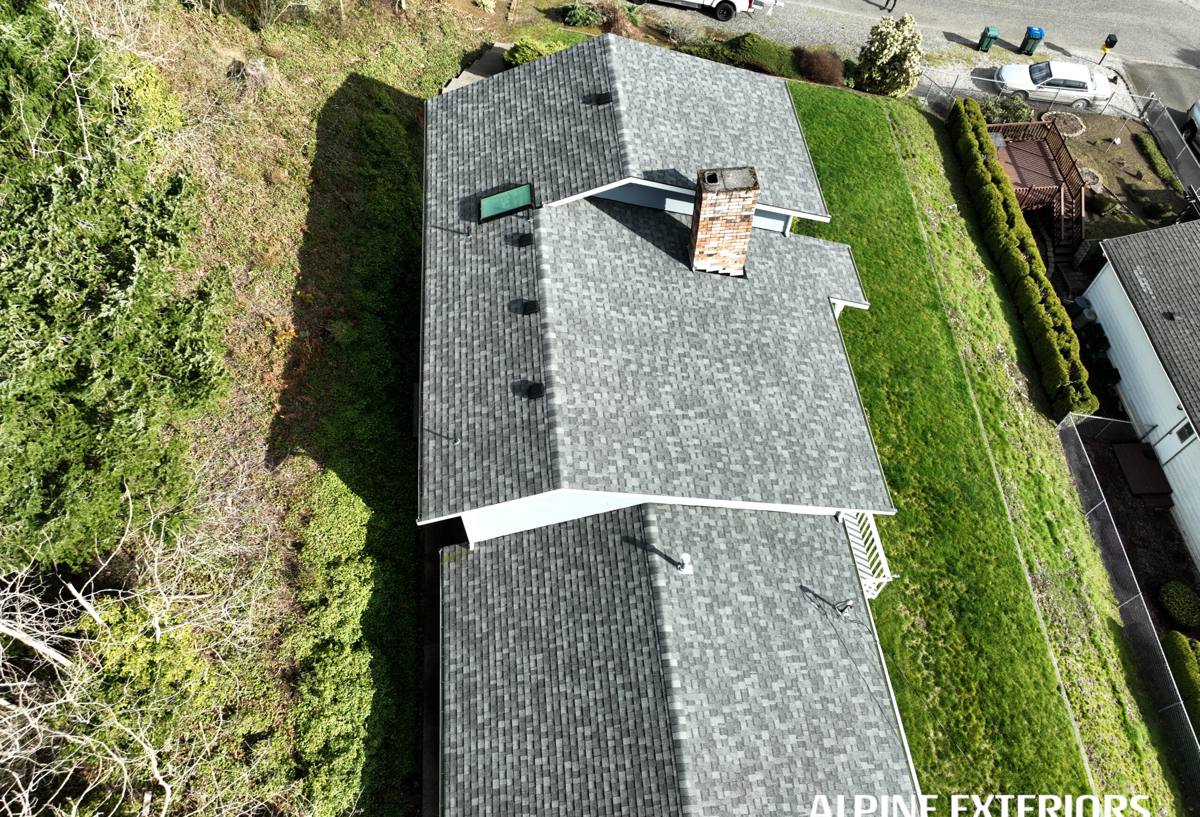
What a Correctly Installed Asphalt Shingle Roof Needs Here
Asphalt shingle roofing is still one of the most practical choices for this area — it's proven, repairable, and reasonably priced — but only when the installation accounts for local conditions. A few things matter more in Sudden Valley than they would on a drier, more open lot:
Ventilation That Actually Dries the Roof Out
Under a tree canopy, a roof deck rarely gets a full day of direct sun to bake off moisture. Balanced intake and exhaust ventilation — soffit vents paired with ridge or box vents — is what does that job instead. Without it, moisture gets trapped in the attic and roof deck, which shortens shingle life and invites rot in the sheathing underneath, regardless of how good the shingles themselves are.
Underlayment and Ice-and-Water Protection at Vulnerable Points
Eaves, valleys, and any low-slope transitions are where water sits longest and where shingles fail first. Self-adhered ice-and-water shield in those areas, backed by synthetic underlayment across the rest of the deck, gives the roof a real second line of defense — not just a formality between the deck and the shingles.
Flashing That's Actually Replaced, Not Reused
Around chimneys, skylights, and roof-to-wall intersections, flashing is one of the most common places we find leaks tracing back to a rushed re-roof. New flashing, properly stepped and sealed, costs little compared to the labor of a tear-off — reusing old, rusted, or poorly fitted flashing to save a few dollars is a false economy.
Nailing Pattern and Fastener Choice
Manufacturer nailing patterns exist for a reason, and in a wind-exposed area like the lake basin, under-nailing or high-nailing is one of the fastest ways to void a warranty and lose shingles in the first serious windstorm. We use corrosion-resistant fasteners set to spec, not gun pressure guessed on the fly.
Signs a Sudden Valley Roof Needs a Closer Look
Because so much of Sudden Valley sits in partial shade, roof problems often show up as slow, quiet deterioration rather than a sudden leak. Homeowners who catch issues early usually notice one or more of these:
- Dark green or black streaking, especially on north-facing slopes that get the least sun
- Visible moss clumps along shingle tabs or in valleys, not just on ridge caps
- Granules collecting in gutters or at downspout outlets
- Shingle edges that look curled, cupped, or brittle when viewed up close
- Soft or spongy decking felt through the attic floor near eaves
- Daylight visible through the roof deck from inside the attic
- Persistent damp or musty smell in an upstairs room or attic space
Our Process for Sudden Valley Roofing Jobs
The steps are similar to any quality tear-off and re-roof, but we adjust the sequencing and site logistics for wooded, sloped lots like the ones common here.
- On-site inspection. We walk the roof and attic, check for soft decking, existing moss growth, ventilation gaps, and flashing condition before quoting anything.
- Tear-off and deck check. Old material comes off down to the deck so we can see the actual condition of the sheathing, not guess at it from the ground.
- Deck repair as needed. Any soft or rotted sheathing gets replaced before a single new shingle goes down — covering bad decking is how roofs fail early.
- Underlayment and flashing. Ice-and-water shield at eaves and valleys, synthetic underlayment across the field, new flashing at all penetrations and transitions.
- Ventilation correction. We balance intake and exhaust venting to match the home's attic volume, which matters more here given how little sun the roof gets.
- Shingle installation. Installed to manufacturer spec for nailing, exposure, and offset — not shortcut for speed.
- Site cleanup and magnetic sweep. Especially important around wooded lots where debris and stray nails can sit in landscaping and become a problem later.
Choosing a Shingle for a Shaded, Moss-Prone Lot
Not every shingle line handles shade and moisture the same way. For a Sudden Valley roof, we generally steer homeowners toward algae-resistant shingle lines, which use copper-containing granules to slow algae and moss growth — a meaningful upgrade given the tree cover here, not a marketing gimmick.
| Shingle Type | Typical Lifespan | Moss/Algae Resistance | Best Fit For |
|---|---|---|---|
| Standard 3-tab | 15–20 years | Low unless treated | Budget-conscious, sun-exposed roof sections |
| Architectural (dimensional) | 25–30 years | Moderate, better with algae-resistant granules | Most Sudden Valley homes — good balance of cost and durability |
| Algae-resistant architectural | 25–30 years | High | Heavily shaded lots, north-facing slopes, lakefront humidity |
| Premium/designer laminate | 30+ years | High | Homeowners prioritizing longevity and appearance over lowest upfront cost |
We don't push the most expensive line on every job — a well-ventilated architectural shingle with algae-resistant granules is the right call for most homes in this neighborhood. Where a roof is almost entirely shaded or sits close to the lake, spending up for the higher-resistance option tends to pay for itself in fewer moss treatments and a longer real-world lifespan.
Maintenance Between Roof Installs
A good install buys time, but a shaded roof still needs upkeep that a sunnier roof can skip. A short list that actually moves the needle:
- Keep overhanging branches trimmed back so more airflow and light reach the roof plane
- Clean gutters and downspouts at least twice a year — clogged gutters back water up under the shingle edge
- Address moss at first sighting rather than waiting for a heavy mat to form; light growth is far easier and cheaper to remove than an established colony
- Skip pressure washing the roof — it drives water under shingles and strips protective granules; low-pressure treatments are the safer route
- Have the roof looked at after any major windstorm, since wind-loosened shingles in a wooded area are often hidden from ground view
Why It Matters That the Crew Already Works This Neighborhood
Sudden Valley's private roads, tree cover, and lot layouts aren't something every roofing crew is used to working around. A crew unfamiliar with the area often underestimates staging space, access for a dump trailer or lift, or how much debris cleanup a heavily wooded lot requires — and that shows up as delays or an incomplete cleanup at the end of the job. Working locally also means we're already familiar with permitting through Whatcom County and typical inspection expectations for re-roofing work in the area, so there are no surprises mid-project.
There's also a simple accountability angle: a contractor based in and around Bellingham, who plans to keep working in this community for years, has every incentive to do the job right the first time and be reachable afterward if a question comes up.
What Affects Cost on a Sudden Valley Roof
Every roof is priced on its own specifics, but a few factors tend to move the number more than others in this area:
| Factor | Why It Matters Here |
|---|---|
| Roof access and slope | Wooded lots and steeper rooflines can require extra staging, safety equipment, and labor time |
| Deck condition | Moisture-related rot found during tear-off adds material and labor to repair before shingles go on |
| Shingle grade | Standard vs. algae-resistant vs. premium laminate shifts material cost and long-term maintenance needs |
| Ventilation upgrades | Homes with poor existing attic ventilation may need added intake or exhaust venting |
| Layers to remove | A tear-off with multiple existing layers takes longer than a single-layer removal |
| Debris removal | Tree-heavy lots often generate more cleanup and disposal work than open lots |
We give straightforward, itemized estimates rather than a single vague number, so you can see exactly what's driving the price before any work starts.
If your roof in Sudden Valley is showing moss, wear, or you just want an honest read on how many years it has left, we're glad to come take a look. Use the form below to request a free, no-pressure estimate.