 Bellingham
 Siding Repair for Sunnyland Homes
Sunnyland is one of Bellingham's older, more established neighborhoods, and it shows in the housing stock: a mix of home ages and styles, a lot of mature tree canopy, and plenty of lots where shade sits on at least part of the siding most of the day. That combination is exactly what wears siding down fastest in Whatcom County. Salt-tinged marine air moves through the whole city, wind pushes rain sideways into laps and seams instead of letting it fall straight down, and the tree cover that makes Sunnyland's streets pleasant to walk also keeps walls damp longer than a home out in open sun. None of that is unique to any one house on any one block — it's a neighborhood-wide condition, and it's why siding repair calls in Sunnyland tend to follow some consistent patterns.
This page is about siding repair specifically — fixing damaged, failing, or deteriorating siding on an existing home, not a full re-side. We work on siding repair calls throughout Sunnyland regularly enough to know what usually causes the damage, what a repair actually needs to include to hold up through another wet season, and when a repair is the right call versus when it's just delaying a bigger conversation.
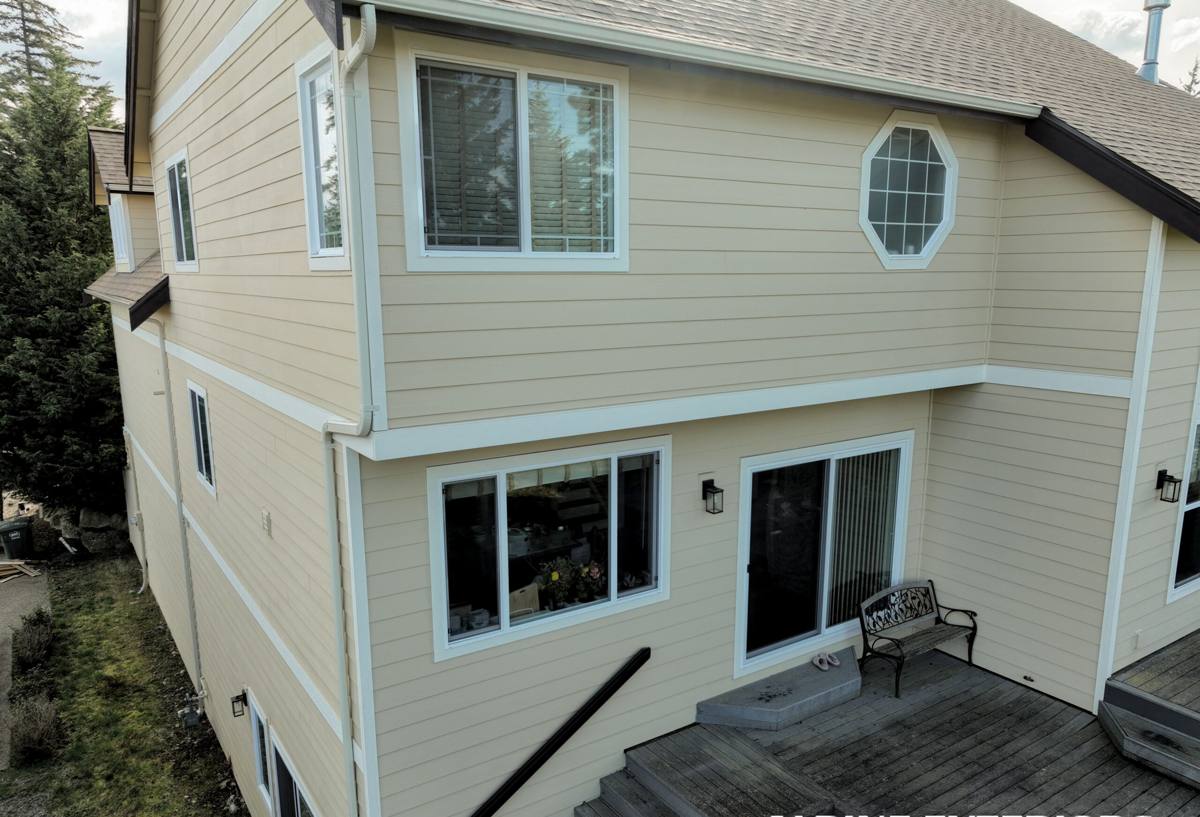
What Bellingham's Climate Does to Siding Over Time
Moss and Shade
Sunnyland's tree cover is one of its defining features, and it's also the reason moss and algae growth shows up on siding here earlier and more persistently than it does on more exposed lots. Shaded, north-facing walls stay damp for days after a storm instead of drying out in an afternoon, and that sustained moisture is exactly what moss needs to take hold. Left alone, moss holds water directly against the siding surface, which accelerates whatever weakness the material already has, whether that's paint failure, swelling at a seam, or slow rot underneath.
Salt Air and Wind-Driven Rain
Bellingham sits on the bay, and the marine air that comes with that is a steady, low-grade stressor on fasteners, flashing, and exposed finishes even on days without a visible storm. Add wind-driven rain, which hits Whatcom County walls sideways rather than straight down, and you get water finding its way into lap joints, trim seams, and fastener holes that a calmer, drier climate would never test. Over years, that's what turns a small original flaw into a real repair.
Slow-Drying Walls
The combination of shade and marine humidity means a lot of Sunnyland siding simply doesn't get the drying time that siding in a sunnier, more open part of the county does. A siding material or installation detail that would perform fine somewhere drier can still fail here, not because the product is bad, but because this specific wall never gets a real chance to dry out between rain events.
Signs Your Sunnyland Home Needs Siding Repair
Most siding damage doesn't show up as an obvious hole or crack. It shows up as small changes that are easy to write off until they've been quietly getting worse for a season or two. Worth checking for on a walk around the house:
- Soft or spongy spots when you press on the siding, especially near the bottom of walls or below windows
- Persistent moss or dark staining that comes back quickly after cleaning
- Boards or panels that are visibly cupping, bowing, or pulling away from the wall
- Peeling or bubbling paint, particularly on shaded or north-facing walls
- Gaps opening up at seams, corners, or around window and door trim
- Visible cracking, especially after a cold snap or a period of heavy wind
- Musty smells or moisture staining on interior walls that share an exterior wall with damaged siding
- Rust streaking from fasteners, which usually means the fastener itself is failing
Any one of these on its own might be minor. Several of them together, or any of them near a window, door, or the base of the wall, are worth a real inspection rather than a guess from the ground.
The Difference Between a Patch and a Correct Repair
Not all siding repairs are equal, and the gap between a quick patch and a correct repair is usually invisible until the next wet season. A patch addresses what's visible. A correct repair addresses what caused the damage in the first place, which is the part that actually determines whether the problem comes back.
| Step | Quick Patch | Correct Repair |
|---|---|---|
| Diagnosis | Fixes the visible damage only | Checks behind the siding for moisture, rot, or failed flashing before closing it back up |
| Water source | Often left unaddressed | Traces where water actually got in — a seam, a flashing gap, a caulk failure — and corrects that detail |
| Materials | Whatever's closest to a match | Matched material and, where the substrate is failing, an honest conversation about whether patching is the right long-term fix |
| Fasteners and flashing | Reused or left as-is | Replaced or corrected where corrosion or improper spacing contributed to the failure |
| Result | Looks fixed for a season or two | Addresses the actual cause, so the same spot isn't a repeat call in a year |
A patch isn't always wrong — sometimes the damage really is isolated and cosmetic. The problem is when a patch gets used to cover damage that's actually a symptom of a wall assembly issue, because that just delays the real repair and usually makes it more expensive when it finally happens.
Repair or Replace: How We Help You Decide
Siding repair makes sense when the damage is localized and the underlying material and wall assembly are still sound. Replacement becomes the more honest recommendation when the damage is widespread, the material itself is reaching the end of its useful life, or repeated repairs in the same area point to a systemic problem rather than a one-time issue. We won't quote you a price without seeing the specific damage, but here's what actually moves that decision:
| Factor | Leans Toward Repair | Leans Toward Replacement |
|---|---|---|
| Extent of damage | Isolated to one area or a few boards | Spread across multiple walls or a large section |
| Cause | A single identifiable event or failed detail | Ongoing moisture intrusion or a material reaching end of life |
| Repair history | First time addressing this spot | Same area has been patched more than once already |
| Material condition elsewhere on the home | Rest of the siding is sound | Similar wear showing up on other walls too |
| Cost relative to full re-side | Repair cost is a small fraction of replacement | Repair cost is approaching a substantial share of what replacement would run |
We'll always give you the honest version of where your home falls on that list rather than steering you toward whichever option is easier for us. Plenty of Sunnyland homes just need a targeted repair and nothing more.
Why We're Honest About What We Repair
We install James Hardie fiber cement siding exclusively on new work — we don't offer LP SmartSide, vinyl, Cemplank, Allura, primed spruce, or cedar. But siding repair is different from new installation: the siding on your Sunnyland home is whatever it is, and our job on a repair call is to work with that material honestly, not to push a sales pitch.
If your home has Hardie siding, we repair it to the same standard we install to. If it has a different material — wood, vinyl, an engineered product — we'll assess it on its own terms and tell you straight whether a repair will actually hold. Where we draw a hard line is on stringing along a repeated-repair situation. If a section of siding has failed once already, is showing the same symptoms in the same place, or the material itself is simply reaching the point where it can't be reasonably kept ahead of Bellingham's moisture, we'll tell you that plainly instead of billing you for a patch we don't expect to last. When replacement genuinely is the better move, James Hardie is what we recommend, for the same reasons it's the only thing we install new: it doesn't swell or cup with repeated wet-season cycling, its factory-cured finish holds up better than field-applied paint on a shaded wall, and it's built for exactly this kind of sustained coastal moisture exposure.
Our Siding Repair Process
- Inspection: We look at the damaged area and the surrounding siding, not just the spot you called about, since moisture problems often extend past the visible damage.
- Diagnosis: We check what's happening behind the siding — the house wrap, flashing, and framing — to understand the actual cause rather than just the symptom on the surface.
- Scope and options: We explain what we found in plain terms, including whether a repair is a durable fix or a short-term one, and what replacement would look like if that's the more honest recommendation.
- The repair itself: Matched materials where possible, corrected flashing and fastening where that's what caused the failure, and attention to how the repaired section will shed water going forward, not just how it looks the day we finish.
- Cleanup and walkthrough: We walk the finished repair with you and point out what to keep an eye on, especially if the surrounding siding is aging and might need attention down the line.
Why a Crew That Already Works Sunnyland Matters
A siding repair crew that's worked across Sunnyland has already seen how homes of different ages in this neighborhood tend to fail — which orientations hold moisture longest under the tree canopy, which older siding materials common to homes of a certain vintage are prone to specific problems, and where a fastener or flashing shortcut from an earlier install tends to show up years later as a repair call. That's the kind of pattern recognition that comes from doing the work in this specific neighborhood repeatedly, not from a general siding background. It also means a faster, more accurate diagnosis on your first visit, instead of guesswork that turns into a second or third trip before the actual cause gets addressed.
If you've noticed damaged, aging, or failing siding on your Sunnyland home, we're glad to come take a look, explain what we find in plain terms, and give you a straightforward, no-pressure estimate for the repair. There's a form below — reach out and we'll get a time on the calendar.