 Bellingham
 Composite Decking Built for Lynden's Climate
Lynden sits inland from Bellingham Bay in the heart of Whatcom County's farmland, but it shares the same wet, marine-influenced weather as the rest of the region. Long gray winters, steady rain from fall through spring, and humidity that lingers over the Nooksack valley all put real stress on an outdoor deck. A deck built here needs to shed water fast, resist moss and mildew, and hold up through repeated freeze-thaw cycles without cupping, splintering, or rotting out at the joists. Composite decking, installed correctly, is one of the most reliable ways to get a deck that does all of that with a fraction of the upkeep wood demands.
This page covers what Lynden homeowners should know before installing composite decking: what the local climate actually does to a deck, what separates a correct installation from a sloppy one, and how our process works from first look to finished project.
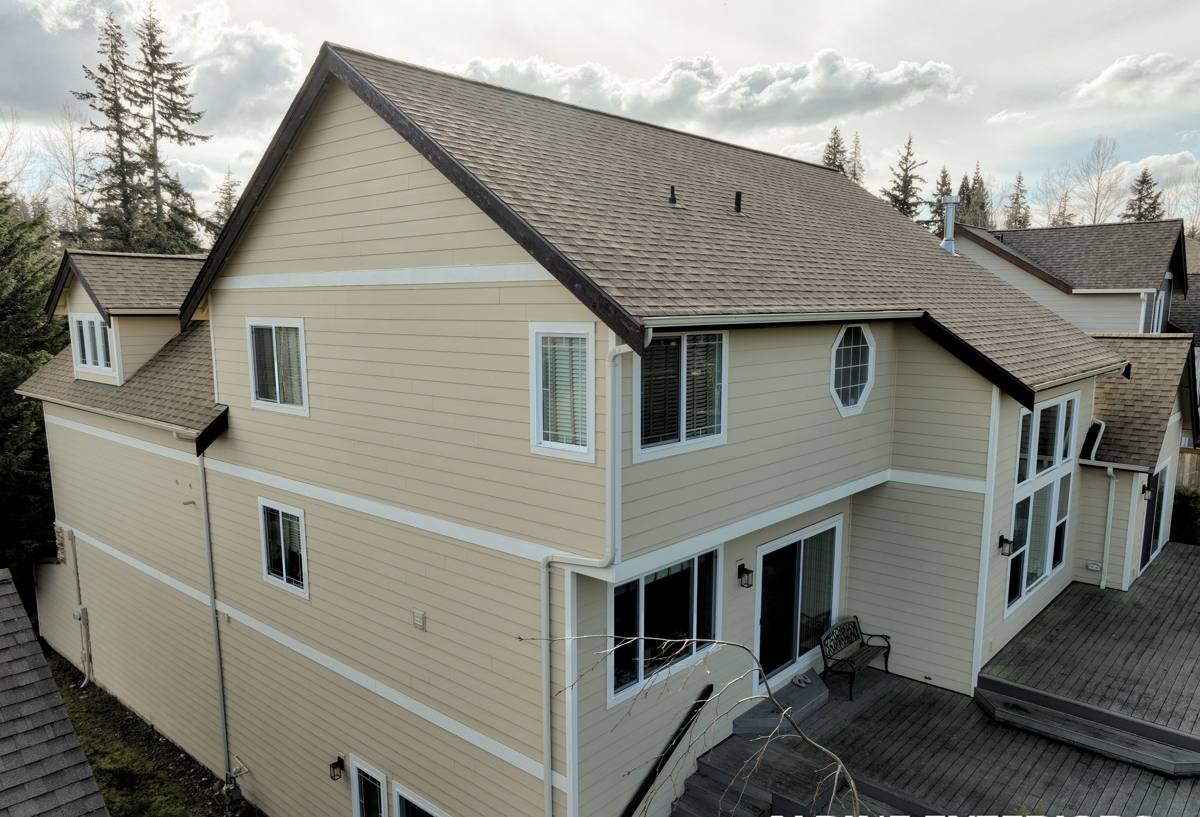
What Whatcom County Weather Does to a Deck
Whatcom County doesn't get brutal storms very often, but it makes up for that with duration. Rain falls steadily for months at a time, humidity stays elevated even between rain events, and direct sun is scarce enough that decks rarely get a chance to fully dry out. That combination is exactly what wood decking struggles with and what composite decking is designed to resist.
Moss and Mildew
Shaded decks, decks under trees, and decks on the north side of a house are especially prone to moss growth in this climate. Moss holds moisture against the deck surface, which accelerates wood rot and makes any deck surface slick and hazardous underfoot. Composite boards don't feed moss the way untreated wood does, but moss and algae can still form a film on any surface exposed to constant damp — the difference is that composite doesn't degrade from it.
Freeze-Thaw Cycling
Whatcom County doesn't see deep winter freezes often, but it does see repeated cycles of light freeze and thaw through the colder months. Water that gets into a crack, a screw hole, or a poorly sealed board end expands and contracts with those cycles, widening the damage a little more each time. This is one of the main reasons cut ends and fastener points on any decking material need to be treated as vulnerable spots, not afterthoughts.
Sustained Humidity
Even without direct rain, the air here stays damp for long stretches, especially near the river bottomland around Lynden. Decking that can't dry out between rain events is decking that stays perpetually damp at the joist level — which is where rot starts on a wood deck, hidden from view until it's a structural problem.
Wood vs. Composite for a Lynden Deck
Wood decking isn't a bad product — it's a maintenance-intensive one. In a climate that rarely gives a deck a chance to dry out, that maintenance burden gets steeper every year. Here's the honest comparison for this specific climate:
| Factor | Wood Decking | Composite Decking |
|---|---|---|
| Moisture behavior | Absorbs water; swells, cups, and checks with repeated wet-dry cycles | Doesn't absorb moisture into the board itself; dimensionally stable |
| Moss and mildew resistance | Low — untreated surfaces feed moss growth | High — surface doesn't provide the same organic food source |
| Annual maintenance | Sanding, staining, or sealing every 1-3 years | Periodic washing; no staining or sealing required |
| Splintering / cracking | Common as boards age and dry unevenly | Rare under normal use |
| Upfront cost | Lower material cost | Higher material cost |
| Expected lifespan (Whatcom climate) | 10-15 years with regular upkeep | 25-30+ years with minimal upkeep |
For a homeowner who wants to actually use their deck instead of maintaining it, composite is the better long-term trade in this climate. For someone who wants the lowest possible upfront cost and doesn't mind the upkeep, wood remains a legitimate choice. We install both — this page is about doing composite right when that's the product you choose.
What a Correct Composite Deck Installation Actually Involves
Composite decking is often marketed as low-maintenance, and it is — but "low-maintenance" only holds true if the installation underneath it is done correctly. Most composite deck failures we're called to look at aren't a problem with the boards; they're a problem with what's underneath them.
Framing and Joist Spacing
Composite boards flex differently than wood and generally require tighter joist spacing than a traditional wood deck — manufacturers publish specific spacing requirements for straight and diagonal board runs, and those specs matter more in a wet climate where any sag or bounce becomes a long-term structural issue. Framing lumber should be pressure-treated and properly flashed against the ledger board where the deck meets the house, since that's the single most common spot for hidden rot on any deck in this region.
Ventilation and Drainage
A deck built low to the ground or over a patio needs a clear path for air to move and water to drain underneath it. Without that airflow, the humid conditions common here get trapped under the deck surface, which shortens the life of the framing even when the visible decking is holding up fine.
Fastening
Hidden fastener systems are standard with most composite boards now, and they matter for more than looks — every exposed screw head is a point where water can sit and eventually work its way into the board core. Board ends, especially at picture-frame borders, need to be capped or properly finished so moisture can't wick in from a cut edge.
Expansion Gaps
Composite boards expand and contract with temperature more than most people expect. Gaps between boards, and at the perimeter where the deck meets a wall or post, need to be sized correctly for the product and the run length. Get this wrong and you either get boards that buckle in warm weather or gaps that widen and catch debris in wet weather.
Composite Decking Options
Not all composite decking is built the same way, and the differences affect how a board performs over years of Whatcom County weather, not just how it looks on day one.
| Board Type | What It Is | Best For |
|---|---|---|
| Capped composite | Wood-plastic core wrapped in a protective polymer shell | Most Lynden homes — strong moisture and stain resistance for the cost |
| Uncapped composite | Wood-plastic blend without a protective outer layer | Budget-conscious projects; needs more attention to moisture exposure |
| PVC / cellular decking | All-polymer board, no wood content | Maximum moisture resistance, higher price point |
We'll walk through specific manufacturers and their warranty terms during your estimate. What matters most for a decision is matching the board to how the deck will actually be used and how much sun or shade it gets, not just picking the least expensive option off a sample board.
Our Process, Start to Finish
- On-site assessment. We look at the existing structure (if there is one), grade and drainage around the deck footprint, sun and shade exposure, and how the space connects to the house.
- Honest recommendation. We tell you what board type and framing approach fits your budget and how the deck will be used — not just what's easiest for us to install.
- Written estimate. Clear scope, materials, and price before any work starts. No surprise change orders for things we should have caught up front.
- Permitting. Deck projects in Whatcom County and the City of Lynden may require a building permit depending on size and height — we handle that as part of the job when it applies.
- Framing and installation. Proper joist spacing, ledger flashing, drainage planning, and fastening done to manufacturer spec, not shortcuts.
- Final walkthrough. We go over the finished deck with you, including basic care specific to the board you chose.
Maintaining a Composite Deck in This Climate
Composite decking is low-maintenance, not no-maintenance. In a climate with this much sustained moisture, a small amount of seasonal attention goes a long way toward keeping a deck looking and draining the way it should.
- Sweep leaves and debris off the deck regularly, especially in fall — trapped organic matter holds moisture against the board surface and feeds moss growth
- Rinse or wash the surface a couple of times a year to clear pollen, dirt, and early moss film before it takes hold
- Keep gutters and downspouts near the deck clear so runoff isn't dumping directly onto or under the decking
- Check that gaps between boards stay clear of debris so water can drain through as designed
- Trim back overhanging branches to cut down on shade and leaf litter, which both extend the time boards stay damp
- Inspect fasteners, railings, and stairs once a year for any movement, even though composite itself won't rot
Why Hire a Crew That Already Works in Lynden
A deck built to a generic spec sheet doesn't always hold up to what Whatcom County actually throws at it. Crews who install regularly in this area know which framing details matter most against local rain patterns, how much ventilation a deck needs to avoid trapped moisture, and how to flash a ledger board so it doesn't become a hidden rot problem two winters later. That local pattern recognition is the difference between a deck that needs attention in five years and one that's still performing in twenty-five.
It also means straightforward communication — realistic timelines around our wet season, honest answers about permit requirements, and a crew that shows up and does the work they quoted.
If you're considering composite decking for your Lynden property, we're happy to come take a look and give you a straightforward, no-pressure estimate — just fill out the form below.