 Bellingham
 Why Siding in Puget Takes a Different Kind of Beating
Homes in the Puget area near Bellingham don't fail the same way houses do further inland. The combination of salt-laden air off the water, wind-driven rain that hits walls sideways instead of falling straight down, and a moss season that can stretch for months creates a specific, repeatable pattern of damage. We see it on nearly every service call in this part of Whatcom County: soft trim boards at the bottom edge of a wall, dark streaking under window sills, and moss creeping up from the ground line long before anyone notices a leak.
Salt air accelerates corrosion on fasteners, flashing, and any exposed metal trim. Driving rain doesn't just wet a wall's surface — it gets pushed up and under laps, seams, and trim joints that would stay dry in a calmer climate. And moss holds moisture against the siding surface for days at a time, which matters a lot more than people expect, because it's sustained dampness, not a single storm, that actually rots wood and delaminates old fiber cement or hardboard products.
None of this means Puget homes are doomed to constant repair. It means the repair work has to account for how water actually moves on a coastal wall here, not just patch the spot that looks bad.
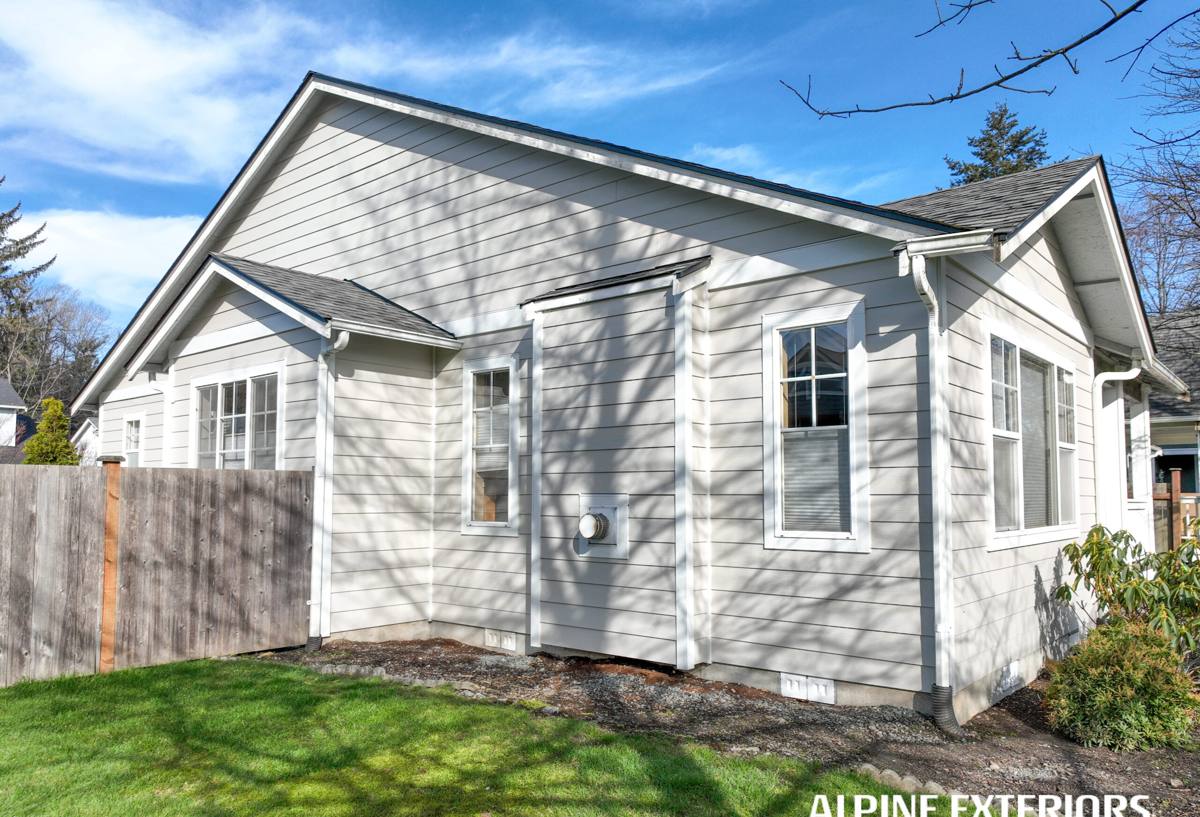
Signs Your Puget Home's Siding Needs Repair, Not Replacement
Most siding problems we're called out for in this area are localized — a section behind a downspout, a corner exposed to prevailing wind, trim around a window that was never flashed correctly. Catching these early is what keeps a repair a repair instead of a full re-side.
- Soft or spongy spots when you press on the siding, especially near the bottom courses or below windows
- Paint that's bubbling, peeling, or failing in one concentrated area rather than across the whole wall
- Visible gaps or separation at butt joints and corner boards
- Dark staining, streaking, or a musty smell near an exterior wall on the interior side
- Moss or thick algae growth that's been left long enough to hold constant moisture against the surface
- Cracked, warped, or bowed panels — common with older hardboard or lower-grade products after years of coastal exposure
- Rust bleed around nail heads or trim fasteners
- Caulk that's shrunk, cracked, or pulled away from joints and penetrations
Any one of these on its own is usually a repair. Several of them together, or damage that shows up in more than two or three separate areas of the same wall, is usually a sign the underlying material has reached the end of its service life and a section-by-section approach stops making financial sense.
What a Correct Siding Repair Actually Involves
Diagnosing the Water Path, Not Just the Symptom
The visible damage on a siding repair is rarely where the water actually got in. A soft board at the bottom of a wall is often being fed by a failed flashing detail two or three feet higher up, or by a gutter that's been overflowing onto the wall below it. Before we cut into anything, we trace the path — checking flashing at windows, doors, and roof-to-wall intersections, checking kick-out flashing at rooflines, and checking how water sheds off decks and porch roofs onto the siding beneath them. Repairing the visible spot without fixing the source just buys a year or two before the same repair call comes back.
Matching Material and Fasteners
Once we know what's actually failing, the repair itself has to match the wall it's going into — same reveal, same profile, fasteners rated for coastal exposure rather than standard interior-grade nails that will rust and streak within a couple of seasons. This is a place where cutting corners shows up fast in this climate; a mismatched fastener or an unpainted cut edge left exposed to salt air and rain will telegraph as a stain or a soft spot within a year or two.
Sealing and Flashing Details
Every cut edge on fiber cement needs to be sealed before it's installed. Every penetration — hose bibs, light fixtures, vents — needs proper flashing and compatible sealant, not just a bead of caulk over the gap. On a driving-rain coastline, the small details at joints and penetrations do more to keep a repair from failing again than the patch itself.
Repair vs. Replace: How We Make the Call
We don't push replacement when a repair will genuinely hold up, and we don't recommend patching a wall that's structurally past the point of a clean fix. The honest answer usually comes down to how much of the wall is affected and what's causing it.
| Factor | Repair Usually Makes Sense | Replacement Usually Makes Sense |
|---|---|---|
| Extent of damage | Isolated to one or two sections or elevations | Recurring across multiple walls or the whole home |
| Underlying material | Fiber cement or sound wood siding, otherwise healthy | Older hardboard, particleboard, or products known for widespread moisture failure |
| Water intrusion | Source identified and correctable | Sheathing or framing already compromised behind the wall |
| Age of siding | Well within expected service life | Near or past manufacturer's expected lifespan |
| Cost over time | One-time fix with low recurrence risk | Pattern of repeat repair calls to the same areas |
If we open a wall for what looks like a routine repair and find rotted sheathing or framing behind it, we'll tell you before we do anything else. A patch over compromised structure isn't a repair — it's a delay, and it costs more in the long run than doing it right the first time.
Why We Repair With James Hardie — Not Whatever's on the Wall
When a repair is small and the existing siding is sound, we'll match it as closely as we can. But when a repair grows into replacing a full elevation, or when the existing material is the reason for the recurring damage in the first place, we only install James Hardie fiber cement. We don't install LP SmartSide, vinyl, Cemplank, Allura, or primed wood siding, and on a site like this we think that decision deserves an honest explanation rather than a marketing line.
Vinyl expands and contracts with temperature swings and can warp or crack in prolonged cold snaps; it also isn't a great match for a wall that's already fighting moss and moisture, since it doesn't hold paint and can't be feathered into a repair invisibly. Engineered wood products like LP SmartSide use wood strand technology that's genuinely improved over older hardboard, but any wood-based product depends on an unbroken factory coating and flawless field sealing at every cut and joint to resist the kind of sustained coastal moisture this area sees — miss one detail and it's vulnerable to swelling and rot. Other fiber cement brands make a reasonable product, but we've standardized on Hardie's HZ5 line, engineered specifically for climates with heavy moisture exposure, because it's what we trust to hold up here without surprises, and because Hardie's ColorPlus factory finish and transferable warranty give homeowners something concrete to rely on rather than a promise.
That standardization is also why our repairs hold up. When we know one material system inside and out — how it cuts, seals, fastens, and ages in this exact climate — we're not guessing on a repair, we're applying the same detailing we'd use on a full install.
Our Process From Call to Finished Repair
Inspection
We start by walking the affected area and the rest of the exterior, because siding damage in one spot is often an early warning for the same conditions elsewhere on the house. We'll check flashing, gutters, grading, and vegetation contact along the way, since those are usually part of the real cause.
Estimate
You get a clear, written estimate that separates the repair scope from anything else we noticed during inspection. If we find something beyond the original call — a failed flashing detail, a gutter issue, early rot in an adjacent section — we'll explain it and let you decide how to handle it. Nothing gets added to the job without you knowing first.
The Work Itself
Damaged material comes out, the substrate underneath gets inspected and dried or repaired as needed, and new material goes in matched to the existing reveal and profile. Every cut edge is sealed, every fastener is rated for the exposure, and every flashing detail is corrected, not just re-caulked.
Cleanup and Follow-Up
We clean up debris and old material fully before we consider the job done, and we'll walk you through what we did and what to watch for going forward — especially useful if the damage was tied to something ongoing, like a drainage issue near the foundation.
Moss, Mildew, and the Puget Maintenance Cycle
Even correctly installed and repaired siding needs some seasonal attention in this climate. Moss and algae growth is the single most common thing that turns a minor cosmetic issue into an actual repair call here, simply because it holds water against the wall for weeks or months at a stretch rather than letting the wall dry between storms.
A simple annual rinse-down of north-facing and shaded walls, keeping gutters clear so water doesn't sheet down the siding face, and trimming back vegetation that's shading a wall or holding moisture against it will do more to prevent repair calls than almost anything else a homeowner can control. Fiber cement handles this cycle far better than wood-based products because it doesn't absorb and swell the way organic materials do, but no siding material is completely maintenance-free on a wall that gets driving rain and long damp stretches every year.
Why Hire a Crew That Already Works in Puget
A repair crew that mostly works drier, inland jobs will sometimes treat a coastal Whatcom County wall like any other wall — standard fasteners, standard caulk, standard flashing details. Those choices don't fail immediately; they fail in year two or three, which is exactly when it's hardest to trace the cause back to the original repair. Working repeatedly in this area means we already know which details matter here: fastener corrosion resistance, sealing standards for cut edges, and where water actually tends to find its way in on a Puget Sound-adjacent wall exposed to salt air and driving rain. That's not a sales pitch — it's the difference between a repair that holds and one that comes back.
Getting Started
If you're seeing soft spots, staining, moss buildup, or failing paint on your Puget-area home, it's worth having someone look at it before it spreads. We offer free, no-pressure estimates — no obligation, and an honest answer about whether you're looking at a repair or something bigger. Reach out using the form below and we'll take it from there.