 Bellingham
 Building Decks for Sudden Valley's Particular Conditions
Sudden Valley sits in a different microclimate than a lot of in-town Bellingham lots. Between the lake proximity, tree cover, and the terrain that shapes so many of the home sites out here, decks in this community deal with more shade, more standing moisture, and more moss pressure than a deck built on an open, sun-exposed lot closer to downtown. Add in Whatcom County's long wet season and the salt-tinged air that moves in off the Sound, and you've got a combination that will find every weak point in a deck's design within a few winters.
We're not describing a worst-case scenario — this is just normal weather for this part of Washington. A deck built without that in mind usually looks fine for the first year or two, then starts showing problems: soft spots near the ledger, black streaking on horizontal surfaces, hardware that rusts faster than it should, and moss that comes back every fall no matter how many times it's power-washed off. None of that is inevitable. It comes down to material choices, drainage detailing, and fastener selection made before the first board goes down.
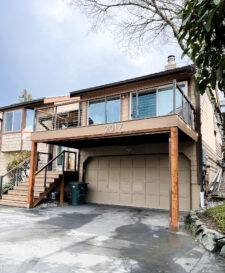
What the Climate Actually Does to a Deck Here
Moisture that doesn't leave
Shaded lots and tree cover mean decks in Sudden Valley often stay damp longer after a rain than a deck out in the open. That extended dry-time is what drives rot at joist tops, ledger boards, and post bases — the parts of a deck that are hardest to inspect once it's built and hardest to fix without tearing into the structure.
Moss and organic growth
Moss needs shade and moisture, and a lot of Sudden Valley properties offer both in abundance. Moss holds water against decking boards long after the surface would otherwise have dried, which accelerates surface wear on wood and can make composite decking slick and grimy if the surface texture and drainage gaps weren't designed with that in mind.
Salt air and hardware
Whatcom County's proximity to the water means salt-laden air travels further inland than people expect, especially with the wind patterns that funnel through this area. Fasteners, brackets, and connectors rated for interior or dry-climate use corrode faster here. It's a slow problem — you won't see it in year one — but by year five or six, standard hardware can be visibly compromised while marine-grade or coated fasteners are still doing their job.
What a Correctly Built Deck Looks Like Out Here
None of this requires exotic materials or a radically different approach — it requires getting the ordinary details right, consistently, in a way that accounts for this specific site condition.
- Ledger flashing that actually sheds water away from the house rim joist, not just a bead of caulk
- Joist tape or a comparable protective barrier on top of every joist, so standing moisture can't soak directly into end grain
- Stainless steel or heavy hot-dip galvanized fasteners and structural connectors, not standard zinc-coated hardware
- Decking gaps sized correctly for the specific board product, since undersized gaps trap debris and moisture that feed moss growth
- Post bases set on proper footings with a moisture break, keeping end grain off concrete and out of standing water
- Airflow underneath the deck — skirting, if used, needs venting, not a sealed box that traps humidity against the frame
Decking Material Choices for This Neighborhood
There's no single "correct" decking material — it depends on how much sun the specific site gets, how much maintenance the homeowner wants to take on, and budget. What matters is picking with the local shade-and-moisture pattern in mind rather than defaulting to whatever's cheapest at the yard.
| Material | How it handles shade & moss | Maintenance | Typical lifespan |
|---|---|---|---|
| Pressure-treated wood | Needs regular cleaning and re-sealing to resist moss and staining in shaded spots | Annual cleaning, re-seal every 1-3 years | 10-15 years with upkeep |
| Cedar | Naturally moisture-resistant but still needs cleaning in shaded, damp areas | Periodic cleaning, occasional oil/stain | 15-20 years with upkeep |
| Composite decking | Resists rot, but low-grip or poorly grooved profiles can get slick with moss film in shade | Periodic washing, no sealing/staining | 25-30+ years, manufacturer-dependent |
| PVC decking | Fully moisture-resistant; still benefits from occasional washing to prevent surface film in shaded areas | Low — occasional washing | 25-30+ years, manufacturer-dependent |
We install several of these depending on the site and the homeowner's priorities. We don't push one product line as a universal answer — a heavily shaded lot under mature trees calls for a different recommendation than an open, south-facing yard even a few properties away.
Why we're selective about certain products
Some composite and wood-composite hybrid products on the market are more sensitive to installation tolerances — gap spacing, ventilation, fastener type — than others. When those details aren't followed exactly, the manufacturer's warranty can be voided even though the product itself performed as designed. Our standard is to only install products where we're confident in the installation requirements and warranty structure, and to walk homeowners through what voids coverage before we start, not after something goes wrong.
Structure: Where Decks Actually Fail
The decking surface is what people notice, but the structure underneath is what determines whether a deck lasts 15 years or 30. In a damp, shaded environment like Sudden Valley, three structural areas deserve extra attention:
Ledger attachment
The ledger board — where the deck ties into the house — is the single most common point of structural failure in decks generally, and dampness makes it worse. Proper flashing, correct fastener spacing, and a moisture barrier between the ledger and the house rim joist are non-negotiable, not optional upgrades.
Footings and post bases
Frost depth and drainage both matter for footing design in Whatcom County. Footings poured too shallow, or without adequate drainage around them, can shift over time as the ground freezes, thaws, and saturates through the wet season.
Beam and joist sizing
Span tables assume dry lumber and standard load conditions. A deck built for entertaining, hot tubs, or heavy furniture needs beams and joists sized for that actual load — not the minimum the span table allows — especially when the wood will spend more of the year damp than dry.
Our Process for a Sudden Valley Deck Project
- Site walk and assessment — we look at sun exposure, tree cover, drainage patterns, and existing structure (for replacements or rebuilds) before recommending anything
- Design and material discussion — layout, decking material, railing style, and any features like built-in seating or lighting, matched to the site conditions and your budget
- Permitting — most deck projects in Whatcom County require a permit; we handle the application and inspections as part of the job
- Demolition, if applicable — removing and properly disposing of an existing deck
- Footings and framing — footings, posts, beams, and joists built to the load and moisture conditions of the specific site
- Ledger flashing and moisture protection — the details that determine long-term durability, done before decking goes down
- Decking, railing, and finish work — installed to manufacturer specification to keep warranties intact
- Final walkthrough — we cover maintenance expectations specific to your site's sun and shade pattern
Maintenance That Actually Matters Here
A deck built correctly still needs some upkeep — the goal is to make that upkeep minimal and predictable rather than a constant battle.
- Sweep debris off the deck surface regularly, especially in fall, so leaves and needles don't trap moisture against the boards
- Wash the surface at least once a year to remove the organic film that leads to moss and slip hazards, more often on heavily shaded sections
- Check railing connections and stair treads annually for looseness — hardware works its way loose faster in freeze-thaw cycles
- Keep gutters and downspouts near the deck clear so roof runoff isn't dumping extra water onto or under the structure
- For wood decks, plan on re-sealing on the schedule the product actually requires, not just when it looks dry
Why Hire a Crew That Already Works This Neighborhood
A contractor who's built decks throughout Sudden Valley already knows which lots run damp, where moss comes back hardest, and how the tree cover on a given street affects drying time after a storm. That's not something you get from a general contractor coming in from outside the area for a single job — it's built from having worked the terrain repeatedly and having gone back to see how earlier work has held up. It also means we're not guessing about permitting or typical lot conditions in Whatcom County — we've been through that process for this specific area before.
If you're planning a new deck, replacing an old one, or just want an honest look at whether your current deck's problems are cosmetic or structural, we'd be glad to take a look. Reach out for a free, no-pressure estimate using the form below — we'll walk the site, answer your questions, and give you a straight assessment before you decide anything.