 Bellingham
 Siding Built for How Sudden Valley Actually Weathers
Sudden Valley sits in a different microclimate than a lot of the rest of Bellingham. Tucked against Lake Whatcom and surrounded by mature timber, homes here deal with more shade, more standing moisture in the air, and a longer window each year when surfaces simply don't dry out. Add in Whatcom County's broader exposure to driving rain off the Sound and a salt-tinged marine air mass that pushes inland on windy days, and you get a combination that's hard on exterior materials that weren't built for it. Siding here isn't just a cosmetic choice — it's the first line of defense against a climate that stays wet longer than most of the country ever experiences.
We install James Hardie fiber cement siding exclusively, and Sudden Valley is exactly the kind of neighborhood that explains why. This page walks through what the local conditions demand, what a correctly installed job actually involves, and how we handle projects in this specific area.
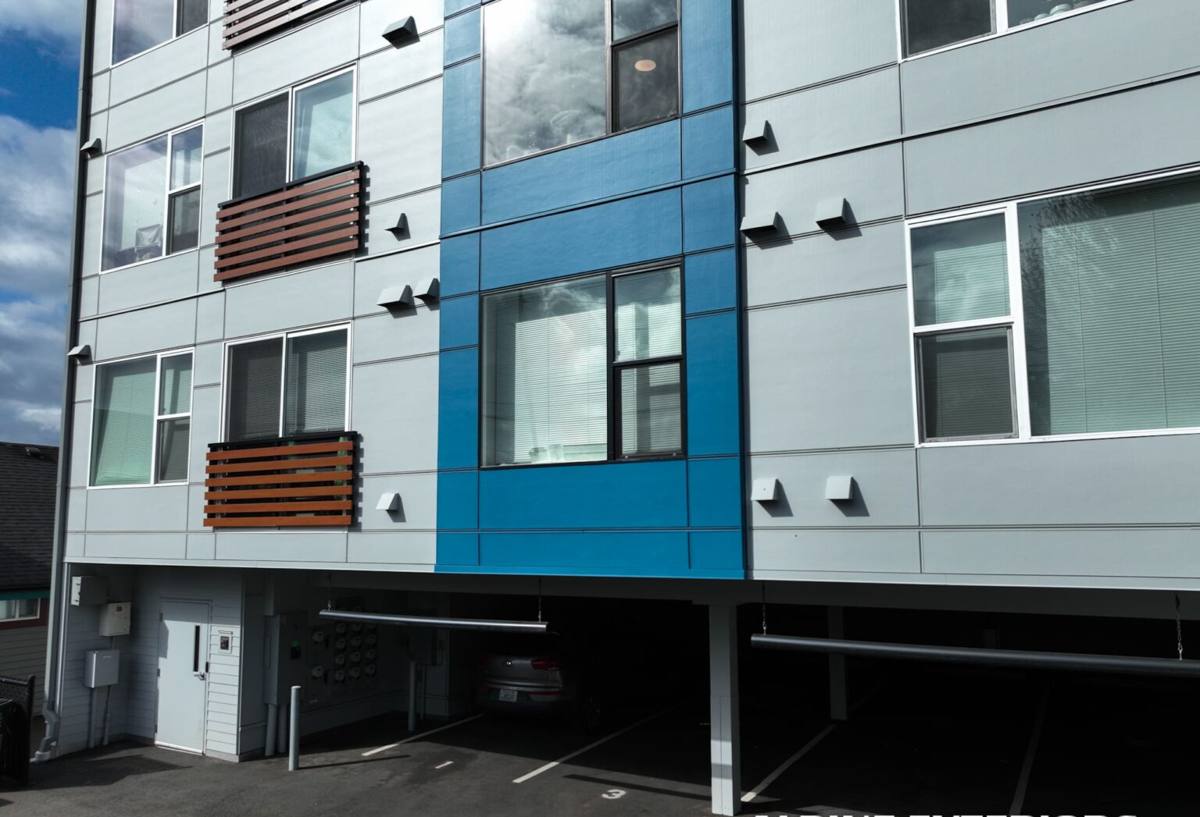
What Sudden Valley's Conditions Do to a House Over Time
Moss and Algae Season Runs Long
With tree cover reducing direct sun exposure on large stretches of most homes' exteriors, north- and west-facing walls in Sudden Valley can stay damp for days after a storm passes. That's ideal growing conditions for moss, algae, and mildew. On wood-based siding products, that sustained moisture works its way into the substrate over years, softening fibers and setting up rot pockets, especially at seams, butt joints, and anywhere caulk has started to fail.
Driving Rain Finds the Weak Points
Storms coming off the water don't just fall straight down — wind-driven rain gets pushed sideways into laps, corners, and trim intersections. If a siding product wasn't engineered with that kind of exposure in mind, or if it was installed without proper flashing and drainage planes, water finds its way behind the cladding. That's when you get hidden damage that doesn't show up until a wall starts to feel soft or paint starts bubbling.
Salt Air Adds a Slow, Steady Load
Bellingham's proximity to Puget Sound means airborne salt is part of the equation for the whole area, Sudden Valley included on windier days. Salt-laden moisture accelerates corrosion on exposed fasteners and can degrade lower-quality paint finishes faster than inland climates would, which shows up as chalking, fading, and eventually peeling on painted wood surfaces.
Why We Only Install James Hardie in This Neighborhood
James Hardie fiber cement is engineered specifically for climates like this. It's non-combustible, doesn't absorb moisture the way wood-based products do, and holds its factory-applied ColorPlus finish far longer than field-applied paint. For a neighborhood like Sudden Valley — shaded, damp, and exposed to both driving rain and salt air — that combination matters more than it would in a drier, sunnier region.
The HZ5 Climate Engineering
Hardie manufactures region-specific product lines, and the HZ5 formulation is built for wetter, colder Pacific Northwest conditions. It's engineered to resist moisture-related damage and to hold up through repeated freeze-thaw cycles and prolonged dampness — exactly the stress pattern Sudden Valley puts on an exterior.
ColorPlus Finish vs. Field-Applied Paint
A baked-on factory finish resists the fading, chalking, and peeling that field-applied paint struggles with in a shaded, humid environment. That matters here specifically because homes tucked under tree cover don't get the sun exposure that helps painted surfaces dry out and stay stable — the finish is carrying more of the weather load on its own.
What a Correct Siding Installation Involves
The product is only half the equation. A huge share of siding failures we get called out to inspect — regardless of brand — trace back to installation shortcuts, not the material itself. In a climate like this one, the margin for error is smaller.
- Removal of old siding down to the sheathing, with an inspection for hidden rot or moisture damage before anything new goes up
- Repair or replacement of any compromised sheathing, framing, or trim found underneath
- Installation of a code-compliant weather-resistive barrier and drainage plane, not just a single layer of house wrap stapled flat
- Correct flashing at every window, door, and roofline intersection — the majority of hidden leaks start here
- Proper fastener spacing, type, and depth per Hardie's published installation specs
- Correct panel and lap clearances from grade, roof lines, and decks to avoid wicking moisture upward
- Caulking only where Hardie's specifications call for it — over-caulking traps moisture just as often as under-caulking lets it in
Skipping any one of these steps can void the manufacturer's warranty and, more importantly, sets up the exact failure mode this climate is primed to cause.
How Our Process Works for Sudden Valley Homes
1. On-Site Assessment
We start with a walk-around of the home, looking specifically at shaded elevations, areas with visible moss or staining, and any spots where past caulk or trim work has failed. We also check for grade issues near the foundation that keep moisture sitting against the lower courses of siding.
2. Scope and Product Selection
Based on that assessment, we put together a scope that covers tear-off, any needed sheathing repair, the weather barrier system, and the specific Hardie product line and profile that fits the home — lap siding, panel siding, or a combination with trim and accent work.
3. Installation to Manufacturer Spec
Our crews install to James Hardie's published fastening, clearance, and flashing requirements, not a generic approach carried over from other siding types. This is also what keeps the manufacturer's warranty intact.
4. Final Walkthrough
We walk the finished job with the homeowner, checking clearances, seams, and trim details before calling it complete.
Cost Factors Specific to This Kind of Job
Every home is different, but a few factors tend to move the price on siding installation in a neighborhood like Sudden Valley more than they would in a drier, more exposed subdivision.
| Factor | Why It Affects Cost Here |
|---|---|
| Hidden moisture damage | Shaded, damp exteriors are more likely to have sheathing or framing repair needs discovered during tear-off |
| Access and lot layout | Wooded, sloped lots common in the area can add setup and material-handling time |
| Trim and detail complexity | Homes with more roof intersections, dormers, or multi-story walls need more flashing and detail work |
| Product line and profile | HZ5 lap, panel, and shingle profiles carry different material costs |
| Existing siding removal | Full tear-off of failed wood or vinyl siding adds labor beyond a straightforward re-side |
We give a firm, itemized estimate after the on-site assessment rather than a rough number over the phone — too much of the real cost depends on what's actually happening behind the existing siding.
Signs a Sudden Valley Home May Need Attention Now
- Persistent moss or dark streaking on shaded walls that pressure washing only temporarily clears
- Soft spots or visible warping, especially near ground level or under windows
- Paint that's chalking, fading unevenly, or peeling in sheets rather than wearing gradually
- Gaps opening up at butt joints, corners, or trim where caulk has failed
- Rusting or staining fasteners visible on the siding face
- Higher heating bills that may point to a compromised weather barrier letting conditioned air escape
Any of these on their own isn't necessarily an emergency, but together they usually mean the siding system is past the point where patching makes sense.
Why Local Experience Matters for This Job
A crew that mostly works drier, sunnier parts of Washington or out-of-state markets doesn't build the same instincts for a neighborhood like this one. Knowing which elevations of a Sudden Valley home stay damp longest, how far up a wall moss tends to creep, and where past contractors in this area have historically cut corners on flashing all comes from working here repeatedly — not from a general installation manual. That local pattern recognition is a big part of what separates a siding job that lasts twenty-plus years from one that starts showing problems in five.
We also know the practical side of working in this part of Whatcom County — permitting through the county versus city, typical delivery access on the area's roads, and seasonal windows where weather makes installation harder to schedule around.
Get a Straightforward Estimate
If your Sudden Valley home is showing signs of wear, or you're planning ahead before a small problem becomes a bigger one, we're happy to come take a look. The estimate is free, there's no pressure, and you'll get a clear, itemized answer on what your home actually needs — just fill out the form below.